Washington, United States. The Supreme Court on Wednesday began hearing arguments over the legality of President Donald Trump’s directive to restrict birthright citizenship in the United States, with Trump in attendance. The case concerns an executive order that would change long-held understanding of the Constitution’s 14th Amendment.
Appeal of blocked executive order
The justices were hearing the Trump administration’s appeal of a lower court decision that blocked his executive order directing U.S. agencies not to recognize the citizenship of children born in the United States if neither parent is an American citizen or a legal permanent resident, also called a “green card” holder.
The lower court found the directive violated citizenship language in the 14th Amendment and a federal law codifying birthright citizenship rights, in a class-action lawsuit by parents and children whose citizenship is threatened by the directive.
Presidential attendance and courthouse protests
Trump was sitting in the public gallery of the courtroom, according to a court spokesperson.
Trump became the first sitting president to attend an oral argument at the Supreme Court, according to Clare Cushman, the resident historian at the Supreme Court Historical Society. Cushman cited examples of 19th century presidents arguing cases before the court though not while in office, including John Quincy Adams, Grover Cleveland and Benjamin Harrison. William Howard Taft, who served as president from 1909 to 1913, later became chief justice on the Supreme Court.
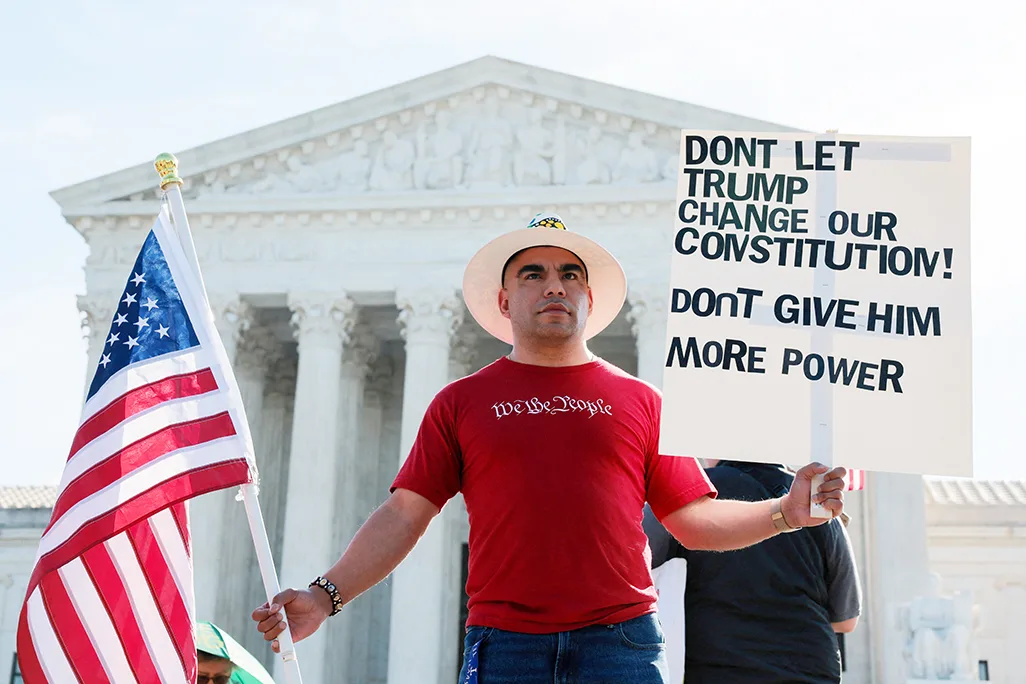
Groups of demonstrators gathered outside the courthouse, some holding anti-Trump signs reading “Trump must go now” and “hands off birthright citizenship.” Attorney General Pam Bondi traveled with Trump in his motorcade to the Supreme Court.
Background and constitutional provision
Limiting who qualifies for citizenship at birth is a top priority for the Republican president, who issued the order last year on his first day back in office as part of a suite of policies to crack down on legal and illegal immigration. Critics have accused him of racial and religious discrimination in his approach to immigration.
Trump has repeatedly criticized certain members of the court since it struck down on February 20 the sweeping global tariffs he imposed last year under a law meant for national emergencies, saying he was “sickened” by two justices he appointed during his first term, Neil Gorsuch and Amy Coney Barrett, and calling them “an embarrassment to their families.”
The 14th Amendment has long been interpreted as guaranteeing citizenship for babies born in the United States, with narrow exceptions such as the children of foreign diplomats or members of an enemy occupying force.
The provision at issue, known as the Citizenship Clause, states: “All persons born or naturalized in the United States, and subject to the jurisdiction thereof, are citizens of the United States and of the state wherein they reside.”
What do you think the Supreme Court’s ruling could mean for birthright citizenship in the United States?