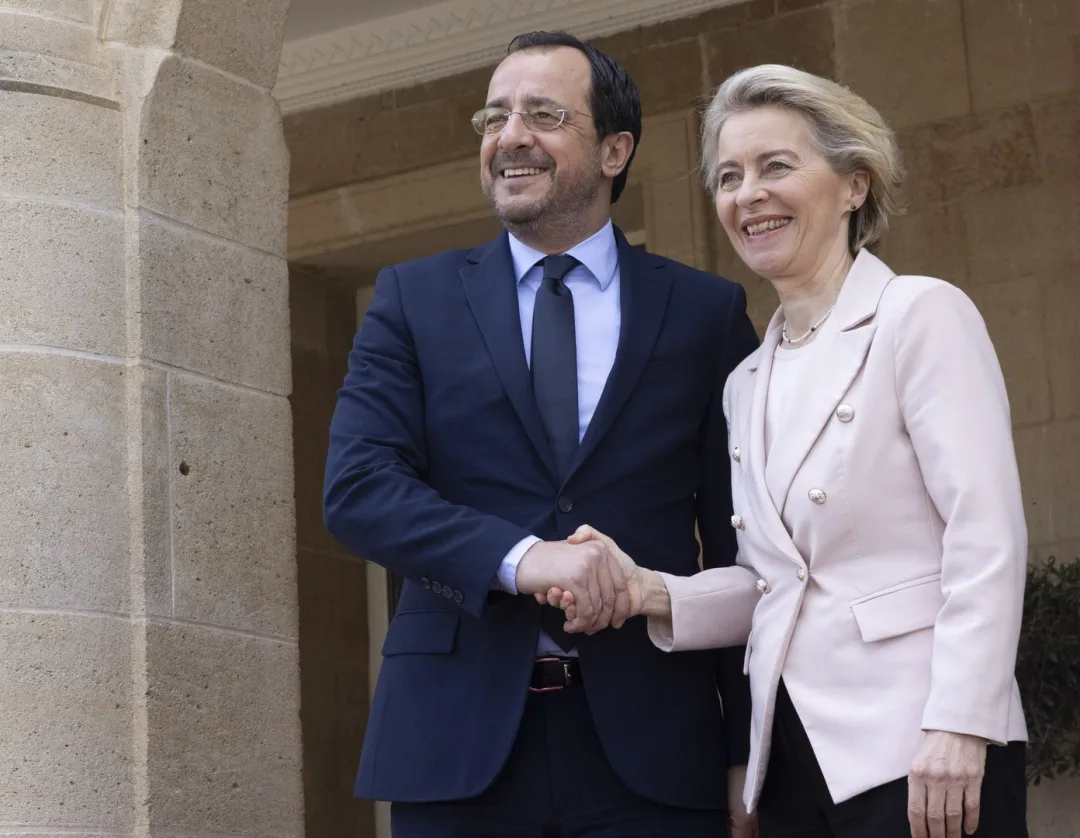
Brussels, Belgium. European Commission President Ursula von der Leyen said regional stability and prosperity in the Levant are closely linked to progress on the Cyprus problem. She reaffirmed the European Union’s commitment to a settlement based on United Nations Security Council resolutions.
EU position on Cyprus settlement
In an interview with Kathimerini, von der Leyen said the EU remains committed to a settlement based on UN Security Council resolutions. She described support for a bizonal, bicommunal federation with political equality as the agreed framework.
Support for UN-led efforts
Von der Leyen said the Cyprus issue remains a central factor in wider regional dynamics and is closely linked to stability and prosperity in the Eastern Mediterranean. She said the EU continues to support UN-led efforts and is prepared to contribute actively to the process.
Regional cooperation and Cyprus role
On regional cooperation, von der Leyen referred to the participation of Mediterranean partners in recent EU meetings hosted in Cyprus. She also pointed to existing EU partnerships with countries including Egypt and Jordan, and said Cyprus has a special role due to its position on the EU’s southeastern border, describing it as a bridge between the Union and its wider neighbourhood.
Commission portfolio replacement process
Von der Leyen said the selection process for a replacement following the resignation of Johannes Hahn is currently underway, without giving a timeline for completion.
EU challenges and foreign policy decision making
Asked about broader geopolitical challenges, von der Leyen said issues such as competitiveness, demographics, strategic dependence and political cohesion cannot be addressed separately. She said the most important question is whether Europe is ready to face them all together, adding that doing so could turn these challenges into opportunities to deepen integration and strengthen the EU’s global position.
She also said decision making in foreign policy has at times been slowed by the requirement for unanimity, and argued that a shift to qualified majority voting would be an important step to avoid repeated deadlocks.
How do you think changes to EU foreign policy decision making could affect its role in the Eastern Mediterranean?