Fidias Panayiotou leads protest over electricity costs at presidential palace
Protesters led by Fidias Panayiotou delivered a letter to President Nikos Christodoulides seeking recognition of electricity and fuel as essential goods.
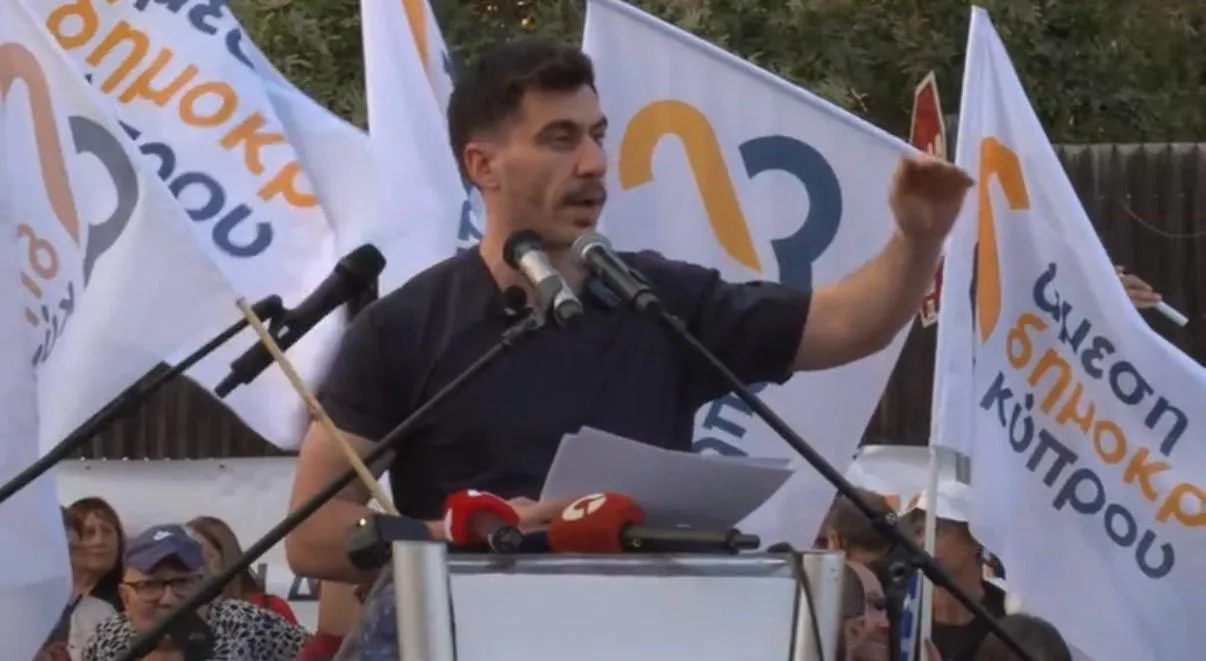
Nicosia, Cyprus. Direct Democracy Cyprus leader Fidias Panayiotou led demonstrators to the presidential palace on Saturday in protest at electricity bills that are already high and continuing to rise. They delivered a letter asking President Nikos Christodoulides to recognise electricity and fuel as essential goods.
Pressure on households and businesses
The letter described the nationwide demonstration as a shared and justified call to ensure that unaffordable energy did not prevent households or small and medium-sized businesses from meeting essential needs.
It argued that electricity was essential to a decent standard of living and society’s wellbeing, rather than a luxury, while its price continued to weigh heavily on household finances and undermine local businesses’ competitiveness.
Citing the state statistical service, Cystat, the protesters said energy prices had increased by 15 per cent from August last year to August this year. The letter said a household could pay as much as €295 for 1,000 kilowatt hours.
For people earning the minimum wage, it added, electricity, housing rent, food and transport together consumed a substantial share of disposable income.
The protesters argued that Cypriot consumers were bearing the consequences of policies beyond their control. They cited costly electricity generation and fuel, renewable energy without storage capacity, high VAT and a state response confined to short-lived measures that did not adequately support consumers.
Tax and emissions demands
The letter sought a lasting cut in VAT to five per cent. Such a measure would breach European Union law, which sets a 15 per cent minimum VAT rate for most goods sold across the bloc. The limited exemptions do not cover electricity or fuel.
The protesters also requested a reassessment of how pollution allowances are priced within the EU’s emissions trading system, or ETS. However, the system uses a market-based mechanism: permission to release CO2 within the EU is auctioned to member states, rather than sold at a price fixed by a national government.
A further demand was for emissions revenues to fund targeted subsidies directly for vulnerable households, alongside investment in the network.
The proposed direct household subsidies would also breach EU law. According to the European environment agency, ETS proceeds may support six areas: decarbonising industry, transforming energy systems, clean technologies, climate-change adaptation, cutting transport-sector emissions and measures supporting a just transition.
This news item was generated automatically by Cyprus Inform from publicly available materials. Report an error →