Limassol’s Agricultural Heritage: Produce and People
Vineyards, carob trees, orchards and rural industries in the Limassol district. How to interpret the heritage, take contemporary changes into account and organise a visit.
Checked: 3 October 2026.
Where to explore Limassol’s agricultural heritage
Limassol’s agricultural heritage is best viewed on a regional scale: the coastal town, the foothills and the mountain villages are characterised by different conditions and crops. To get to know the area, choose a specific product or place – a vineyard, an old mill, a museum or a meeting with a producer – rather than relying on a general image of a ‘village by the sea’.
There may still be patches of cultivated land within the town, but a single photograph of a field between houses does not tell the story of all the neighbourhoods. One should not attribute motives to landowners or draw conclusions about land rights based on the land’s appearance. Urban plots and the agricultural landscape require different sources of information and different lines of inquiry.
This article does not contain a ranking of farm profitability or advice on buying land. It helps readers to see the connection between produce, labour and the cultural landscape. The history of a specific plot, its architectural features and economic performance require separate documentation, rather than conclusions drawn from a tourist walk.
Grapes and wine-growing villages
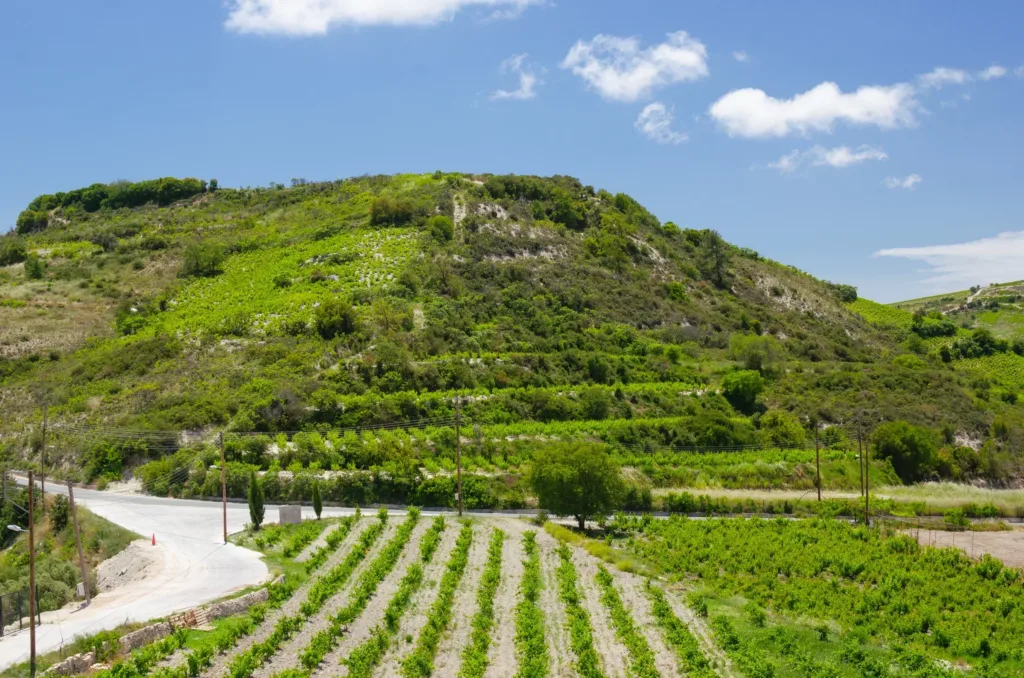
Vineyards form a significant part of the district’s foothill heritage. The name ‘Krasochoria’ refers to the wine-producing villages of Limassol, which are featured on the official wine routes. A visit there allows you to link the product to the local area, but this does not mean that every house or every establishment open to the public is an active winery.
To make the most of your visit, check in advance whether you can tour the estate and discuss the winemaking process, or whether they only offer tastings of the finished wine. These formats vary in terms of duration and access. Don’t assume you’ll be able to take a tour of the vineyard just because you see a sign outside a shop selling local produce.
The grape variety, vineyard and production method are important for a particular producer. Ask where the raw materials come from and which stages of the process visitors are shown. A discussion about the product does not require the exact date of ‘the world’s first wine’: a controversial historical record is often less useful than a clear explanation of how the estate operates today.
The carob tree and old production facilities
The carob tree and products made from its fruit are prominent features of Cypriot rural culture. In Limassol, the memory of carob processing lives on, particularly in the area around the old carob mill. Such a site helps to illustrate how this raw material linked the countryside with urban production and trade.
A historic industrial building may now serve a different purpose. The presence of a restaurant, gallery or cultural venue does not imply that the original manufacturing process is still in operation. Before your visit, check whether there is an exhibition on display and which parts of the machinery can be viewed, so as not to confuse the heritage site with an active workshop.
When buying a carob product, check the name and ingredients of the specific pack. Syrup, flour and other products are not all the same thing. To familiarise yourself with the product, it is sufficient to understand how to use it; claims of therapeutic benefits and conclusions about its usefulness are no substitute for verified specialist information.
Olives, orchards and the diversity of the district
The rural landscape is not limited to vineyards. Depending on the area and the farm, you may see olive trees, orchards and other crops. Differences in altitude, water sources and location are important, but it is best to ask the owner about the purpose of a particular plot rather than trying to guess from the appearance of a single tree seen from the road.
The market and the shop introduce you to the produce, but they do not in themselves prove that it was grown in the nearest village. If provenance is important to you, ask the producer and check the labelling. The terms ‘local’ and ‘traditional’ are useful as conversation starters, but not as a substitute for specifying the place of origin and ingredients.
A tour of the region could combine a visit to a museum with a pre-arranged visit to a farm. This sort of itinerary allows time to ask questions and understand the differences between the produce. It is not worth trying to visit too many places in a single day if access to each one depends on the farmers’ schedules and seasonal tasks.
Water, the weather and recent changes
Modern agriculture depends on the availability of water and weather conditions. The official assessment of climate risks for Cyprus identifies drought and heat stress as significant factors. This is the general context; it does not prove that a particular field has been abandoned specifically because of drought, or that all farms are changing in the same way.
It is important to read reports on crop damage and farm recovery, noting the date and the specific area concerned. An event in a single season is not a permanent feature of the entire district. When speaking to a producer, ask how conditions are changing locally, rather than relying on a ready-made explanation you may have seen in a news headline.
Tourism and direct sales may complement economic activity, but one should not expect them to solve all rural problems. A single successful tasting room does not represent the region’s economy. A visitor can support a particular producer by making a purchase, whilst recognising the limitations of their own observations and the scope of their conclusions.
Visiting the farm and access restrictions
A working vineyard, orchard or field is not automatically a public attraction. Before visiting, ask for permission, agree on a time and find out where you are allowed to walk. Do not pick fruit or approach machinery just to take a photograph: an interest in heritage does not override the owners’ right to carry out their work.
During the tour, please follow the instructions and stay on the designated route. Seasonal works, ground conditions and equipment may restrict access. If part of the site is closed, this does not necessarily mean that the owners are unwilling to welcome visitors; the production process and conditions on a particular day are factors in their own right.
If you are visiting with children, please check the format of the visit in advance. A museum exhibition, a walk around the grounds and a visit to an active farm require different levels of preparation. Comfortable footwear and a clear map are useful, but they are no substitute for confirming access; do not promise your child they can take part in the harvest without the owner’s confirmation.
How to see the connection between the past and the present
Old equipment and traditional names explain part of the story, but a modern producer can make use of new methods. Such a change does not automatically make their product any less local. Ask what is being preserved, what is being changed and why: the answer reveals a living heritage better than expecting rural life to remain unchanged.
When comparing the museum’s narrative with the current situation, distinguish between the past function and the present one. Make a note of the names of the crops, the place of production and the verified details of your visit. Do not add any assumptions about ownership, income or the character of the local inhabitants: these conclusions cannot be drawn from the equipment and landscape you have observed.
The official itinerary helps you choose a direction, whilst the opening status of specific sites and the seasonal programme should be checked before travelling. Unconfirmed planting areas or employment figures are not listed here. The value of the visit lies in the clear connection between the land, the produce, the labour and the people who explain it all on site.
Continue planning
- Limassol: neighbourhoods, attractions and itineraries
- Troodos: villages, trails and routes through the mountains of Cyprus
- A leisurely 3-, 7- and 10-day itinerary around Cyprus
Official sources
- Visit Cyprus — wine routes
- Visit Cyprus — the old carob mill
- Cyprus environment ministry — climate risk assessment
Zenon Winery vineyards in Cyprus · Photo: Serhio Magpie · CC BY 4.0 · converted to WebP and resized.
