Cyprus Airport Arrivals: Passport Control, Kiosks and Customs
How passport control works at Larnaca and Paphos, whether EES and ETIAS apply in Cyprus, what BorderXpress kiosks are, how to choose a customs channel and what to do if your bag does not arrive.
Checked: 25 October 2026.
Arriving in Cyprus: in brief
After landing at Larnaca and Paphos airports, passengers go through passport control, collect their baggage and leave through the red or green customs channel. Cyprus is in the European Union but is not yet a full member of the Schengen area, so there is passport control even for people arriving from a Schengen country.
The EU’s new Entry/Exit System (EES) does not apply in Cyprus, and the ETIAS travel authorisation is not yet in operation anywhere. These are the main answers to the question of what has changed at passport control in Cyprus.
Below we explain how the checks work for EU citizens and for everyone else, what the kiosks by the desks are for, what changes are expected, how to choose a customs channel and what to do if your baggage does not arrive.
Passport control: kiosks and officers
BorderXpress kiosks have been in use at Larnaca and Paphos airports since 2018. You scan your passport at the kiosk and it takes a photo, but according to the newspaper Politis, the decision on entry is still made by a passport control officer, and if the check fails the passenger is sent to the officer.
According to the Cyprus Mail, 80 kiosks were installed at the two airports; installation was completed in 2022, and the Ministry of Transport described them as intended for passengers from the EU, the UK and the European Economic Area. Signs in the hall show who can use the kiosks today.
According to Politis figures for 2025, 21.4% of kiosk checks required additional control, and 13% were flagged as a journey by a minor: the officer then checks that the child is travelling with a parent or legal guardian. Keep the child’s documents to hand.
EU citizens
An EU citizen can enter Cyprus with a valid passport or national identity card. Under EU rules, since 3 August 2026 identity cards without a machine-readable zone are no longer valid for travel, even if they have not expired, so if you have one of these, it is better to travel on your passport. The EU’s Your Europe portal points out that you must show a document on flights between Cyprus and Schengen countries as well, because border checks with Cyprus have not yet been lifted.
The new EES and ETIAS systems are not meant for EU citizens: they concern third-country nationals coming for short stays. So for an EU citizen, arriving in Cyprus has hardly changed.
If you fly from Cyprus to a Schengen country such as Greece, your document will be checked again on departure. Allow time for this, especially in the peak summer months.
British and other non-EU citizens
The UK government says a British passport must have been issued less than 10 years before the date you arrive, be valid for at least three months after the date you plan to leave and have at least one blank page. Without a visa you can stay in Cyprus for up to 90 days in any 180-day period.
Because Cyprus is not part of the Schengen area, days spent in Cyprus do not count towards the Schengen limit, and vice versa. The UK government advises making sure your passport is stamped on entry and exit.
Requirements for citizens of other countries depend on nationality, so check them in advance on the website of the Cyprus Ministry of Foreign Affairs or with a consulate. The authorities of the Republic of Cyprus regard entry through Tymbou (Ercan) airport in the north of the island as illegal; our guide to Nicosia airport explains more.
EES and ETIAS: what applies in Cyprus
According to the European Commission, the Entry/Exit System is in operation in 29 European countries: it started in phases on 12 October 2025 and became fully operational on 10 April 2026. It registers third-country nationals coming for short stays.
Cyprus does not apply EES: the UK government states plainly that you do not need to register in the system when you enter Cyprus. According to the Cyprus Mail, a third-country national will be registered in EES on their next entry into a Schengen country, for example when flying from Cyprus to Greece.
Cyprus is on the list of 30 countries where ETIAS will be required: according to the European External Action Service, the authorisation will cost 20 euros and be valid for three years or until your passport expires. As of October 2026 ETIAS is not operating and no launch date has been announced, so check the official EU website before you travel.
What is changing soon
According to the Cyprus Mail, Cyprus has ordered 40 new-generation automated border gates for Larnaca and Paphos airports; they are expected by the end of 2026. Unlike the kiosks, they allow fully automated checks, and the ministries responsible will decide who can use them.
According to the same source, the kiosks will stop being used once Cyprus joins the Schengen area and border checks on flights within Schengen are lifted. As of October 2026 Cyprus is still outside the Schengen area: according to the Cyprus Mail, the Deputy Minister for Migration gives 2027 as the target for full accession.
Do not confuse these gates with the ‘e-gates’ mentioned by Hermes Airports: those are in the departures area and read your boarding pass before security screening, but do not check your passport.
Customs and baggage
After collecting your baggage, you choose the channel yourself. According to the Cyprus Customs and Excise Department, the green channel is for people carrying only goods within the duty-free allowances and nothing prohibited or restricted, and the red channel is for those who have something to declare. According to the department, cash of €10,000 or more must be declared in writing when entering Cyprus, including from another EU country. Duty-free allowances are covered in our separate article.
The UK government points out that meat, milk and products made from them cannot be brought into the EU from non-EU countries, including the UK, with rare exceptions such as powdered baby milk. If in doubt, use the red channel: by choosing the green channel you declare, on your own responsibility, that you have nothing to declare.
Airlines and their ground handling agents are responsible for delivering baggage, and once you leave the reclaim area you cannot go back in. If your suitcase has not arrived or is damaged, fill in a Property Irregularity Report at the airline’s desk before you leave; according to Your Europe, a written complaint about damage must be made within seven days, and for delayed baggage within 21 days of receiving it.
Continue planning
- Larnaca Airport: Terminal, Services and Parking
- Duty-free and tax-free shopping in Cyprus: what tourists need to know
- Nicosia Airport: Why It Is Closed and How to Fly to the Capital
Official sources
- Hermes Airports — Passport control & visa
- Cyprus Customs & Excise Department — red/green channel system
- European Commission — Entry/Exit System (EES)
- Your Europe — travel documents for EU citizens
- GOV.UK — Cyprus entry requirements
- Hermes Airports — baggage delivery, lost luggage & items
- EUR-Lex — Regulation (EU) 2025/1208 on identity cards
- Cyprus Customs Department — cash declaration
- European External Action Service — ETIAS
- Cyprus Mail: Cyprus expects to join Schengen in full in 2027 (10.10.2026)
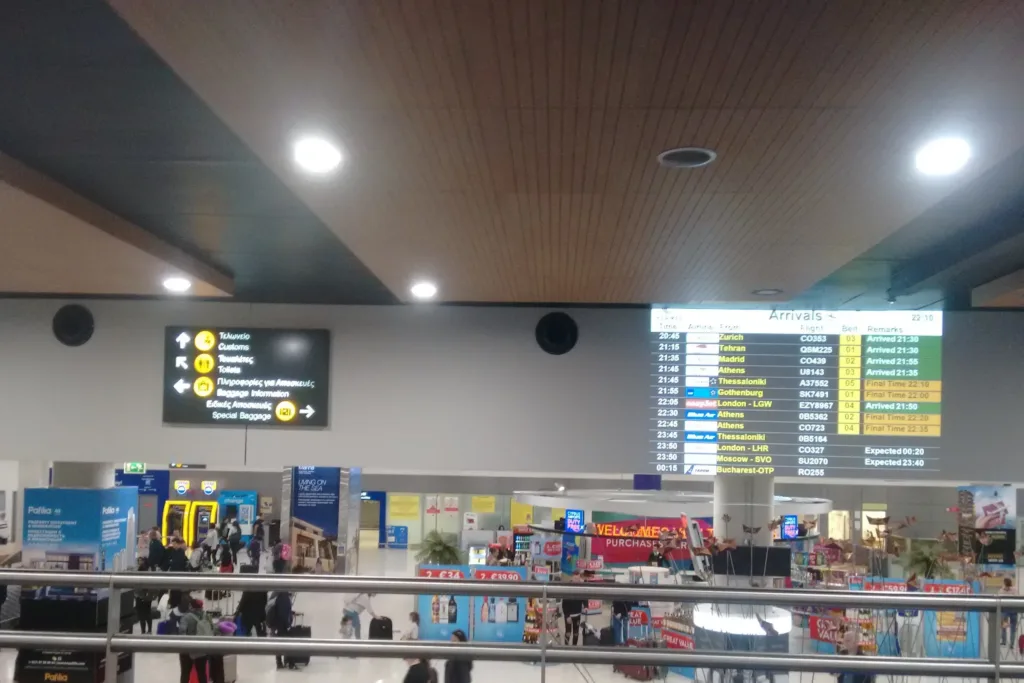
The arrivals hall at Larnaca Airport · Photo: Héctor Ochoa (Robot8A) · CC BY-SA 4.0 · cropped, converted to WebP and resized.
