Road accident in Cyprus: what to do after a crash
When to call the police after a road accident in Cyprus, what the law requires after a minor collision, what to do if the other driver is uninsured or has fled, and how to get a police report.
Checked: 27 October 2026.
Road accident in Cyprus: at a glance
After an accident in Cyprus, first stop, switch on your hazard lights and check whether anyone is hurt. If someone is injured, call 112: it is free from any phone, and the 199 number also still works in Cyprus.
If nobody is hurt, police attendance is not needed and the cars can still be driven, the law now requires drivers to clear the road. Before that, you must report the accident to your insurer, exchange details and photograph the scene.
Below: when to call the police, what to do after a minor collision, what to do if the driver at fault is uninsured, has fled or is driving a foreign-registered car, how to get a police report, and how long the insurer has to respond.
When to call the police
Call the police if anyone is injured, if one of the drivers is uninsured, if the driver at fault has fled or is unknown, or if a foreign-registered or government vehicle is involved. Also call them if you suspect the other driver is drunk, if the cars cannot be moved safely, or if the other driver refuses to give their details.
Do not move injured people unless they are in danger where they are, and wait for the ambulance. Calls to 112 are answered by the police, who transfer them to the ambulance or fire service if needed.
After an accident, a police officer may require anyone they reasonably believe was driving to take a breath test for alcohol and a saliva test for drugs. Refusing without a reasonable excuse is an offence for which you can be arrested without a warrant. The general limit is 22 micrograms of alcohol per 100 millilitres of breath; for new drivers with less than three years’ experience, learners, riders of motorcycles and mopeds and professional drivers it is 9 micrograms.
Minor collision: what the law requires
Section 14B of the Motor Vehicles and Road Traffic Law 86/1972 was introduced in July 2025, and at first drivers could move their cars only if both agreed. Since April 2026, under amending Law 77(I)/2026, the consent condition has been removed: if there are no visible injuries, police attendance is not needed and the cars can be driven without being towed, they must be moved to the nearest place where they do not obstruct traffic.
Before moving the cars, drivers must immediately report the accident to their insurers and exchange names, insurance certificate numbers, driving licence numbers, vehicle details and phone numbers. They must then photograph the cars in the position where they came to rest, their number plates, the damage and the surroundings, exchange the photos and send them to the person designated by their insurer.
If you cannot take the photos yourself, ask the other party, someone you know or a representative of your insurer. Moving your car is not an admission of fault and does not count as leaving the scene; it does not breach your policy terms and does not take away your right to claim later for injuries that were not immediately apparent.
Exceptions and fines
The rule does not apply if an uninsured or government vehicle is involved, or if one of the drivers has left the scene. In these cases, stay at the scene and call the police.
Failing to meet the duties in section 14B — moving the cars, exchanging details or taking photographs — is punishable by a fine of up to €1,000. The same maximum fine applies to anyone who pressures or forces another driver not to comply.
The photos and the other party’s details may be used only to deal with the accident and the insurance claim. Using them for any other purpose can lead to fines under data protection rules.
Uninsured, hit-and-run or foreign vehicles
The Motor Insurers’ Fund (MIF, Ταμείο Ασφαλιστών Μηχανοκινήτων Οχημάτων) pays compensation if the driver at fault is uninsured or unknown, or if their insurer has gone into liquidation. If you are hit by an uninsured car, tell the police, have the Fund inspect your car before repairs, and submit a claim on the MIF form together with your vehicle ownership document and your insurance certificate.
If the driver at fault has fled and the vehicle cannot be traced, call the police to the scene or report the accident to them within 48 hours, and notify the Fund immediately. The Fund pays for personal injury, but covers property damage only under certain conditions and if it exceeds €500.
If you collide with a foreign-registered car, call the police to record the accident, note the registration number and country, and ask to see the Green Card or insurance policy. Then contact the Cyprus Motor Insurers’ Bureau, which operates within the MIF, as soon as possible.
Police report and accident form
A traffic police report (Αστυνομική Έκθεση Τροχαίας) is requested online through the DIGIPOL portal. The request can be made by anyone involved in the accident, their insurer, their lawyer or another person with a legitimate interest; a verified CY Login account is required, and no documents need to be attached.
You can follow the progress of your request in DIGIPOL under “Applications in Progress”. For questions about the portal, the help desk can be reached at [email protected].
Insurers usually provide their own accident notification form or use the European Accident Statement. Sign it only if you understand the text and agree with the other driver on what happened; do not admit fault at the scene, and report the accident to your insurer even if you do not intend to claim.
Claim deadlines
The insurer of the driver at fault, its claims representative, or the MIF where an accident with a foreign car is settled through it as the bureau, must within three months of the claim make a reasoned offer if liability is not disputed, or give a reasoned reply if it is. If it fails to do so, interest is added to the amount.
After an accident in another EU country, you can claim at home through the claims representative of the at-fault driver’s insurer or, if there is none, through the national compensation body. Here, too, the offer or reply is due within three months.
A negligence claim for damages must, as a general rule, be filed in court within three years, but there are exceptions to this time limit, so if you have been injured it is best to see a lawyer straight away. The information in this article was checked as of 27 October 2026.
Continue planning
- Driving in Cyprus: rules and safety
- For car owners in Cyprus: MOT, road tax and insurance
- Fines and speed cameras in Cyprus: what drivers need to know
Official sources
- CyLaw — Motor Vehicles and Road Traffic Law 86/1972 (s. 14B)
- Official Gazette — Law 77(I)/2026
- Motor Insurers' Fund of Cyprus — local accidents
- Cyprus Police — request for a traffic police report (DIGIPOL)
- CyLaw — Motor Vehicles (Third Party Liability Insurance) Law 96(I)/2000
- Your Europe — car insurance cover abroad / accidents
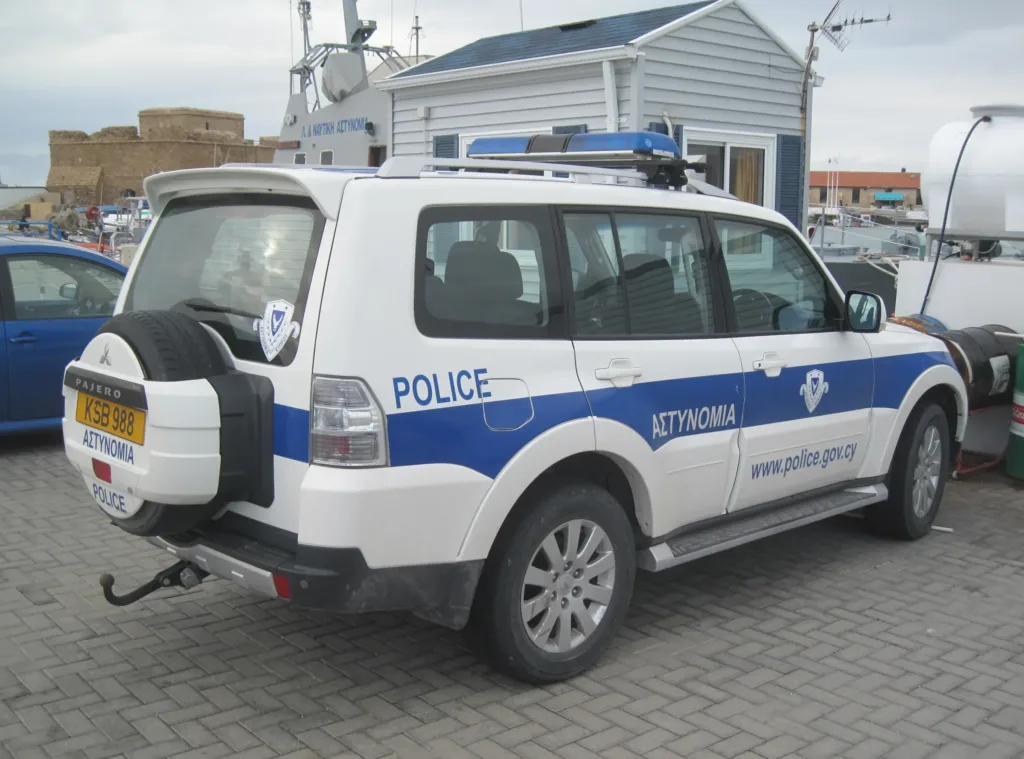
A Cyprus Police patrol vehicle · Photo: Dickelbers · CC BY-SA 3.0 · converted to WebP and resized.
