Water safety in Cyprus: currents, jellyfish and flags
How to choose a beach with lifeguards, understand the flags, what to do if caught in a current or stung by a sea creature, and how to help without putting yourself at risk.
Checked: 23 September 2026.
Choosing a beach before swimming
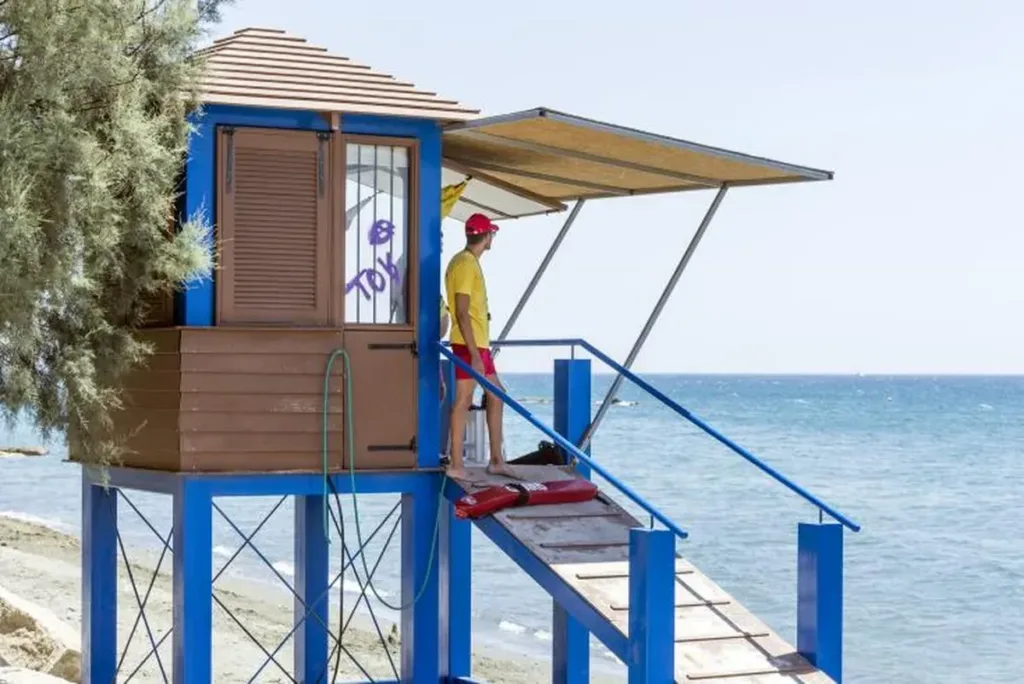
A managed beach does not guarantee consistent conditions throughout the day, but it does provide the infrastructure to assess the risks. Look for an operational lifeguard post, check the duty hours, and observe the flag, waves, wind, buoys and boat lanes. A beach information card is useful for planning, but the final decision is made on the spot by the lifeguard.
The SALAMIS National Beach Safety Plan coordinates the equipment and operations of organised beaches; however, timetables vary by season and area. An empty lifeguard tower means there is no supervision, even if lifeguards were on duty there last year. Families should choose a time when the lifeguard post is actually staffed.
An unfamiliar cove, large waves, strong winds, currents, rocks and a lack of people are all reasons to avoid going in the water. Do not judge the sea solely by its proximity to the shore: currents can run parallel to or away from the shore. At night, after drinking alcohol, or when alone, you’re more likely to notice a problem too late.
Flags, buoys and zones
A red flag raised by a lifeguard means you must get out of the water immediately: it may indicate dangerous waves, a current or some other hazard. A yellow flag warns you to swim with caution. Check the meaning of local markings on a notice board or with a lifeguard, rather than relying on someone else’s photograph of the flag.
Red buoys along the shore mark the swimming area. Channels for boats and jet skis usually run perpendicular to the beach; do not swim or linger in them. Do not go beyond the line of buoys in search of clearer water: the risk of collision with a vessel increases there, and it is more difficult to get help.
When a lifeguard gives an order, arguing on the basis of personal experience is out of place. Waves and currents can intensify faster than a person in the water realises. If there is no flag, this does not mean it is safe: the lifeguard post may not be manned. In that case, assess the conditions yourself and choose a more sheltered beach with a lifeguard on duty.
Currents and fatigue
If you are being swept away, the most important thing is not to panic and not to waste your energy trying to fight the current head-on. Signal for help, stay afloat and assess the direction. If the current is flowing parallel to the shore, go with it, gradually approaching the beach at an angle, as advised by the coastguard.
If you become tired, roll onto your back or assume a stable horizontal position, catch your breath and call for help. Do not try to stop a cramp by making a sudden dash for the shore: relax the muscle and move slowly. If you feel dizzy, cold or short of breath, get out of the water as soon as possible.
Do not swim alone far from the shore and do not overestimate the return journey: wind, waves and fatigue all add up. An inflatable lilo is not a life-saving device and can quickly drift away from the shore. For a child, constant adult supervision is more important than a swim ring or armbands.
Children, heat and alcohol
A child must be within immediate physical reach of an adult; supervision must not be divided between a mobile phone, a book or a conversation. The Cypriot police place particular emphasis on the continuous supervision of children aged five and under and the use of suitable individual flotation devices.
Heat and UV rays are also a risk in the water: the coolness masks dehydration, whilst the reflection intensifies UV exposure. Plan for shade, water, appropriate clothing and breaks. Do not leave a child at the water’s edge whilst an adult goes to fetch items, and do not entrust supervision to another child.
Alcohol impairs coordination and risk assessment, so it should not be combined with swimming, boating or diving. Official guidelines advise waiting a while after eating; it is more important not to enter the water if you feel heavy, weak or drowsy. If you have a chronic medical condition, discuss any restrictions with your doctor.
Jellyfish and other organisms
The presence of jellyfish varies with the wind and currents. Before entering the water, ask a lifeguard, check the surf line and do not touch any organisms washed ashore: stinging cells may remain active even after the organism has died. A large concentration of jellyfish is a reason to choose another beach, rather than relying on protection from sun cream or clothing.
If you come into contact with a jellyfish, get out of the water, call a lifeguard and do not rub the affected area with sand or a towel. The best course of action depends on the type of creature, so follow local advice; universal home remedies may increase the release of venom. Remove any remaining tentacles only using a safe method, not with your bare hands.
Difficulty breathing, facial swelling, a widespread rash, severe pain, weakness or loss of consciousness require you to call 112. Do not touch or feed sea urchins or fish; footwear reduces the risk of cuts from rocks, but does not make walking on the reef safe in heavy waves.
How to help without becoming a second casualty
If you see someone in distress, call a lifeguard immediately and dial 112. Throw a flotation device or pass one to them from the shore. Do not jump into the water unprepared: a panicked person may grab hold of the rescuer and drag both of you under, and the current will affect the rescuer in the same way.
Specify the beach, the nearest landmark, the lifeguard tower number and the victim’s position relative to the buoys. Ask a specific person to meet the rescue team. Once the victim has been rescued, follow the dispatcher’s instructions; if the victim is not breathing properly, carry out the first aid you have been trained in and use an automated external defibrillator (AED) if one is available.
Do not gather a crowd around the casualty or film the incident. Clear a path for the rescue team, shield the person from the sun and wind, and do not give them food or alcohol. Even after an apparent recovery from drowning or water inhalation, a professional assessment is required.
Pre-entry checks
Check the following five points: is the lifeguard on duty, which flag is flying, where are the swimming boundaries and the shipping channel, what are the wave and wind conditions, and who is supervising the children. Then assess your own condition, any medication you are taking, your alcohol intake, the heat, and whether you have enough energy for the return journey.
Take water, sun protection, a fully charged mobile phone and shoes for the shore. Tell your companion where you’ll be swimming and stay within sight of them. When snorkelling, use a brightly coloured surface marker where required, and never hold your breath to try to outdo others.
Schedules, flags and the presence of marine life change daily. The sources were checked on the date below, but the situation on the beach and the lifeguard team remain the deciding factors. If even one key detail is unknown, the safe option is not to enter the water or to move to a supervised area.