Languages of Cyprus: Greek, Turkish and English
Greek and Turkish are the official languages of the Republic of Cyprus. English is widely used, but it is not an official state language.
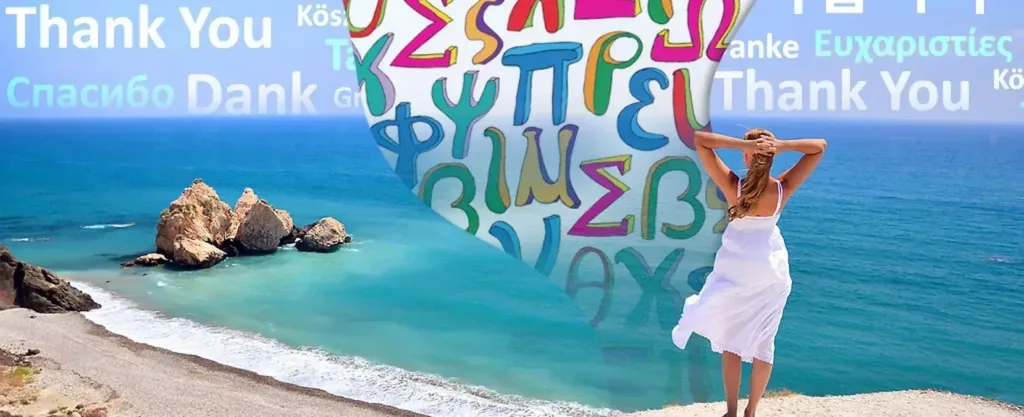
In brief: Greek and Turkish are the official languages of the Republic of Cyprus. Greek predominates in daily life in areas under the effective control of the Republic of Cyprus. English is widely used in tourism, business and services, but it is not an official language of the state.
Which languages are official in Cyprus?
An official Republic of Cyprus reference lists Greek and Turkish as the two official languages. The European Union country profile separately lists Greek as the EU official language associated with Cyprus. The statements answer different questions: the status of languages in the state and the language arrangements of EU institutions are not identical.
The island’s territorial and historical context is explained in our guide to where Cyprus is located.
Greek and the Cypriot variety
Modern Standard Greek is used in official documents, education and standard written communication. Cypriot Greek is common in informal speech; its pronunciation and some vocabulary differ from the standard language. A visitor does not need to learn the dialect separately. Standard Greek is understood, and local features can be treated as part of everyday spoken language.
Where Turkish is used
Turkish has official status in the Republic of Cyprus and is widely used by the Turkish Cypriot community and in the north of the island. The language of signs and services depends on the controlled area. For an official procedure, follow the requirements and forms of the relevant authority rather than assuming that the language used in casual conversation is sufficient.
Can you manage with English?
English is generally sufficient for basic tasks at airports, hotels, restaurants, car-hire desks and in popular tourist areas. That is not a guarantee in every setting. A small village, municipal office, medical facility or complex contract may require Greek or an interpreter.
For important legal, medical or financial documents, do not rely on an informal spoken summary. Ask for an official version, a qualified translation or clarification from the competent authority.
Useful Greek phrases
| English | Greek | Approximate reading |
|---|---|---|
| Hello | Γεια σας | Ya sas |
| Thank you | Ευχαριστώ | Efharistó |
| Please / you’re welcome | Παρακαλώ | Parakaló |
| Yes / no | Ναι / Όχι | Ne / Óhi |
| Do you speak English? | Μιλάτε αγγλικά; | Miláte angliká? |
| I need help | Χρειάζομαι βοήθεια | Hriázome voíthia |
The readings are approximate. They help start a conversation but do not reproduce every sound or stress pattern.
Practical takeaway
- English is usually enough for a tourist visit;
- a few Greek phrases help with everyday interaction;
- for official documents, check the language requirements of the specific authority;
- do not describe English as an official language of Cyprus.
Official status and everyday usage
Greek and Turkish have official status in the Republic of Cyprus, whilst English is widely used in tourism and business. These statements are not contradictory: an ‘official language’ refers to the state system, whereas a ‘widely used language’ refers to the practical ability to communicate in specific situations.
The language available at a particular institution depends on the type of organisation, the staff member and the procedure. Being able to speak English does not guarantee that a legal document will be in English. Before your visit, check whether a translation will be accepted and whether a certified translator is required.
In areas outside effective government control, language practices differ. Do not interpret the language usage map as a political statement. For your itinerary, it is sufficient to politely ask which language is preferred and to have a written address.
Cypriot Greek and Standard Greek
Standard Modern Greek is used in education, official texts and most teaching materials, whilst Cypriot characteristics of pronunciation and vocabulary are evident in everyday speech. Knowledge of the standard language remains the working basis and does not require you to imitate the dialect.
If a local word is unclear, ask for it to be repeated or written down. Do not assume that the person is speaking ‘incorrectly’. The dialect expresses identity, and the choice of register depends on the situation and the person you are speaking to.
When learning, it is helpful to break down your goals: everyday phrases, work, exams or reading documents. A course designed for one purpose does not automatically cover the others. Check which variant of the language and which level the programme is designed to prepare you for.
Critical situations
In medical, police or legal contexts, do not rely on a rough understanding. Ask for an interpreter if the meaning affects your consent, rights or safety. Do not sign a document that you cannot verify.
Keep your address, the name of any medication, your diagnosis or any allergies in writing in the appropriate language, but do not use this as a substitute for a specialist. When making an emergency call, start by stating your location and the nature of the threat; brief, clear facts are more important than perfect grammar.
In tenancy and employment agreements, spoken English does not override the written terms. Ask for a version of the contract you can understand or an independent translation. Discuss any discrepancies before signing, not after a dispute has arisen.
Practising respectful communication
Start with a greeting and ask if you can switch to English. Keep your sentences brief, and rephrase instead of raising your voice. For names and addresses, use a note on the screen or on paper.
Automatic translation is useful for menus and drafts, but it makes mistakes with legal, medical and dialectal expressions. Do not send confidential documents to an unknown service. Important translations should be checked by a suitably qualified person.
A few phrases can help establish contact, but they do not give you the right to expect the other person to act as your teacher. Listen to their response and acknowledge the limits of your understanding. This is more practical than a list of transliterations without audio or context.
Official sources
Information checked on 8 September 2026. The official status of languages is reviewed yearly or when the source changes.