Waste sorting in Cyprus: packaging and local regulations
How to check your local collection timetable, prepare your recycling for collection, and sort batteries, electrical appliances and glass into separate bins.
Checked: 28 September 2026.
Why do we need a local timetable first?
Waste sorting in Cyprus varies depending on the local authority, the bins available and the operator’s scheme. Green Dot Cyprus publishes its service coverage and packaging guidelines, but collection timetables for one street should not be applied to another area. Start by checking the official page for your address.
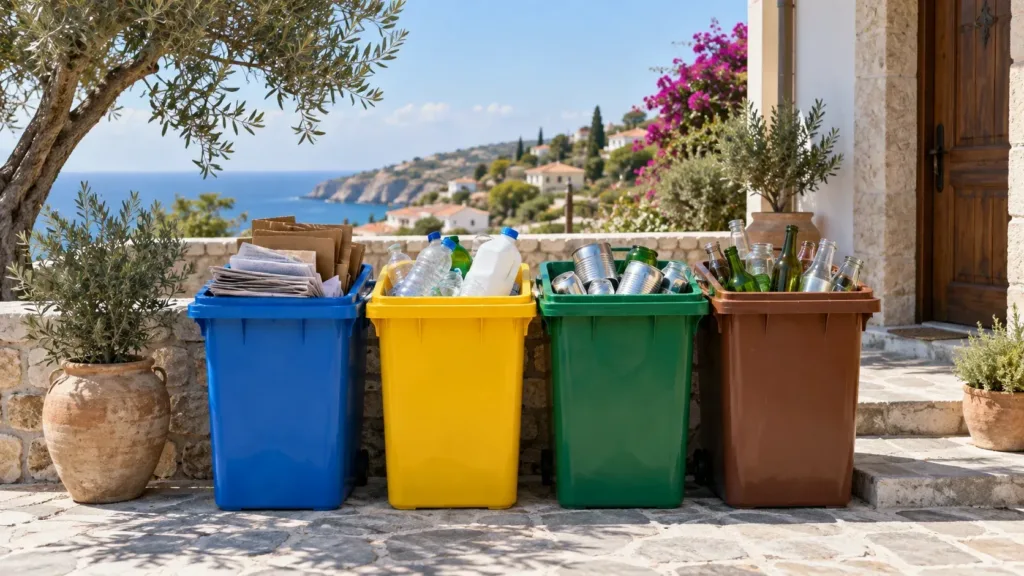
Please separate general household waste, recyclable packaging and specific waste streams such as batteries, electrical appliances or hazardous substances. The colour of the bin shown in a photograph from another country may be misleading. Check the local signage and the list of accepted materials, rather than just the colour of the lid.
At home, set aside a small space for clean packaging and label the containers in accordance with your local scheme. A system that is too complicated will quickly stop working; it is sufficient to ensure that wet waste does not contaminate dry materials. If in doubt, check the example on the operator’s website.
Packaging and preparation
Green Dot explains which types of packaging are accepted in its collection schemes and how to prepare them. Empty containers must be clean enough not to spoil the rest of the contents. Do not use excessive amounts of water to wash them thoroughly: simply remove any food residues and allow the packaging to dry.
Flatten boxes and bottles if permitted by local guidelines; this way, they take up less space. Separate items that are not packaging, even if they are made of similar materials. A plastic toy and a plastic bottle may be sent along different routes.
Complex multi-layered packaging, greaseproof paper and glass containing foreign objects must be checked against the current list. Do not apply the rule ‘if it can be recycled elsewhere, it can be put here’. An incorrect item contaminates the batch and increases the amount of manual sorting required.
Glass, batteries and electrical appliances
Please place glass packaging in the designated stream or at the collection point specified in your local recycling scheme. Tableware, mirrors and light fittings may be made of different materials and should not automatically be placed with bottles. Pack broken glass securely and check how to dispose of it to avoid putting staff at risk of cuts.
Do not mix batteries and electronic items with household waste. Look for official collection points and check whether they accept that specific type of item. For devices containing personal data, first delete your accounts and storage media using a secure procedure; recycling the casing does not resolve privacy concerns.
For paint, chemicals, building rubble and large items of furniture, check with your local authority for specific procedures. Leaving items by the bin without authorisation may obstruct passage and prevent them from being recycled. Keep your collection confirmation if the service is booked separately.
Waste collection and communal areas
Check the day and time for putting out bin bags, the collection point and the rules for your block of flats. If the estate is managed by a private company, ensure that its system is in line with the local authority’s: the presence of coloured bins in the courtyard does not necessarily mean that all waste streams are actually collected separately.
Do not leave bin bags in the sun for several days: the smell and animals will damage the site. Keep communal bins closed and do not block access for fire engines. If the site is full, notify the relevant authority and find an authorised alternative, rather than creating a rubbish tip nearby.
For short-term rentals, provide guests with a simple guide setting out local rubbish collection days and the addresses of collection points. The phrase ‘sort everything’ is useless without a diagram. The host should check the schedule periodically for any changes and avoid copying instructions from another town.
If you’re not sure where to put an item
Determine whether the item is packaging, hazardous waste, electrical equipment or an ordinary item. Then check the Green Dot website and your local authority’s website for specific information on the material. If you cannot find the answer, contact a customer service representative with a photograph that does not show any personal details and wait for further instructions.
Do not burn waste or pour household chemicals onto the ground or into the drainage system. For leftover medicines, ask your chemist or the relevant authority about the correct disposal procedure. The general rule for recycling packaging does not automatically apply to medical and chemical waste.
It is better to set aside any items you are unsure about in a safe place for the time being than to spoil a whole container. Make a note of the operator’s response for your family’s reference. Over time, you’ll become familiar with the local guidelines, and the number of mistakes will decrease without the need for complicated apps.
How to reduce the amount of rubbish
Reusing an item that is still in good working order is often easier than recycling it. Before buying, check whether you can make do with reusable packaging, have the item repaired, or pass on an unwanted item. However, do not pass on faulty appliances to someone else as if they were in working order, and do not leave them at a charity collection point without prior agreement.
Plan your shopping so that less food ends up in the bin. There are separate local arrangements for organic waste; do not put it in with packaging for recycling; check the local route for organic waste. Composting is only possible if you have a suitable space and follow the rules at home; otherwise, it will cause a smell and attract pests.
Green Dot’s official pages were checked on 28 September 2026. Geographical coverage, timetables and lists are subject to change; for your specific address, the current instructions from the operator and local authority take precedence. This guide provides a method for checking this information, rather than a single timetable covering the whole of Cyprus.
Questions for at home and for neighbours
If you live in a block of flats, find out who is responsible for the bins, keeping the grounds clean and liaising with the waste collection operator. Only put up a short notice near the refuse room with the property manager’s consent. A long list of all materials is of little use unless it specifies the nearest glass recycling point and the day for packaging collection.
Discuss recurring issues with your neighbours without making accusations: an overflowing bin may be the result of a missed collection, rather than anyone’s negligence. Provide the operator with the date, address and a photo of the site, ensuring no people or vehicle number plates are visible. Once you’ve received a reply, update the local guidelines rather than spreading speculation in the residents’ chat group.
Check the timetable and collection point addresses once a season: containers may be moved, and the scheme may be expanded. Pass on an up-to-date link and the contact details of the person in charge to new residents. Waste sorting works effectively when the rules are easy to find and any items you’re unsure about can be quickly checked against the official list.
Continue planning
- SEPA transfers in Cyprus: IBAN, processing times and security
- Registering a child’s birth in Cyprus: documents and procedure
- Registering a dog in Cyprus: microchip, licence and responsibilities