Water bills in Cyprus: meter readings, rates and leaks
How can I check the volume and charges, and request a review of my bill in the event of a leak?
Checked: 4 October 2026.
How to check your water bill
Check the supplier’s bill for the customer number, water meter number, billing period, previous and new meter readings, and the breakdown of charges. Then compare this information with the meter itself and the previous bill. A high total amount does not necessarily mean there is a leak: it may include fixed charges, a carry-over balance or an adjustment.
In Cyprus, tariffs and procedures vary depending on the area and the service provider. You cannot apply the tariff table for one EOA to another address. Please check the supplier’s name and the official payment page against your current contract or a verified bill, particularly following changes to the structure of local authorities.
Water supply, sewerage and other local charges may be calculated on different bases. Examine each line item separately and check which period each one relates to. If the document combines several services, a change in the amount for one of them does not necessarily indicate an increase in the volume of water consumed.
Take readings without interference
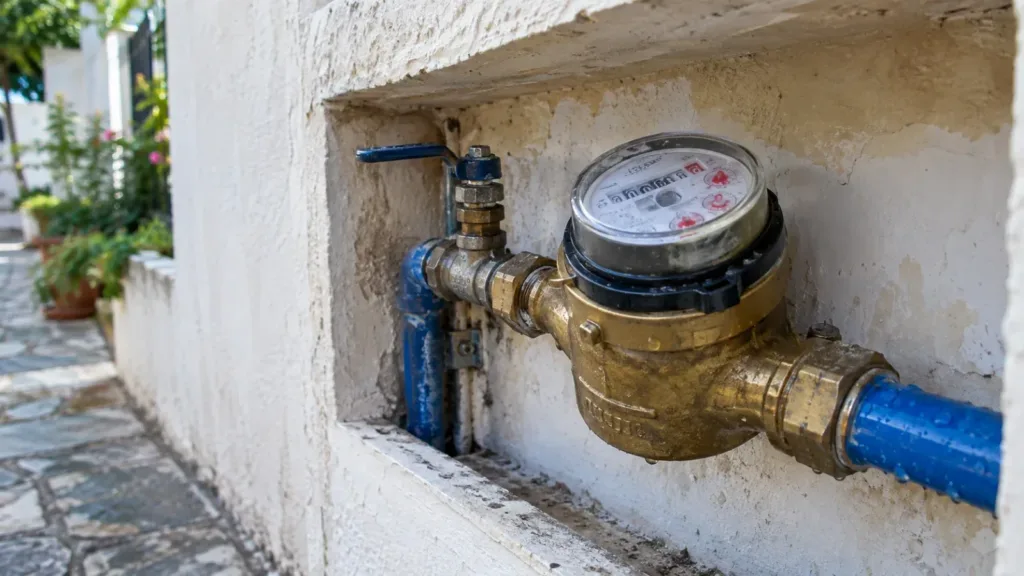
Find the correct water meter by its number, not just by the location of the meter box. Take a photograph of the number and the reading together with the date. In a building with several meters, check in advance which one belongs to your flat and which one measures the communal consumption; selecting the wrong meter will render any subsequent calculations pointless.
Check the meter’s units and digits by referring to the instructions or contacting your supplier. Whole cubic metres and fractional values must not be mixed. For example, the difference between 338 and 326 cubic metres is 12 cubic metres; this is a simple arithmetic example, not a consumption standard or a local tariff.
Do not remove the seals, dismantle the meter or attempt to move it yourself. If access is unsafe, the cover is damaged or the reading is illegible, please contact the responsible organisation. It is useful to observe whether the indicator is visibly rotating, but the device’s final operational status is determined by the prescribed inspection.
Check the billed volume and tariff
Please clarify whether the charge is based on actual or estimated meter readings, and how any subsequent adjustment is made. If the document specifies a volume, check the difference between the meter readings and the dates. Do not compare consumption figures for periods of different lengths without taking into account the number of days and the actual time spent in the property.
With a tiered tariff, it is important to consider how consumption is allocated across the different bands and which billing period is used. Request the official table applicable to your address and consumer category. Applying the highest rate to the entire volume or using the average price from someone else’s bill may lead to an incorrect result.
Check recurring payments, taxes, adjustments and outstanding balances separately. Ask for an explanation of any unusual items and a breakdown of the charges for each service. If the bill includes a carry-over balance, attach proof of your previous payment: sometimes disputes arise because of how a payment has been recorded, rather than because of the water meter reading.
When to suspect a leak
If your water consumption has increased without any change in the number of occupants or your habits, check any accessible taps, cisterns and visible sections of pipework. Keeping an eye on the meter during a period when there is no usual consumption may help you identify the problem. However, first check for automatic watering systems, cisterns and other systems that use water without you realising.
Please report any leaks upstream of the water meter outside your property, or any damage to the meter, to your water supplier. For the section downstream of the water meter, EOA Lemesos recommends that you contact a plumber and close the stop valve located downstream of the meter. Only do this if you can access the valve safely and are certain of its function; do not attempt to adjust the main valve yourself.
In the event of flooding near electrical installations, ensure your safety and contact the appropriate emergency service. Do not touch wet electrical appliances and do not enter the danger zone just to take a photograph of the meter reading. Preserving evidence is important, but it must not delay the arrival of help or cause further damage to neighbouring premises.
Revision of the bill following repairs
You should check with your supplier regarding the procedure for requesting a bill review due to a leak. Official regulations may set out the conditions, the form of the claim and proof of repair. EOA Lemesos has a separate refund procedure; the existence of such a procedure does not mean that any large outlay will automatically be refunded.
Gather the invoice, meter readings, photographs of the problem, the date it was discovered, and the plumber’s documentation regarding the cause and the repair. Ask the contractor to describe the location of the leak and the work carried out in detail. An invoice with just a single line item stating ‘repair’ may not be sufficient if the organisation requests confirmation that the fault has been rectified.
Submit your application via the official channel, obtain a reference number, and clarify the response timeframe and payment arrangements pending a decision. Do not automatically cancel the payment once you have lodged a complaint: enquire about the applicable procedure. The conditions for a review in another district or as set out in last year’s publication do not guarantee the same outcome.
Leasing and transfer of the property
When you move in, check the water meter reading, the date and the reading together with the owner. Clarify who enters into the contract with the supplier, who receives the bill and how the total consumption is allocated. If payment is to be made via the owner, ask for a copy of the bill and agree on a method for confirming payment.
Outstanding debts, consumption prior to moving in and repairs to concealed pipework are dealt with separately from the standard water bill. Keep the handover report and any correspondence. Liability for a leak between the landlord and tenant depends on the cause, the tenancy agreement and the applicable regulations, rather than solely on the name shown on the bill.
On departure, take further photographs of the meter number and readings, and agree on the final settlement date and the procedure for handing over the property or terminating the tenancy agreement. If the final bill arrives later, make a note of how to reconcile the figures. Do not leave an unspecified reserve from the deposit without a clear purpose, supporting documents or a procedure for the final settlement.
A query that can be answered
In your enquiry, please state your customer number, address, account number, the disputed item, the period concerned and the explanation you are seeking. Attach meter readings and payment records, ensuring that any unnecessary personal details are redacted. A request to ‘explain the bill’ is more effective when accompanied by a specific discrepancy between the document and your own calculations.
Please distinguish between errors relating to meter readings, tariffs, payment processing and reports of water leaks. Different procedures may apply to each of these. Please keep a record of each response and the reference number, and ensure that any follow-up enquiry is linked to the previous one. A technical complaint regarding water quality or pressure does not in itself constitute a financial review of the bill.
Once the decision has been made, check the new balance and the next charge to ensure that the adjustment has actually been included in the calculation. Continue to monitor consumption after the repairs and identify the cause of any renewed increase. The desired outcome is consistent readings and a clear billing statement, rather than a promise of a single ‘standard amount’ for all properties in Cyprus.
Continue planning
- Buying property in Cyprus
- Long-term home rental in Cyprus
- Setting up utilities in Cyprus after moving