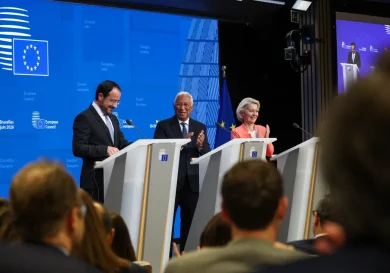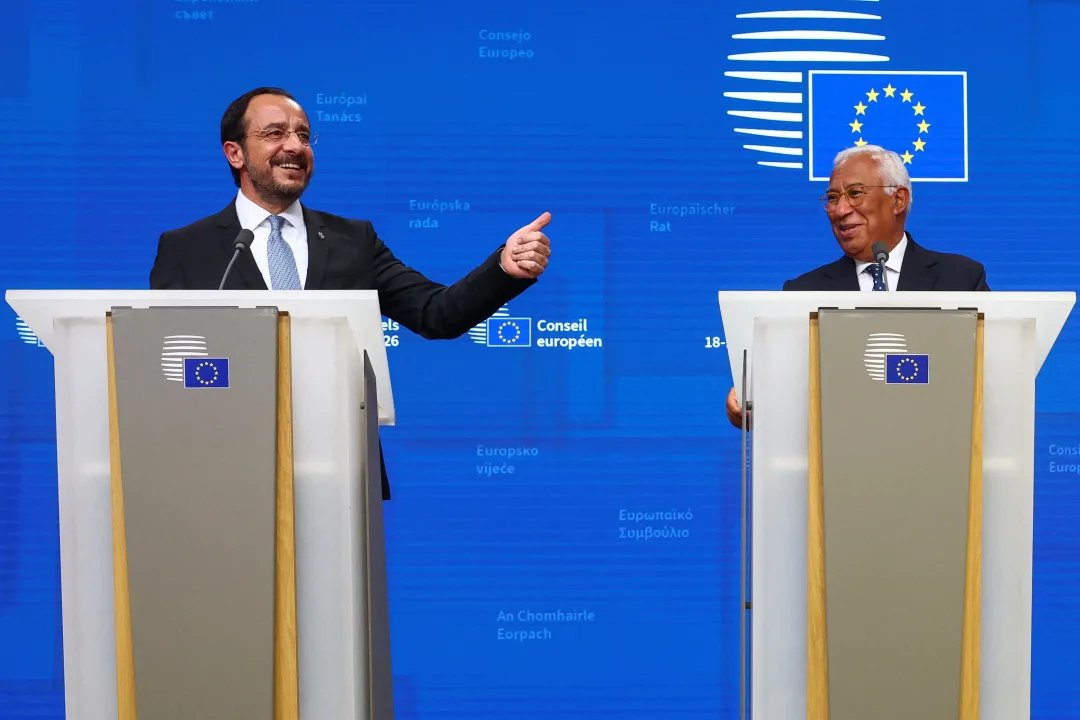
Nicosia, Cyprus. European Council President Antonio Costa on Friday praised Cyprus and President Nikos Christodoulides for their work during the island’s six-month term holding the rotating presidency of the Council of the European Union. He also confirmed reports that one of his senior aides had opened a channel of communication with Russia and defended the move.
Cyprus presidency and EU priorities
Costa said Cyprus had made progress on the European Union’s priorities in recent months, including the multiannual financial framework, the EU’s budget for 2028 to 2034.
He said that, with Cyprus having submitted a budget proposal last week and member states beginning to find consensus on aspects of it, the EU was “one step closer to a new European budget … that meets our ambitions”.
He also referred to the start of negotiations this week for Ukraine to join the European Union, saying, “we are celebrating a historic milestone on Ukraine’s path towards the European Union”.
“In all these areas, the common denominator has been unity, and building this unity is a daily effort. To a large extent, this is due to the tireless efforts of Nikos Christodoulides and the Cyprus presidency in recent months, in close cooperation with the European Parliament and the European Commission,” he said.
Enlargement remarks
Speaking about European Union enlargement, Costa said, “the main problem … is that we would need to wait for another 17 years for another Cypriot presidency”, referring to enlargement as one of Cyprus’ priorities during its six-month term.
Russia communication channel
Costa was later asked about reports that one of his senior aides had opened a channel of communication with Russia. He confirmed the reports and defended his decision to instruct his aide to contact Moscow.
“When it comes to the interests of the European Union, the EU institutions should defend them, in accordance with the treaties,” he said.
He added that he “does not see any contradiction, nor any competition between different actors” on the issue of Ukraine.
Costa also said the European Union “is not and does not intend to be mediators” between Russia and Ukraine, echoing remarks made by EU foreign policy chief Kaja Kallas during last month’s informal foreign ministers’ summit in Limassol.
At that summit, Kallas said, “Europe will never be a neutral mediator between Russia and Ukraine” because “we are on Ukraine’s side and we are defending our own core security interests”.
Reaction from EU leaders
Reuters reported on Friday that German Chancellor Friedrich Merz and French President Emmanuel Macron were “not enthusiastic” about Costa’s move, while leaders of Nordic and Baltic EU member states were described as “most disturbed”.