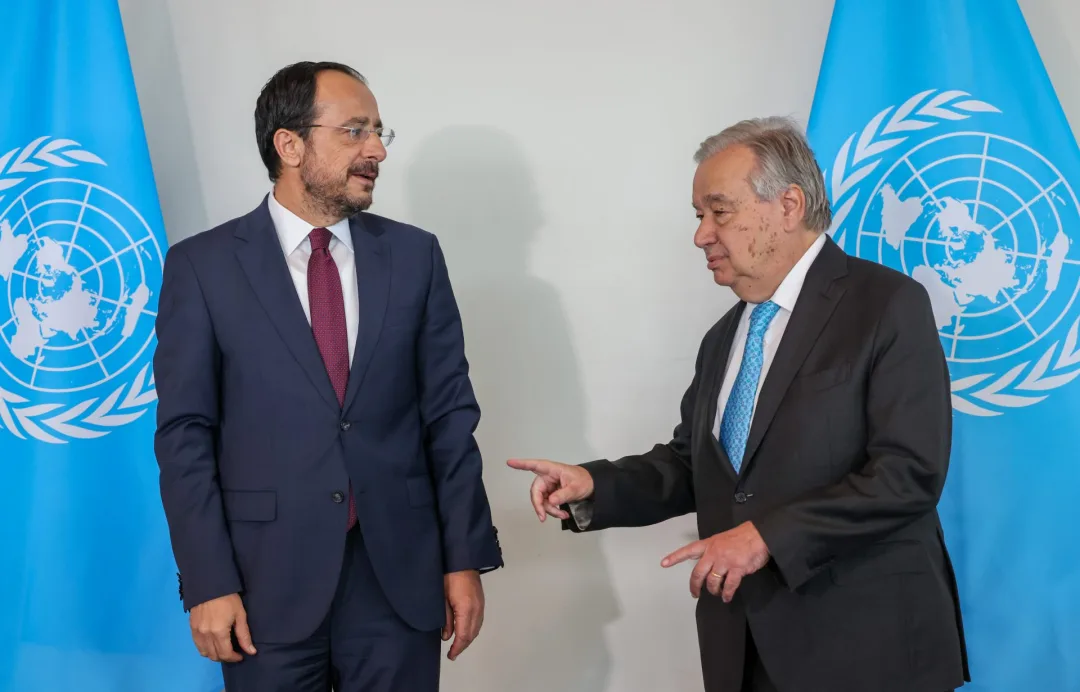
Emba, Cyprus. President Nikos Christodoulides said on Sunday that United Nations Secretary-General Antonio Guterres has a specific plan for the next steps in efforts to resume talks on the Cyprus problem. He said the plan is intended to lead to an enlarged meeting and the restarting of negotiations.
Guterres plan and upcoming meeting
Speaking to journalists during a visit to the Paphos district village of Emba, Christodoulides said Guterres had informed him in March of his intentions.
He said Guterres has “a very specific plan, a specific design,” adding that he shares the UN chief’s approaches and views.
Christodoulides said the current effort is to turn Guterres’ reasoning into something concrete that will lead to the convening of an enlarged meeting, essentially to restart talks.
Holguin visit
UN envoy Maria Angela Holguin is set to arrive on the island on Monday and hold meetings with both Christodoulides and Turkish Cypriot leader Tufan Erhurman.
Christodoulides described his planned meeting with Holguin as “very important,” saying it continues a series of meetings that have been taking place for a long time.
He said the process began with Guterres’ visit to Turkey, his discussion with Turkish President Recep Tayyip Erdogan, followed by his meeting with Guterres and discussions held in Brussels in March.
Aim of enlarged meeting
Christodoulides said Holguin’s visit will help assess the current situation and how to give further impetus to efforts aimed at convening an enlarged meeting, during which the resumption of talks would be announced.
He said he was looking forward to the meeting and hoped it would produce results.
Turkey’s reported position
Holguin’s visit comes as sources informed the Cyprus Mail that Erdogan has green-lit the “new initiative” being undertaken by the UN to bring about a resumption of formal negotiations on the Cyprus problem.
According to the sources, Erdogan believes the lack of a solution to the Cyprus problem has unduly cost Turkey through no fault of its own in recent decades, particularly given that Turkish governments led by Erdogan supported both the 2004 Annan plan referendum and the failed 2017 negotiations in Crans-Montana.
The sources said Turkey’s support for the 2004 referendum and the 2017 negotiations, both of which were rejected by the Greek Cypriot side, shows Erdogan’s “pragmatic and constructive stance” and “will to engage in the hope of securing a solution to the Cyprus problem”.