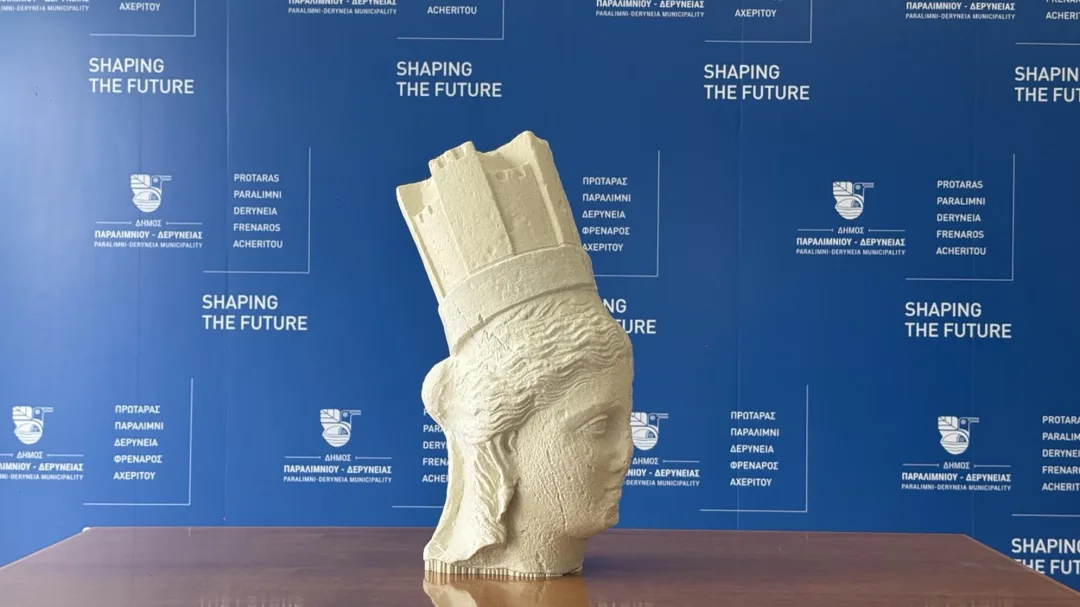
Paralimni, Cyprus. A faithful replica of the head of Aphrodite of Lefkolla, one of the most significant archaeological finds from the Famagusta district, arrived at the Paralimni-Deryneia town hall on Friday. The municipality described the arrival as a symbolic return of the artefact to the area where it was originally discovered.
Replica project
The bust is intended to draw attention to the cultural heritage of ancient Lefkolla, the settlement that once stood in the area of present-day Protaras.
The replica was produced following an agreement between the municipality, the Neues Museum in Berlin and Humboldt University of Berlin. The institutions provided a three-dimensional digital reproduction of the sculpture, allowing for the creation of an accurate copy of the original artefact.
Municipal authorities said the replica was constructed after months of discussions and coordinated efforts with the two German institutions, which agreed to provide the digital model free of charge.
Historical significance
The original sculpture is regarded as one of the most important examples of ancient Cypriot art.
Archaeologists believe the head belonged to a colossal limestone statue of Aphrodite, the patron deity of ancient Lefkolla, which stood within a sanctuary dating to the Classical period in the fourth century BC.
Discovery and collection
The sculpture was discovered in the late Ottoman period by Luigi Palma di Cesnola, an Italian-born American diplomat who served as United States consul in Cyprus during the nineteenth century.
Cesnola amassed a vast collection of antiquities from across the island during his tenure, many of which were exported abroad and later entered museum collections in Europe and the United States.
Approximately 35,000 pieces of antiquities that he had collected from Cyprus were lost at sea after his commissioned vessel, the Napried, was lost at sea.