Syrian Democratic Forces dissolve after integration into Syrian army
The Kurdish-led Syrian Democratic Forces announced their dissolution after completing the integration of their fighters and administration into Syrian state institutions.
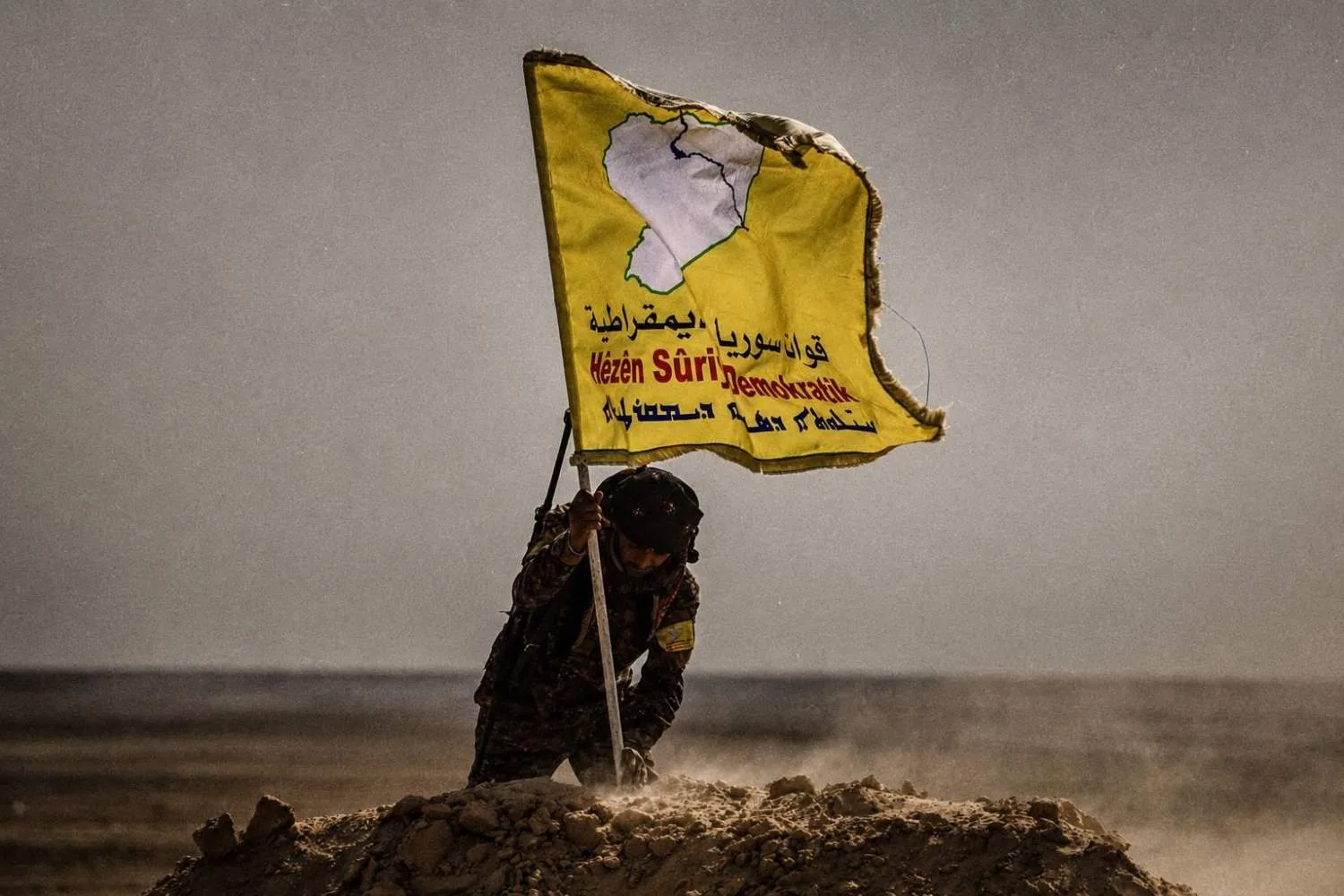
Damascus, Syria. The Kurdish-led Syrian Democratic Forces announced on Tuesday, 25 August, that they had dissolved after integrating their fighters into the Syrian military. The move ends the force’s existence as Washington’s principal partner against Islamic State and as the authority governing a de facto autonomous area in northeastern Syria.
Announcement from Damascus
SDF commander Mazloum Abdi announced the dissolution in a televised speech from the presidential palace in Damascus after meeting President Ahmed al-Sharaa. Senior Kurdish administration official Ilham Ahmed also attended the meeting.
Speaking to reporters in Arabic and Kurdish, Abdi said the SDF’s mission had ended and that it was dissolving as an independent military force after its fighters were integrated into Syrian army brigades.
He said the force had carried a heavy responsibility during one of Syria’s most difficult periods, but that the country was entering a new phase of peace. Abdi said the SDF had liberated Syrian cities and towns first from Baath rule and later from Islamic State.
Syrian state television reported that the announcement also covered the dissolution of the Kurdish-led Autonomous Administration and all affiliated military and civilian formations, which would be fully integrated into state institutions.
Formation and territorial control
The SDF was formed in 2015 at US instigation to fight Islamic State. It drew primarily on the People’s Protection Units, or YPG, the main armed force of Syria’s Kurdish community.
At its peak, the SDF controlled a de facto autonomous zone across much of northeastern Syria, including significant oil and agricultural land. The force was estimated to have had tens of thousands of fighters.
Its position changed after the ousting of Bashar al-Assad in December 2024. Washington developed close ties with the new Damascus government led by al-Sharaa, while the SDF lost most of its northeastern territory during a government offensive in January before agreeing to merge with the army.
The YPG had already been incorporated into state structures. Its commander, Sipan Hamo, was appointed deputy defence minister for Syria’s eastern territories on 10 March.
Before Tuesday’s announcement, Hamo said the SDF’s role was over and that there could not be two administrations within one state. He said the Syrian government would take over the region’s administration.
Kurdish rights
Al-Sharaa addressed Kurdish concerns during negotiations with the SDF. During ceasefire talks in January, he issued a decree strengthening Kurdish rights, making Kurdish an official language alongside Arabic and recognising Nowruz as a national holiday.
The decree also restored citizenship to tens of thousands of Kurds in northeastern Hasakah province who had been stripped of it during the 1962 census.
Abdi said al-Sharaa had promised that Kurds would have the right to education in their own language. He said last week that the integration of the northeastern administration into state institutions had been completed, while efforts to secure Kurdish rights through Syria’s constitutional framework would continue.
Turkey and the PKK
The dissolution removes what Ankara had long regarded as a security threat along its southern border. Turkey considers the YPG to be the Syrian branch of the Kurdistan Workers’ Party, or PKK.
The PKK is designated a terrorist organisation by Turkey, the United States, the European Union, the United Kingdom and France. Turkey has carried out multiple military operations against the YPG in Syria.
The United States has treated the YPG and PKK as separate groups, banning the PKK while relying on the YPG as its main ally in Syria against Islamic State.
The development comes as the PKK follows a separate process in Turkey. After a call from jailed leader Abdullah Öcalan, the PKK formally renounced its armed struggle against Turkey in May 2025, ending four decades of violence that claimed around 50,000 lives.
Turkish Foreign Minister Hakan Fidan had accused the group of delaying the Syrian integration process. He said Turkey had approached the process with good intentions but was aware of what he called ruses, and said YPG members from Turkey, Iraq and Iran had not left Syria.
Regional diplomatic activity
The SDF’s dissolution represents a consolidation of central authority in Damascus after nearly 14 years of civil war and fragmentation.
It comes amid increased diplomatic activity concerning Syria, including US-mediated talks between Damascus and Israel in Jordan on Sunday. The talks aimed to halt Israeli strikes on Syrian territory and revive negotiations towards a security agreement.
The sides also discussed preventing Israeli-Turkish rivalry from extending into Syrian territory. For Turkey, the outcome removes a longstanding point of friction with Washington and strengthens Ankara’s position in northern Syria as its regional security role expands.
This news item was generated automatically by Cyprus Inform from publicly available materials. Report an error →