Service description
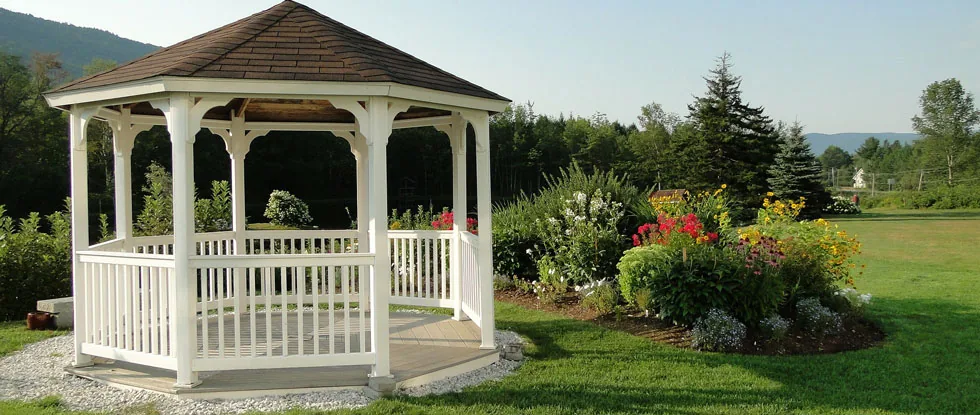
A rotunda (from Latin), a gazebo (from English) and a belvedere (from Italian) — these are all names for gazebos, small garden and park structures of various shapes, which serve as cosy places for relaxation and conversation, as well as shelter from drizzling rain and the scorching sun.
Gazebos come in circular, rectangular and polygonal shapes, and can be open or enclosed; they are also made from a wide variety of materials, including timber, natural stone, iron, brick and so on.
Recently, so-called barbecue gazebos have become particularly popular; these are designed for gatherings with large groups of family and friends and are equipped with a barbecue or grill.
Wooden gazebos
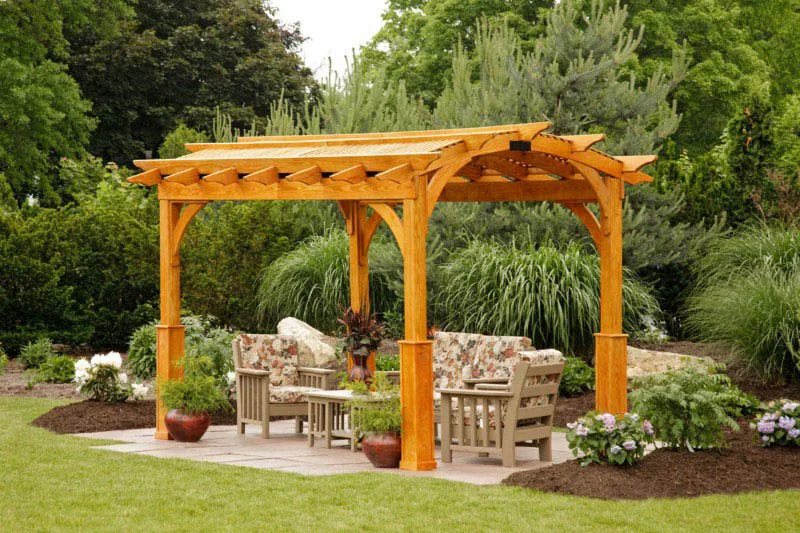 A gazebo serves not only as a place of seclusion and relaxation, but also a beautiful architectural feature that blends perfectly into the landscape design of a park area, against a backdrop of trees or by a pond, as well as in the garden of a country house, cottage or summer house.
One of the main advantages of wooden gazebos is that wood is easy to work with. To build a log gazebo, you don’t necessarily need to call in professional builders; it’s perfectly possible to do it yourself.
Garden gazebos for your own home and holiday home:
- open-air summer gazebos;
- temporary, collapsible gazebos;
- enclosed gazebos in various ethnic styles;
- wooden gazebos with an attached pergola;
- carved gazebos, etc.
You can arrange wooden benches around the perimeter of such a gazebo or place a table and wicker chairs in the centre, if desired, you can connect it to the mains, insulate the floors and walls, and fit plastic windows or carved latticework to enjoy relaxing in the evenings and during cooler periods.
The only drawback of wooden gazebos is the constant need for protection from the weather and regular maintenance.
Stone gazebos
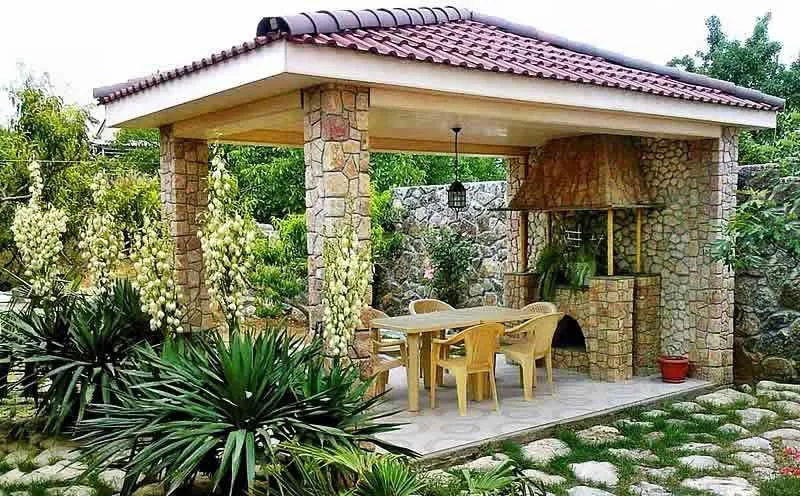 Gazebos made of natural stone are typical of countries with a subtropical climate, including Cyprus. Stone provides the best protection from the sweltering heat and offers a pleasant coolness that Cypriots sorely lack, especially during the summer months.
Gazebos made of natural stone are not unique to Cyprus and European countries. In Russia, too, gazebos are built from this material; they can withstand unpredictable weather and are characterised by their strength and durability.
The following materials are used in the construction of this type of gazebo:
- granite;
- marble;
- sandstone;
- rubble;
- boulders;
- artificial stone.
Building a gazebo of this kind requires a significant investment of money and effort, which is by no means within everyone’s reach.
Arbours made of plants
A living arbour
A living arbour made of plants not only looks beautiful but is also one of the best solutions for landscaping a plot. The materials used are trees, whose trunks form the framework, whilst the crown and branches serve as the roof and walls.
In such a green canopy, summer cottage owners need not fear either the sun or the wind. It blends aesthetically into the overall ambience of any garden plot and does not require significant financial outlay or specialist skills.
The only drawback is the number of years it takes for the trees to reach the desired height, become sturdy, and intertwine their roots and branches to form the framework.
Trees with dense canopies and flexible branches are suitable for a living arbour:
- willow;
- lime;
- Chinese poplar;
- rowan;
- apple tree.
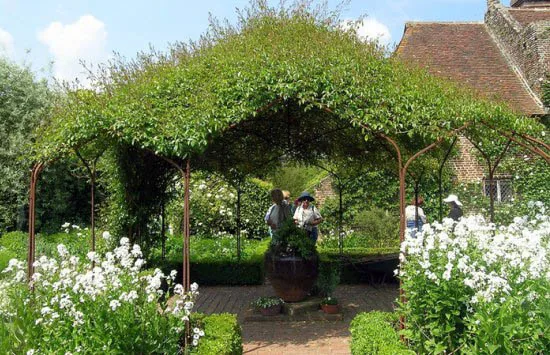
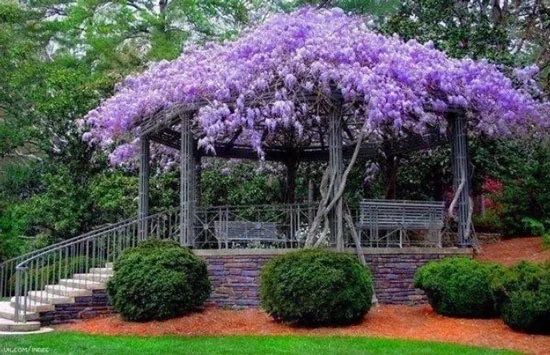
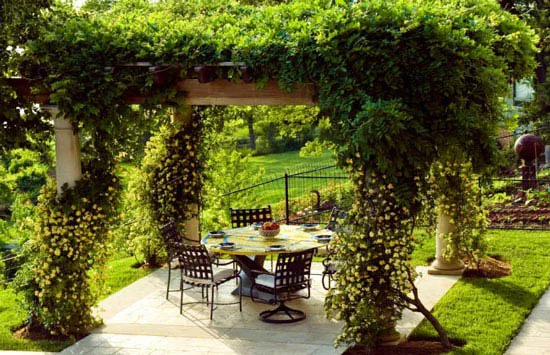
Decorating a arbour with plants
Even an old arbour can be decorated and given a new lease of life with plants.
Suitable plants for this include perennial flowering, climbing or fruit-bearing plants:
- vines;
- ornamental grapevines;
- honeysuckle;
- climbing roses;
- campsis;
- wisteria;
- sweet peas;
- nasturtiums and others.
Inside a gazebo covered in greenery or decorated with flowers, you can set up wicker furniture (a small sofa and a small table) and enjoy a secluded break in harmony with nature.
Metal gazebos
This is one of the most cost-effective options for gazebos that are simple to assemble. Metal gazebo structures can withstand heavy loads; they can be moved from place to place without fear of deformation or breakage.
Metal gazebos:
 open and enclosed;
- portable and collapsible;
- permanent (support posts dug into the ground and set in concrete);
- wrought iron;
- made from profiled tubes;
- round;
- arch-type;
- polygonal, square and rectangular shapes;
- hexagonal and octagonal.
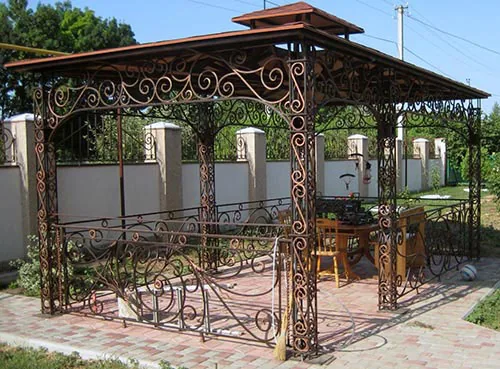
Roofing materials such as slate, polycarbonate and profiled sheet metal go well with a metal frame. Inside the arbour, you can install wrought-iron or wooden benches, a small sofa, chairs and a table, or set aside a special area for a grill or barbecue.
The only drawback is corrosion, which should be dealt with promptly using special chemical cleaners.
Polycarbonate gazebos
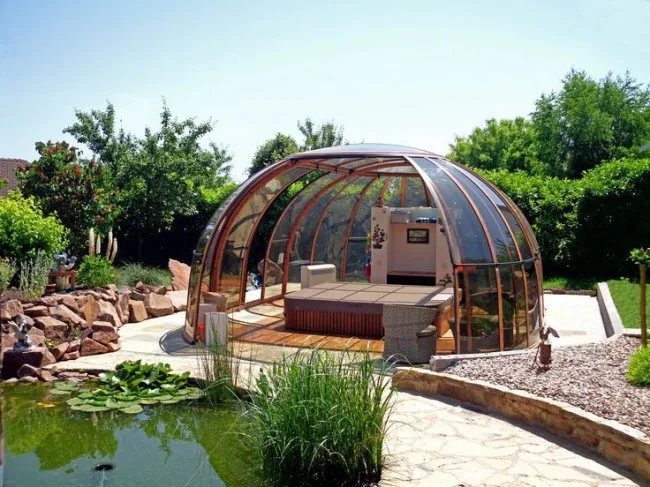 Polycarbonate is a translucent material that comes in a variety of shapes and colours.
Polycarbonate can be used to construct the roof and walls of a gazebo, whilst metal profiles, timber beams, bricks, natural stone or plastered concrete are suitable for the frame. This type of gazebo can be installed on any surface and, if desired, moved or dismantled.
Types of polycarbonate gazebos:
- open and enclosed;
- portable;
- fixed;
- canopy-style;
- with a grill or barbecue;
- of various geometric shapes and polygonal.
Polycarbonate is a fairly flexible and practical material; it bends, cuts and drills easily, and is resistant to a range of temperatures, UV light and fire.
Inside this original polycarbonate structure, you can weld carved benches and a table to the walls of the arbour or place them on the floor. For a more pleasant evening, you might also consider adding lighting. Decorative elements such as curtains, a tablecloth and a tea set will also add to the cosiness and comfort.
If the gazebo is open-plan, you can protect yourself from dust and insects using a special mosquito net or screening in the form of a hedge, artificial pine needles, or with embroidered patterns, etc.


