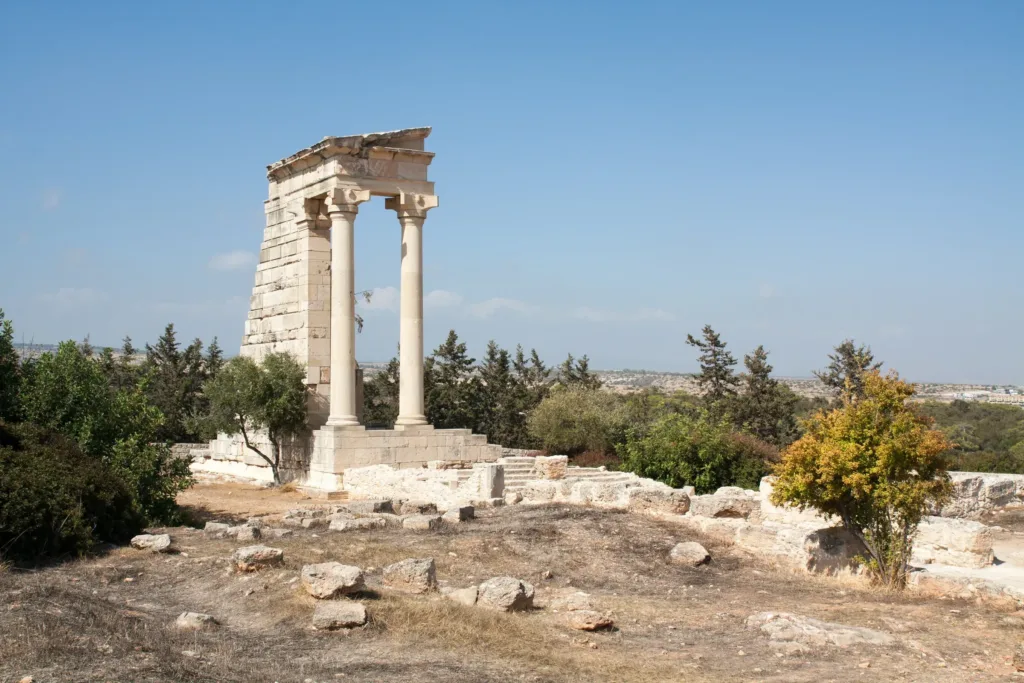
The Sanctuary of Apollo Hylates: archaeology and visiting the site
About the place
Checked: 2 October 2026.
A separate monument next to Kourion
The Sanctuary of Apollo Hylates is situated to the west of the Kourion archaeological site, on the road towards Paphos. It is a separate site with its own entrance. It is worth including in your itinerary for the layout of the ancient religious centre itself, rather than just for the famous photograph of the restored columns.
The name ‘Hylates’ is linked to the conception of Apollo as the god of the forests and the patron of Kourion. This is a description of an ancient religion, rather than a modern assertion regarding the supernatural power of the place. For a historical examination, the traces of ritual life, architectural changes and the layout of the entire complex are important.
Kourion and the sanctuary are historically linked, but do not form a single, continuous walking museum route. Before you go, check the route between them, ticket prices and the opening hours of each site. Don’t assume that a visit to the theatre automatically includes entry to the Temple of Apollo.
History and construction phases
The official description dates the worship of Apollo at this site to the period from the 8th century BC to the 4th century AD. The complex was expanded and altered on several occasions. Therefore, the visible remains should not be dated to a single early period or regarded as a single structure without subsequent alterations.
The original site included a temple, an altar and other religious features, whilst additional buildings were added during the Roman period. Researchers sometimes speculate on the functions of individual rooms. If a source mentions the possible accommodation of visitors or the placement of offerings, reflect this degree of uncertainty in your account.
A significant proportion of the monuments featured in this survey are associated with renovations carried out in the 1st century AD. The partially restored temple gives an idea of the architecture, but is not a fully preserved ancient building. Please distinguish between the original remains, scholarly interpretation and elements of restoration.
Starting your visit
At the entrance, read the map and the key explanations to get an overview of the sanctuary as a whole. Then follow the designated route, noting the open spaces and groups of buildings. In this way, the main temple becomes part of the overall layout, rather than an isolated subject for photographs.
When inspecting the site, pay attention to the sequence of approaches to the sacred area. The architecture may have been designed to guide the flow of people and separate spaces serving different purposes. Do not apply the layout of a modern monastery to this ancient complex: a similar religious function does not imply identical rules or layouts.
The on-site information boards are essential for understanding the ruins. A low foundation or a row of stones may look the same without an explanation, but could belong to different buildings. Please do not enter fenced-off areas or move even small fragments in order to take a better photograph.
Temple, palaestra and baths
The partially restored temple is the most recognisable part of the monument. Consider its position in relation to the other remains and the overall form of the visible architecture. Do not attempt to climb the steps or structural elements unless this area is part of the authorised visitor route.
The palaestra is associated with a space for exercise and games, whilst the bath complex reveals another aspect of life in the ancient city centre. Their presence helps us move beyond the image of a single temple building. Study the plan alongside the captions, whilst avoiding definitive reconstructions of domestic details without a source.
The buildings used by visitors and for storing artefacts are interpreted in the light of archaeological evidence. In the official description, some of the uses are described as ‘possible’. This wording is important: the ruins do not always allow us to determine a single function for a room, and a careful qualification makes the narrative more accurate.
Findings and a follow-up on the topic
Votive figurines and pottery bear witness to the practice of making offerings at the ancient sanctuary. These are archaeological artefacts that should be understood in the context of their discovery and study. Do not search for them on the surface and do not take any stones or shards: the site is protected regardless of the size of the object.
To learn more about the region’s archaeological finds, you may wish to visit the Kourion Museum in Episkopi. Please check its current opening hours and the items currently on display. A tour of the sanctuary and a visit to the museum complement each other, but the fact that items are listed in the guidebook does not guarantee that every one of them is on display today.
If you’re particularly interested in archaeology, make sure you allow time to compare the sanctuary with Kourion. The theatre, the remains of the town and the religious centre shed light on different aspects of ancient society. It is better to examine a few connections in detail than to walk through both sites without reading the maps and captions.
Heat, ground surfaces and accessibility
Much of the tour takes place outdoors. Bring water, a hat and comfortable shoes; choose a time that suits the weather and the group’s circumstances. Don’t expect there to be constant shade at every stop, even if the area looks small and easy to walk around in the photographs.
Visitors with reduced mobility should check the surface conditions, changes in level and the accessible route in advance. The fact that you can reach the entrance by car does not guarantee barrier-free access throughout the entire archaeological site. Staff can advise you on which parts are easier to explore without having to navigate difficult terrain.
Stay with your children and explain that the ruins must not be used as a climbing frame. The stonework remains a historic monument even where it appears low and sturdy. Take photographs from the designated paths, without breaching any barriers or disregarding on-site instructions.
The journey and the plan for the whole day
Choose the site of the sanctuary itself, rather than just Kourion or the nearest settlement. On the final stretch, follow the official signposts and consult an up-to-date map. If travelling without a car, check separately for public transport stops, the walking route and your options for returning.
Kolossi Castle can be added to the itinerary as a monument from a different era, allowing time for a separate trip to visit and explore it. This combination highlights the contrast between the ancient religious complex and the medieval fortification. It does not replace the need to give each site its due attention, nor does it require you to visit all the sites in a single short day.
Please check opening times, admission fees and public holiday exceptions via official sources before your visit. These details are not set out here as fixed terms and conditions. A leisurely exploration of the layout, the temple precinct, the palaestra and the baths helps you to appreciate the sanctuary as a whole, whilst distinguishing between authentic finds and presumed reconstructions.
Continue planning
- Limassol: neighbourhoods, attractions and itineraries
- Limassol Castle and the Medieval Museum
- Paphos Castle: History and a Visit
Official sources
Photo: Mercy from Wikimedia Commons · CC BY-SA 4.0 · converted to WebP and resized.
