Paphos Castle: History and a Visit
About the place
Checked: 2 October 2026.
The castle by Paphos Harbour
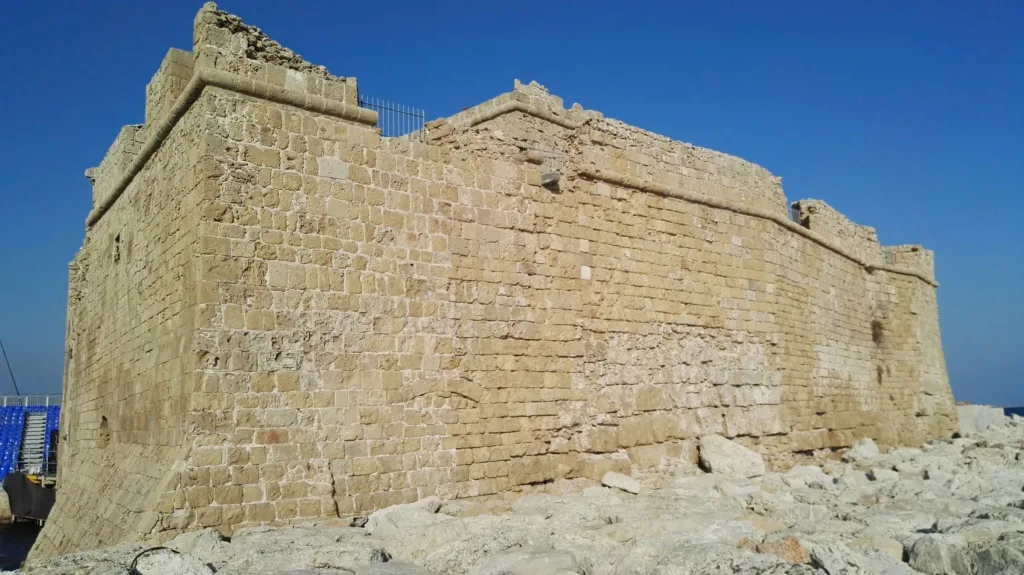
Paphos Castle stands at the western end of Kato Paphos Harbour and is easily recognisable as a compact stone structure right by the water’s edge. It is a standalone monument that can easily be included in a walk around the harbour area of the town. A view from the outside and a visit inside offer different experiences, so decide in advance which option suits you best.
From the outside, the fortification’s location, the approach to the entrance and the building’s connection to the harbour are key features. A tour inside allows you to examine the tower’s structure and the accessible levels. Don’t expect a grand palace complex here: the castle’s appeal lies in its historical layers and its role as a coastal fortification.
The monument should not be confused with the ruins of Saranta Kolones in the archaeological park. These are different sites, although both are linked to the history of Paphos’s fortifications. The castle by the water, the mosaic park and other monuments in Kato Pafos require separate visits, and you should check the admission requirements.
How the fortifications changed
The castle’s history includes a Byzantine period, reconstruction under the Lusignans in the 13th century, and subsequent alterations. Its current appearance cannot be entirely attributed to the earliest stages of its history. When viewing the castle, it is helpful to distinguish between the origins of the fortified site and the age of the building that has survived to this day.
The Venetians dismantled the fortification, and the Ottoman administration subsequently rebuilt it. An official tourist source attributes the surviving appearance of the western tower to the restoration of 1592; an inscription above the entrance refers to this phase of construction. This provides a more precise point of reference than the general description of a ‘medieval castle’.
The building was later used for other purposes. During the British period, it served as a salt store, and in 1935 it was granted monument status under the Antiquities Act. This change in function helps to explain why the building’s history is not limited to military events and sieges.
What to see outside
Start by looking at the castle from the public area of the harbour. Consider its shape and position in relation to the water, then take a look at the entrance. This will help you understand why the fortification is situated here, rather than in the modern administrative centre of Paphos.
Look for an information panel at the entrance explaining the inscription and the building’s restoration. Do not try to work out the date from a random photograph or decorative feature taken out of context. If you are visiting the monument with a guide, it is worth asking them to explain separately the difference between the early stages of consolidation and the current architecture.
There are often large numbers of visitors around the harbour, particularly during city events. Please do not block the access route just to take a photograph, and do not go beyond the temporary barriers. The fact that you can see the façade from the quay does not mean you are permitted to walk freely around all the areas adjacent to the water.
Interior spaces and the upper level
The official description presents the main part of the castle as a square tower with an inner courtyard. On the ground floor are a central hall and small rooms on either side, which were used as cells during the Ottoman period. This layout illustrates the building’s practical functions more clearly than the romanticised image of a knight’s castle.
The upper section offers a view of the harbour and the fortifications from a different vantage point. Please only ascend via the designated route and observe any restrictions imposed by staff. If a level is closed due to works or site conditions, please do not attempt to find a way round: the external viewing area remains an integral part of the visit.
The size of the exhibition and the accessibility of individual rooms may vary. Do not promise trip participants a specific selection of exhibitions unless you have checked it yourself. The main permanent theme of the monument is the building itself and its historical functions; details of temporary exhibitions should be confirmed separately.
Ticket and visiting times
Before your visit, please check the castle’s opening hours on the official website and note any exceptions during public holidays. The promenade and harbour may be accessible even after the interior tour has finished. Therefore, a late stroll along the waterfront does not guarantee that you will be able to buy a ticket and enter the monument.
Please check the prices and concessions directly against the current terms and conditions. Do not assume that ticket conditions for a neighbouring archaeological park or city museum apply to this site. If you are planning to visit several sites managed by the Department of Antiquities, please check separately whether any existing combined ticket options apply.
Allow plenty of time to get there, buy a ticket and take your time exploring before closing time. Don’t judge the visit solely by the tower’s modest external dimensions. Even a compact fortification is more interesting when you have the chance to linger at the information panels and link what you see with the history of the harbour.
The approach, the steps and a walk with the family
It is usually easier to plan the final part of your route through the harbour area on foot, starting from your chosen car park or bus stop. Check the public transport timetable and traffic arrangements for the day of your visit. Do not expect to be able to drive right up to the entrance: events and temporary restrictions may affect vehicle access.
Please check the accessibility of the lower rooms and the staircase separately if there is a person with reduced mobility in the group. As this is a historic building, it may contain steps and narrow passageways. The fact that the grounds appear level from the outside does not guarantee a barrier-free route through the entire castle.
Please take care with children near water, stairs and open edges. In hot weather, bring water and sun protection for a walk around the harbour. If anyone does not wish to go up, agree on a meeting point in advance, taking care not to obstruct the entrance.
What to combine with a castle visit
As part of a day out in the city, it is a good idea to combine a visit to the castle with a stroll around the harbour and a separate visit to the Kato Pafos Archaeological Park. The main attractions at the park are the archaeological finds and mosaics, whilst at the castle it is the coastal fortifications. Separating these two themes helps ensure you don’t rush through both sites.
For a more extensive itinerary around the region, you could include the Monastery of St Neophytos, but this combination requires a journey by car. It is suitable if you have your own transport and enough time for two different types of visit. Don’t turn your visit to the museum and the monastery into a competition to see which has the most stops.
Please check the current opening hours, admission details and events via official sources before you set off. The information provided here is not intended to be definitive. A leisurely stroll, paying attention to the inscriptions, the layout and the location by the sea, allows you to see the history of a real port facility in its familiar silhouette.
Continue planning
- Paphos: archaeology, neighbourhoods, beaches and itineraries
- Larnaca Castle: history, museum and a visit
- Limassol Castle and the Medieval Museum
