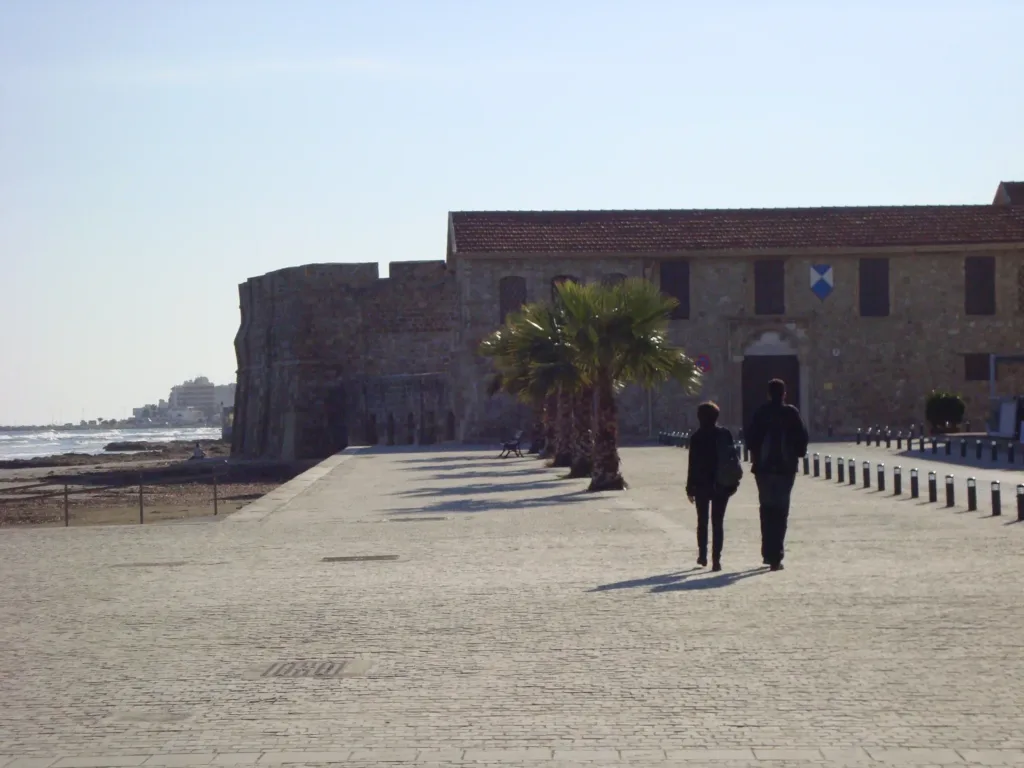
Larnaca Castle: history, museum and a visit
About the place
Checked: 2 October 2026.
The fortress at Finikoudes
Larnaca Castle is situated at the southern end of Finikoudes Promenade, next to the city’s historic quarters. It is also known as Larnaca Fort. This compact fortification is an ideal stop on a day’s walk: here you can combine a tour of the architecture, a visit to a small museum and a further stroll along the seafront.
Do not confuse the museum inside the castle with the Larnaca District Archaeological Museum. These are different institutions with different collections and addresses. If you’re short on time, decide what interests you most: the history of the fortress itself and the medieval artefacts, or a broader archaeological account of the region.
The castle is suitable for a self-guided tour, provided you begin by understanding its functions and the stages of its construction. A single panoramic view from the embankment shows the silhouette, but does not explain the building’s history. Set aside some time specifically for a tour of the interior and check that the museum galleries are open to the public.
Dating without false precision
The origins of the fortification are a matter of debate in the sources. The official tourist guide links the early phase to the Middle Ages, and its present form to the Ottoman period. Therefore, the claim that the entire fortress was built in a single, indisputably established year oversimplifies the history of the monument.
Among the historical accounts, some mention its construction during the reign of King James I of the Lusignan dynasty; other sources link the Ottoman works to the year 1625. However, travellers’ accounts suggest that the fortification existed prior to that date. These accounts should be regarded as different pieces of evidence rather than being combined to form a single definitive date.
It is more useful for visitors to see how the role of the port and the building itself have changed than to simply memorise a disputed date without any explanation. The surviving complex bears traces of several periods of use. On-site information boards and the official description help to link the architectural features to the relevant period.
Military role and use as a prison
The fortifications were intended to protect the town harbour. Their location on the shore explains this purpose better than any comparison with castles situated further inland. When examining the outer walls and passageways, note the building’s connection to the sea and the historic urban landscape.
After the island came under British administration, part of the complex was used as a prison. The official description mentions the room where executions took place and the discontinuation of the use of the gallows in 1948. This is a sombre historical subject that calls for a measured account, without sensational details or romanticisation.
If you’re visiting the castle with children, decide in advance how you’ll explain the prison part of the story. You can focus on how the building’s purpose has changed, without turning the tour into a frightening tale. During your visit, please show respect for the memory of those for whom this place was associated with imprisonment.
What the museum displays
Today, the castle houses a small museum of Larnaca’s medieval history. An official source describes artefacts dating from the early Christian to the Ottoman periods. This does not mean that every exhibit was found directly inside the fortress: the origin of each specific item is indicated in its museum label.
In the exhibition galleries, it is useful to select a few objects and compare their dates, materials and purposes. This approach helps you to see the changes in everyday and religious life. Do not try to gain a complete overview of the entire history of Cyprus from this compact collection in just a few minutes.
Please check which galleries and passageways are open today. Exhibitions, restoration work and events may affect access. If a specific section is important to you, please enquire about it when purchasing your ticket; the general statement that ‘the museum is open’ does not confirm that all the exhibits you expect to see will be on display.
The courtyard and the urban context
The fortress courtyard helps visitors appreciate the scale of the structure and links the museum galleries with the outdoor tour. Please examine the architectural features on display whilst remaining on the designated route. The low walls and old stones must not be used for climbing or moving objects.
The venue may host cultural events. The programme for a specific event does not replace the museum’s normal opening hours and does not guarantee free access to the exhibition galleries. If you are visiting for a concert or a performance, please check the details separately from those for visiting the monument.
Once you’ve left, you can continue your walk through Finikoudes or towards St Lazarus Square. Please do not regard the neighbouring religious buildings and residential neighbourhoods as an extension of the museum exhibition. Each place has its own purpose, its own rules for entry and its own everyday life.
How to prepare for a visit
Choose a car park or public transport stop away from the main entrance and plan to walk the rest of the way. Traffic levels on the city embankment vary depending on the season and events taking place. In hot weather, it’s best to allow a break between your walk along the embankment and your tour of the castle’s interior.
Please check the accessibility of steps and staircases if there is a person with reduced mobility or a child in a pushchair in the group. The fact that you can access the courtyard does not necessarily mean that all rooms are accessible. It is helpful to agree in advance with staff on a route and a meeting point for those who will not be going upstairs.
Please check the official information for the day of your trip regarding opening hours, tickets, concessions and public holiday exceptions. These are not set out here as permanent conditions. Do not assume that weekday opening hours apply at weekends, and do not assume that the waterfront being open means the museum is open.
A programme at a leisurely pace
For a first exploration of the historic centre, you could combine a visit to the castle, St Lazarus’s Church and a stroll through the old streets. This itinerary doesn’t require turning the day into a long car journey. Start with the site that has stricter entry rules, then leave the rest of the walk to explore at your leisure.
If you’re particularly interested in museum collections, choose your next stop based on what’s on display rather than just its proximity. The region’s archaeological museum and the castle museum each offer different insights. Make sure you allow time to read the captions and take a break: examining a few items closely is more rewarding than a rushed tour of all the galleries.
The fortress should be viewed simultaneously as an architectural monument, a former military and prison site, and a functioning museum. This perspective helps to avoid both unfounded romanticised legends and the reduction of its entire history to a single grim function. The verified sources listed below allow you to learn more after your visit.
Continue planning
- Larnaca: what to see, where to stay and how to plan your trip
- Paphos Castle: History and a Visit
- Limassol Castle and the Medieval Museum
Official sources
Photo: Andreas2009 · CC BY-SA 3.0 · converted to WebP and resized.
