Museums in Ayia Napa: Thalassa and maritime heritage
The Thalassa Museum, the ‘Keryneia II’ reconstruction, the maritime collection and other cultural attractions in Ayia Napa: how to prepare for your visit.
Checked: 27 September 2026.
A museum visit in Ayia Napa
Ayia Napa is famous for its beaches, but in the town centre there is the Thalassa Municipal Museum, dedicated to Cyprus’s maritime heritage. For visitors keen to understand the island’s connection with the sea, this is a worthwhile destination in its own right. First, decide whether you want to explore the permanent collection, see a temporary exhibition, or simply add a cultural interlude to your stroll.
Thalassa should not be treated as a substitute for a general list of attractions in Ayia Napa. The monastery, the Makronissos archaeological site and the sculpture park are of interest for different reasons and have their own access requirements. They can be included in an itinerary, but visiting each one requires checking the timing, transport and weather separately.
The Visit Cyprus page and the museum’s own website provide different information regarding opening hours. When planning your visit, please refer to Thalassa’s current timetable and, if necessary, contact them directly, particularly during public holidays or the off-season. The price and timetable listed in the guidebook should not be taken as confirmation for the day of your visit.
What is *Thalassa* about?
The museum’s name means ‘sea’ in Greek. The official description on Visit Cyprus explains its theme as the island’s maritime heritage from antiquity to the present day. It is not merely a collection of beautiful shells: the exhibition brings together the history of seafaring, artefacts of human life and the natural world of the Mediterranean Sea.
In this gallery, you can see how people used the sea for trade and travel, and then compare this with the displays on marine life and the marine environment. Not all the exhibits date from the same period, so it is best to refer to the captions. If the exhibition has been temporarily altered, please ask the staff for details of the current layout of the galleries.
For children, the museum can serve as a useful starting point for learning about the island’s history, provided you select a few exhibits and ask simple questions: what the vessel is made of, what it carried, and where the artefact was found.
The ‘Keryneia II’ and the context
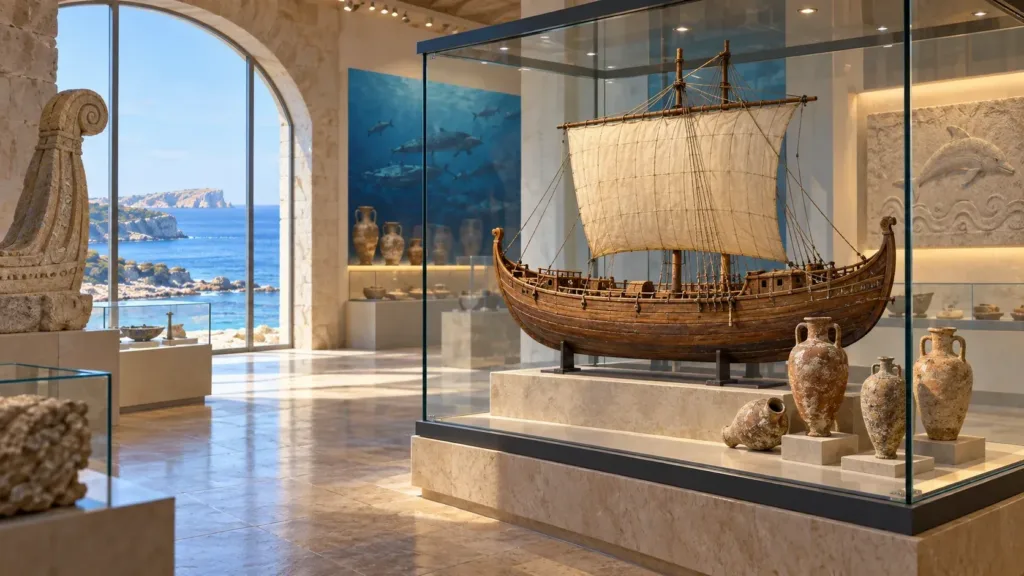
The centrepiece of Thalassa is ‘Keryneia II’, a full-scale reconstruction of the ancient Kyrenia merchant ship built in 1985 for experimental archaeology. It helps visitors visualise the size of the ship and the workings of maritime trade. This modern vessel must not be described as the original archaeological find raised from the seabed.
The original vessel is linked to a find off the coast of Kerynia, whilst the exhibition on display to visitors is in Ayia Napa. These are different geographical and historical locations. The captions and museum materials will help you understand which aspects of the replica are based on the find and which are reconstructions. It is important to maintain this distinction when recounting the story.
Inside the hall, the ship can be viewed from different levels, according to Visit Cyprus. However, the routes between levels, the lift and the accessibility of specific viewing points should be checked to ensure they are currently available. For visitors with reduced mobility, it is better to ask the museum specific questions about the part of the exhibition they wish to see, rather than relying on a general ‘accessible’ label.
Marine life and objects
A separate section of the museum is devoted to marine life: the official information sheet mentions fish, mammals, crustaceans, corals, shells and fossils. Please only compare a modern organism with an ancient find after reading the caption. The age of a fossil does not automatically apply to the entire gallery or to all the species in the exhibition.
For visitors interested in the environment, the museum may provide an opportunity to ask questions about the conservation of the marine environment. However, the exhibit itself does not provide an answer regarding the current condition of a specific beach or the safety of swimming there. Such information needs to be checked against separate official sources for the relevant date.
Photographs of animals and objects often lose their context once posted on social media. If photography is permitted, please include the name of the exhibit and the museum’s description; do not speculate on its origin. Children can choose several objects and compare their shape or habitat, without turning the exhibition into a list of ‘the oldest’ items without citing sources.
Art, events and other places
According to the official Visit Cyprus guide, Thalassa also serves as a venue for art exhibitions and events. However, temporary exhibitions are not part of the permanent exhibition. Before you visit, check the museum’s programme, any age restrictions and whether a separate booking or ticket is required. If you are only interested in a particular exhibition, check whether the relevant gallery is open.
As part of a city tour, you can combine a visit to the museum with a stroll through the city centre or a visit to the Ayia Napa Monastery. The monastery is a religious and historical site with its own rules; it is not a branch of Thalassa. The Sculpture Park and Makronissos also require different times and weather conditions; do not promise that all these places are accessible on a single museum ticket.
The official city guide, Visit Cyprus, lists various cultural attractions in the area. Use it to help you choose, but check with each organiser to ensure the information is up to date. For a short day out, it’s a good idea to stick to one main museum and one walk, especially in summer, when getting about in open spaces in the middle of the day can be quite tiring.
A practical guide to visiting
Find Thalassa on the map using the address given on the museum’s own website, and check the opening hours for the day you wish to visit. Compare this information with that on Visit Cyprus: if there is a discrepancy, check with the museum. Check the price and any available concessions before buying a ticket, as the figures published on third-party websites may not reflect the museum’s current policy.
If you are visiting with a child, consider the time it takes to explore each floor, any breaks you might need, and how easy it is to get around. For visitors with reduced mobility, ask about the entrance, the lift, access to the exhibition and the toilets. For a group tour, confirm the language, time and maximum number of participants. These details are more important than a formal ‘suitable for all’ rating.
Make sure you allow time to read the captions. You can round off a short day out at the museum with lunch and a stroll, without turning it into a race to see every attraction in the area. In hot weather, take some water with you and plan your visits to open-air areas separately. If the temporary exhibition is closed, the permanent collection may still meet your main objective — maritime history.
What to double-check and what to trust
Before your visit, please check the opening hours, exhibitions, tickets, accessibility and photography rules on the Thalassa website or by contacting the museum. Public holidays and private events may affect normal opening hours. If a special exhibition is a key part of your visit, please check that it is open on the day you plan to visit.
When describing a vessel, distinguish between the original archaeological find and a modern replica; in the natural history section, distinguish between genuine fossil material, a modern specimen and a museum reconstruction. This helps to ensure that the visual display does not become an inaccurate historical narrative. For disputed dates, refer to the museum catalogue and primary documentation.
The sources for this page were checked on 27 September 2026: the official Thalassa website, the Visit Cyprus fact sheet and the official Ayia Napa cultural guide. Please check the practical details again before travelling. A museum is most rewarding when visitors know exactly what to expect and distinguish maritime history from a beach itinerary.
Continue planning
- Museums in Larnaca: collections and themed itineraries
- Paphos museums: finds, collections and links to archaeological sites
- Kataklysmos in Cyprus: traditions and how to check the programme