Museums in Larnaca: collections and themed itineraries
The District Archaeological Museum, ecclesiastical art and Larnaca’s municipal collections: what to choose and what to check.
Checked: 27 September 2026.
How to choose a museum in Larnaca
Larnaca offers various ways to explore the city’s past: the area’s archaeological finds, ecclesiastical art, the urban landscape and private collections. Start with whatever interests you most. The Archaeological Museum helps you understand ancient Kition and the neighbouring settlements; the museum at St Lazarus Church showcases a different tradition.
Don’t treat the list of attractions as a guarantee that they’ll all be open on the same day. Smaller venues may have different opening hours, admission requirements and the language in which tours are conducted. Choose one main museum and one additional one, then check the distance between them and the travelling time.
This guide is no substitute for up-to-date information from the organiser. You can find venues by area in the official Visit Cyprus directory, but you should check opening times, exhibitions, tickets and availability before you travel. If there are any discrepancies, please refer to the museum’s own website or contact them directly; information you read several years ago may now be out of date.
The District Archaeological Museum
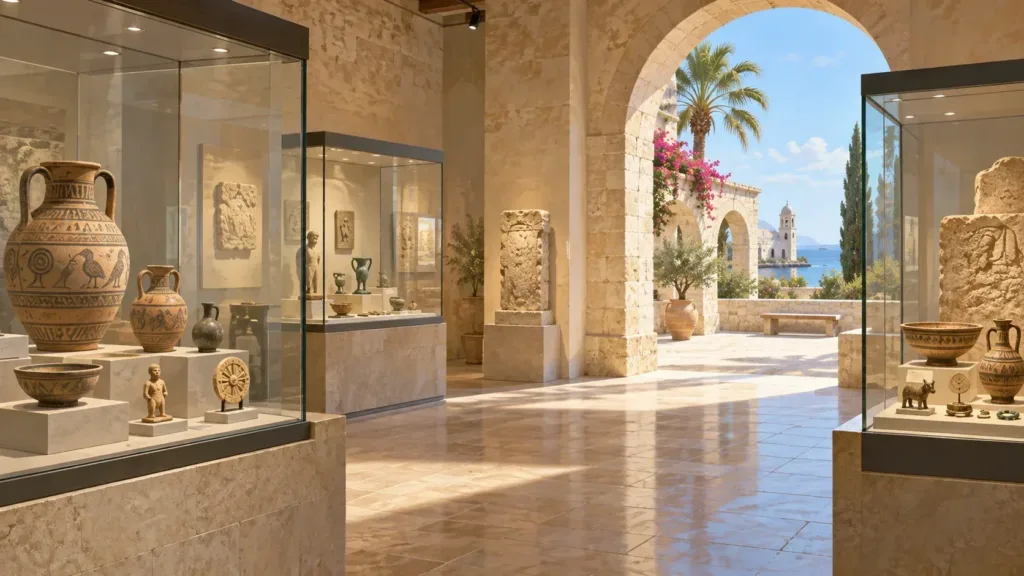
The Larnaca District Archaeological Museum houses finds from various sites across the district. The official Visit Cyprus brochure mentions the ancient city of Kition, as well as artefacts from Hirokitia and Tenta-Kalavassos. These do not come from a single excavation site or a single era: the exhibits help to illustrate how life in the region has changed over a long period of time.
Whilst viewing the exhibits, look out for the labels indicating the findspot, date and purpose of each object. The fact that two vessels are similar in shape does not mean that they were used at the same time or in the same way. If you’re planning to visit an archaeological site after the museum, make a note of its name and check separately whether it’s open to visitors and how to get there.
The museum’s exhibition may be updated, and the galleries and guided tours on offer may vary. Before your visit, please check the current arrangements with the museum or the Department of Antiquities. This is particularly important for families with pushchairs, people with reduced mobility and groups requiring guidance in a specific language.
Byzantine art at St Lazarus’s
The museum at St Lazarus Church is situated next to the church in the centre of Larnaca. The Visit Cyprus description lists icons, liturgical objects and other ecclesiastical artefacts from the area. This museum is a good choice if you are interested in religious culture and the organisation of a church collection, rather than general archaeological chronology.
The saint’s life and local legends should be presented as part of the Church’s tradition, rather than as archaeologically proven events. In the exhibition, you can explore the style of the artefacts, their purpose and their connection to community life. If you are also visiting an active church, please respect the service and the rules of conduct for visitors.
It is best to check the photography rules and access to individual rooms on arrival. Older guidebooks may contain specific prices and opening times, which are subject to change; do not rely on them as a guarantee for your visit today. Before travelling, check the official information sheet, and if the information is crucial to your itinerary, contact the organisation directly.
Municipal and private collections
As well as state museums, Larnaca is home to art galleries, themed collections and private collections. These showcase the city from a different perspective: through paintings, family archives, crafts or the history of a particular trade. Such a museum may be small, so its value depends not on its size, but on how closely the subject matter matches your interests.
Check the status of each venue individually. The name appearing in an old list does not guarantee that the collection is currently open, that the exhibition is permanent, or that it can be visited without booking. Don’t plan your whole day around a private venue until you’ve received confirmation of the time and address from the organiser. If you don’t receive a reply, have a backup plan.
Thematic institutions should not be confused with city attractions simply for the sake of compiling a long list. A castle, a church, an art gallery and an archaeological museum may be located close to one another, but they offer different experiences and different kinds of knowledge. Explain to the children where you are going and what you will be able to see, rather than promising the same ‘museum programme’ at every venue.
Itinerary by interest
For the first day, you could visit the archaeological museum, then take a stroll through the main streets and visit the church collection, if its opening hours are convenient. Visiting exhibitions takes time to read the captions; online itineraries often underestimate this part of the day. Allow time for a break to eat and drink, especially during the hot months.
If you’re interested in ancient Kition, plan a separate trip to the archaeological site; don’t assume the museum and the excavation site are one and the same. The location where the artefact is kept and the place where it was discovered may be different. A map helps you plan your route, but does not guarantee that a particular site will be open and accessible at the time you choose.
When visiting with children, it is best to alternate between indoor galleries and open-air areas. If you have reduced mobility, find out in advance about the entrance, steps, lift, toilets and rest areas specifically in the building you have chosen. A general description such as ‘Larnaca city centre’ says little about the actual accessibility of the museum route.
How to read museum information
A museum label usually includes the date, material, origin and, occasionally, an explanation of the object’s function. These details help to distinguish established fact from a convenient legend. If the label cautiously states ‘presumably’, the commentary should not turn this into a categorical assertion. For religious artefacts, it is also important to distinguish between a description of tradition and historical research.
The information on official information sheets may be brief; they provide key titles and contact details rather than a comprehensive guide. Compare them with the information provided in the exhibition gallery and on the institution’s own website. If the dates and attributions differ, do not choose at random: make a note of the issue and check it in the museum’s published catalogue.
Photographs of exhibits without captions quickly lose their context. If photography is permitted, take a picture of the gallery name and the label alongside the object, rather than just the object itself. When publishing images, please observe the museum’s rules and respect copyright. A travel guide helps you choose a trip, but it is no substitute for the museum’s collection descriptions.
Pre-visit check
Make a short list: the name of the museum you’ve chosen, its official contact details, address, opening hours for the date in question, ticket or booking details, photography rules and access conditions. Check for public holidays and any temporary closures. If you require a guided tour in a specific language, book it in advance and wait for confirmation.
To compare collections, start with the local archaeological museum and the Museum of Saint Lazarus, then only add a gallery or private collection if there is a current programme. Avoid outdated, precise prices, unverified recommendations and promises that all galleries are always open. The itinerary should allow for one visit to be swapped for another.
The sources for this review were checked on 27 September 2026: the Visit Cyprus museum directory and the official information sheets for the Larnaca Archaeological Museum and the Museum at the Church of St Lazarus. Please double-check the visiting conditions immediately before your trip. The most rewarding museum visit begins with a question about the collection and taking the time to find the answer.
Continue planning
- Museums in Nicosia: what to choose and how to plan your visit
- Limassol’s museums: collections, the old town and a day’s itinerary
- Museums in Ayia Napa: Thalassa and maritime heritage