Museums in Nicosia: what to choose and how to plan your visit
The Cyprus Museum, the Leventis Museum and the Art Gallery: comparing the collections and planning a pleasant day out in Nicosia.
Checked: 27 September 2026.
How to choose a museum in Nicosia
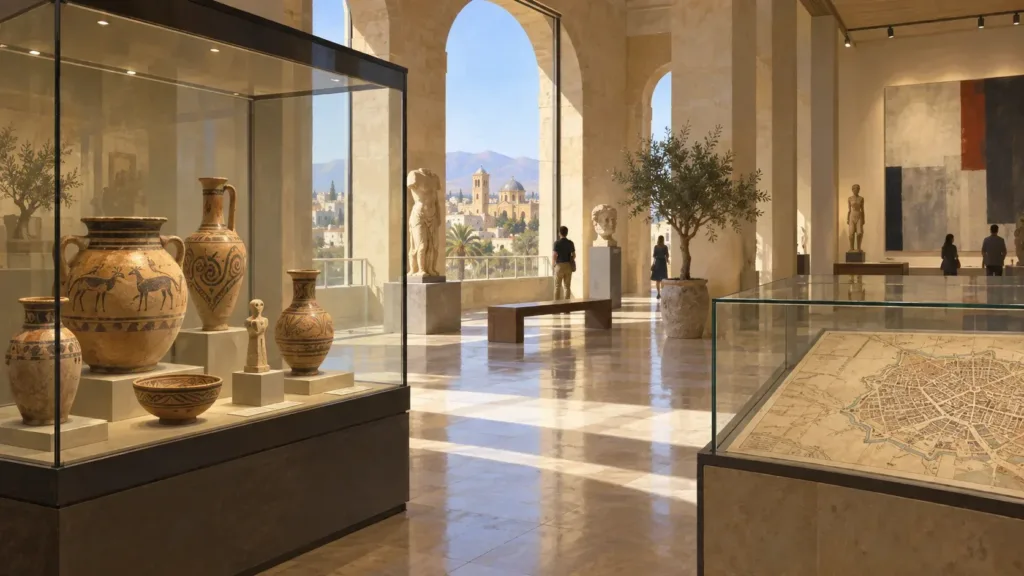
Nicosia is ideal for a day out visiting museums, provided you decide in advance which aspects of history interest you. The Cyprus Museum displays archaeological finds from across the island; the Leventis Municipal Museum tells the story of the city itself; and the A. G. Leventis Gallery is dedicated to art.
Start with one main visit and allow time to walk between the buildings. Spend more time looking at the exhibits, reading the captions and discussing what you’ve seen than you do marking points on the map. For families with children or anyone who finds it difficult to stand for long periods, two shorter visits may be more convenient than a long tour taking in several galleries in a row.
This page is designed to help you compare venues; it is not a substitute for their official websites. Exhibitions, opening hours, admission fees, guided tours and photography policies are subject to change. Before you set off, visit the website of your chosen museum, check the day of the week and any public holiday exceptions, and if you have any questions about accessibility, please contact the staff directly.
Cyprus Museum: the island’s archaeology
The Cyprus Museum in Nicosia houses artefacts found in various parts of the island. The exhibits allow visitors to trace several historical periods and see how archaeologists link an artefact to the place and time of its discovery. Examples cited in the official Visit Cyprus description include prehistoric artefacts, pottery, jewellery and a statue of Aphrodite from Soli.
If this is your first encounter with Cypriot archaeology, pay attention to the dates and captions, rather than just the most striking artefacts. Items from different cities and different centuries may be displayed side by side. The museum helps to provide an overall picture, but it does not turn every archaeological site on the island into part of a single exhibition or a single UNESCO site.
If you are planning to visit Paphos, Kourion or another archaeological site later on, it is a good idea to make a note of the period that interests you and the name of the site. This will make it easier to understand the context of the artefacts on display at the excavation site. Please check with the museum or the Department of Antiquities before your trip for the schedule of special exhibitions and any changes to visiting arrangements.
The Leventis Museum: the history of the capital
The Leventis Municipal Museum is dedicated to Nicosia. Its permanent exhibition galleries are organised chronologically: from the ancient city through the Byzantine and medieval periods to the Ottoman and British eras and the modern capital. The museum’s official description mentions maps, documents, paintings, engravings, costumes and other artefacts relating to city life.
This is a good choice if you’re interested not only in the island’s archaeology but also in the changes that a particular town has undergone. See how the same street or neighbourhood appears on maps from different periods, and what crafts and social customs are reflected in the artefacts. The history of Nicosia does not end with a single era, nor is it limited solely to the division of the city.
Permanent exhibitions and temporary events have different opening times. Before your visit, please check whether the galleries you wish to see are open, whether guided tours are available, and in which languages the commentary is provided. The building is situated in the old town; it’s easy to combine a stroll through the streets with a visit, but it’s best to plan your route and return time according to your own mobility.
The A. G. Leventis Gallery: art
The A. G. Leventis Gallery brings together collections of European, Greek and Cypriot art. The official catalogue describes, in particular, works by artists from various centuries and pieces by the first generation of Cypriot painters. As this is an art gallery, one should not expect to find the same chronological arrangement of archaeological finds here as in the Cyprus Museum.
To get started, choose one collection and see how the curators have arranged the works in the gallery. The captions help you understand the artist, the technique and the date of creation, and you can compare your own impressions after viewing the works. A temporary exhibition may be a reason in itself to visit, but you should check the gallery’s current programme to confirm whether it is on.
If you are visiting with a child, please check the educational programme and the visitor rules. Contact details and current conditions are published by the organisation itself.
Other collections and route boundaries
Nicosia is home to religious, historical and specialist museums, as well as exhibition spaces. The Visit Cyprus directory allows you to filter venues by area and type of collection. However, a listing in the catalogue does not guarantee that all galleries will be open on the day of your visit: a small museum may have different opening hours, require advance booking, or have an exhibition that is temporarily closed.
A separate article on the Police Museum is devoted specifically to this collection and may complement the main itinerary. You shouldn’t lump the institution, the exhibition and a city attraction together in a single list without providing any explanation. For example, an observation deck offers a view of the city, but is no substitute for a museum exhibition; a walk along the old town walls also takes a different amount of time.
If you’re interested in archaeology and UNESCO status, please refer to our separate guide to the island’s archaeological sites. City museums help you prepare for your trip, but the mere fact that an ancient artefact is housed in Nicosia does not make the museum building a World Heritage Site. Be sure to distinguish between the site where the artefact was found, its current location, and the protected area.
How to plan a productive day
First, make a note of the places you really want to visit, then check their addresses on the map and their opening hours on their official websites. You can combine a visit to the museums in the old town with a walk and a stop for lunch. If one attraction is a long way from the others, decide in advance whether it’s worth making a separate trip just to see its collection.
Make sure you plan your return journey before public transport or car parks close, especially if you intend to stay out in the city centre for the evening after visiting the museum. In summer, it is best to schedule part of your walk for a cooler time of day; water and comfortable footwear are essential, even for short distances. In extreme heat, choose a route that suits your group’s actual capabilities.
For a full day out, you could choose archaeology, local history and an art gallery, provided the opening times coincide and you have enough time to explore them all. Don’t buy a ticket or book a tour based on an out-of-date price in a guidebook: check the price directly with the organiser.
What to check before visiting
Please check four things on the museum’s official website: whether it is open on the day you wish to visit, whether your chosen exhibition is running, whether you need a ticket or a booking, and whether the access conditions are suitable for your group. Public holidays and temporary closures are particularly important. If the information on the two pages differs, please contact the museum rather than assuming the more convenient option is correct.
Photography, the use of flash, large bags and group tours may be subject to separate regulations. Please ask staff about the rules and follow the signage in the galleries. The captions accompanying the exhibits and the museum’s information materials provide far greater insight into a particular collection than a casual overview of various attractions.
The sources for this review were checked on 27 September 2026: the Visit Cyprus directory and the official information sheets for the Cyprus Museum, the Leventis Municipal Museum and the A. G. Leventis Gallery. Practical information should be checked again before your visit. You will be better placed to choose a museum if you base your decision on your own interests, the time you have available and the current programme.
Continue planning
- Museums in Larnaca: collections and themed itineraries
- Limassol’s museums: collections, the old town and a day’s itinerary
- Paphos museums: finds, collections and links to archaeological sites