Cyprus Astronomical Calendar: Eclipses and the Perseids
How to check the dates of eclipses and meteor showers for Cyprus, choose a viewing spot and protect your eyes and the night-time environment.
Checked: 23 September 2026.
How to use the calendar
An astronomical event has a global date, but visibility depends on your coordinates, the horizon and local time. First, check whether the phenomenon is visible from Cyprus, then convert the time to EEST or EET for the observation date. A table without a city or time zone is only useful as a reminder.
For an eclipse, the start, maximum, end and phase type at your location are important. For a meteor shower, the key factors are the period of activity, the predicted peak, the position of the radiant and the phase of the Moon. For planets, the key factors are the altitude above the horizon and the time of rise. Update your calculations shortly before the event: forecasts for rare outbursts are subject to revision.
The weather is just as important as celestial mechanics. Cloud cover varies between the coast and the mountains, whilst wind and humidity affect comfort and viewing conditions. Prepare an alternative location and a date close to the peak: a meteor shower lasts for several nights, although the intensity varies.
Upcoming eclipses for Cyprus
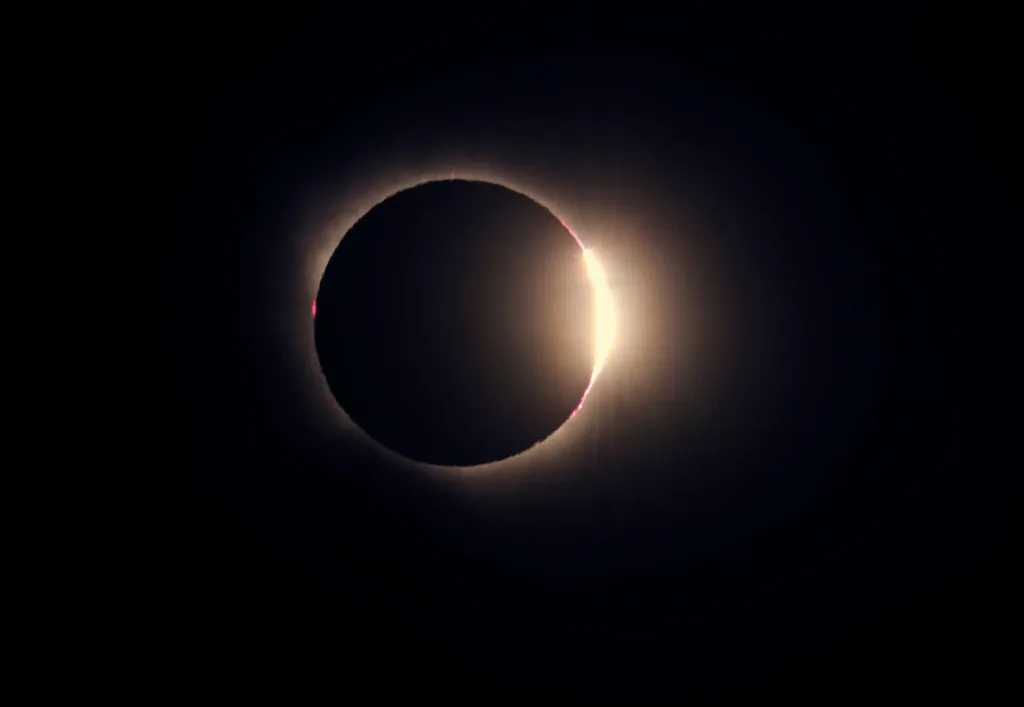
Following the partial lunar eclipse on 28 August 2026, the next notable solar event will take place on 2 August 2027. Globally, it will be a total eclipse, but Cyprus lies outside the path of totality: a partial eclipse will be visible from the island. It must not be advertised here as a total eclipse solely on the basis of the global event’s name.
NASA indicates the path of totality as passing through parts of Spain, North Africa and the Middle East; for Cyprus, local conditions are calculated separately. The times and percentage of coverage vary between Paphos, Limassol, Larnaca and Nicosia. Before travelling, check the latest calculations for your chosen city.
It is safe to observe a lunar eclipse with the naked eye or through optical instruments. A solar eclipse is not: even a partially eclipsed Sun retains a dangerous level of brightness. Ordinary sunglasses, tinted glass, film and a mobile phone camera do not act as filters. You will need certified equipment or a projection method.
The Perseids and other meteor showers
The International Meteor Organisation indicated for 2026 that the Perseids would be active from 17 July to 24 August, peaking on 13 August, with a theoretical maximum rate of up to 100 meteors per hour. This is not a guarantee for any single observer: cloud cover, the Moon, light pollution and limited visibility will reduce the number.
The radiant of the Perseids lies in the constellation Perseus, but there is no need to look directly at it: long trails are more noticeable off to the side. Allow your eyes at least 20 minutes to adjust to the darkness, put away any bright screens and lie down so that you can see a large section of the sky. Binoculars narrow the field of view and usually get in the way when watching meteors.
Check the calendar anew each year. The peak date is close to that in August, but the exact time and the moon’s influence vary. In autumn, the Orionids are visible, and the Geminids later in the year; for each shower, check the official IMO calendar rather than simply copying last year’s date.
Where to observe on the island
Look for an open horizon away from direct streetlights, but do not drive onto closed forest roads or private property. It is darker in the Troodos Mountains, but night-time temperatures are lower, and there may be wind, fog and seasonal restrictions. Access is easier on the coast, but the towns are brighter and the air is more humid.
Reconnaissance the spot during the day: check for a safe place to park, a level path, mobile coverage and authorised access. Do not set up a tripod on the carriageway and do not use a red light near the driver. Let a friend or family member know your route, and take water, a warm layer of clothing and a fully charged mobile phone.
Kition Observatory holds public viewing sessions according to a published schedule and combines telescope viewing with talks. Public events are ideal for beginners, but they are not automatically scheduled for every eclipse or solar maximum. Check with the organiser regarding registration, the language of the programme and the weather.
Safety during solar observations
Never look at the Sun through binoculars, a telescope or a telephoto lens without a solar filter specially fitted in front of the lens. The optics concentrate the radiation and can damage your eyes instantly. A filter attached to the eyepiece is dangerous because it heats up and may shatter.
Check solar eclipse glasses for scratches and use them according to the instructions. Put them on first, then look at the Sun; look away until you have taken them off. An adult should assist children. Protect the camera with a separate, suitable filter: wearing the glasses does not protect the sensor or your eyes when looking through the optical viewfinder.
A safe alternative is projection through a hole or an optical device set up by a specialist so that no one looks directly into it. If there is any doubt about the origin of a filter, do not use it. Pain is not a reliable warning sign: damage to the retina can occur without any immediate sensation.
Night-time etiquette and photography
A dim red light is less disruptive to the eyes’ adaptation to darkness, but it should still be directed downwards. Do not shine a light on people, animals or other people’s equipment without their consent. In nature reserves, do not stray from the path, do not leave litter behind and do not play loud music: darkness does not override the park’s rules.
For your first shot, all you need is a sturdy tripod, a wide-angle lens and manual focus on a bright star. Check the exposure using the histogram, not the brightness of the screen. Long exposures capture the movement of the stars; for star points, reduce the exposure time or use panning.
Do not promise that a photograph will match the visual experience of the naked eye: the camera accumulates light and renders colour differently. In the caption, specify the location, time, lens and post-processing. Mark composite images or superimposed eclipse phases so that the reader does not mistake them for a single moment.
Observer’s checklist
A week in advance, check visibility from Cyprus, the phase of the Moon, the time and the observation site. A day in advance, check the weather, access and fire risk. Before setting off, charge your devices, download a map, inform someone of your route and take clothing, water, a torch and only tried-and-tested safety equipment.
Once there, switch off any unnecessary lights, allow your eyes to adjust and keep a clear path to your car. For the Sun, fit a filter before pointing the telescope; for meteors, set aside the optics. If it is cloudy, do not risk travelling to a remote or obscured location just for a brief clearing.
The calendar on this page explains the method and provides the nearest reference points, but it is not a fixed schedule. The dates are verified below; annual meteor forecasts and local eclipse conditions are updated via NASA, the IMO and the organisers in Cyprus.
Continue planning
- Hiking and nature trails in Cyprus
- History of Cyprus: a guide to the periods
- Archaeology and UNESCO heritage in Cyprus