Cypriot Mythology: Places, Legends and Archaeological Findings
Aphrodite, Petra tou Romiou, Kouklia and the mosaics of Paphos: where cultural memory is evident and how to distinguish legend from archaeological discovery.
Checked: 27 September 2026.
Cypriot mythology and historical traces
Myths help us to interpret the art and cultural landscape of Cyprus, but they are no substitute for archaeology. The story of Aphrodite at the Petra tou Romiou rock, the depictions of gods in the mosaics of Paphos, and the remains of the sanctuary at Kouklia represent different types of evidence. One describes a legend, another a work of art, and the third a physical monument.
It is useful for the traveller to ask two questions: what does the source tell us about people’s beliefs, and what can be observed at the site today? An ancient depiction confirms that the subject matter was familiar to both the artist and the viewers; it does not prove that the events of the myth actually took place.
The official ‘Aphrodite’ route by Visit Cyprus links several regions of the island. This is a themed guide, not a claim that every site dates from the same period. Before you travel, choose one or two sections and check their current opening hours; the historical context and practical circumstances require different sources of information.
Aphrodite in cultural memory
Aphrodite occupies a prominent place in the image of Cyprus. Ancient texts, depictions and later travellers’ accounts link the goddess to the island in various ways. When an official source states ‘according to legend’, bear this caveat in mind. There is no need to treat the beautiful myth of her birth from sea foam as a fact confirmed by archaeological excavations.
Archaeological evidence of the worship of Aphrodite shows that the cult was significant to societies of the past. UNESCO describes Paphos’s connection with this cult as part of the value of the World Heritage site. But the goddess herself belongs to the world of mythology; the material finds relate to the actions of the people who built the sanctuaries and created the artefacts.
When visiting museums, compare the captions for exhibits: the date, place of discovery, material and interpretation may vary. A depiction of a female figure cannot automatically be labelled as Aphrodite without attribution. If the museum’s caption is cautious, the tour should remain cautious too. In this way, the tour becomes a means of learning about the culture, rather than gathering unconfirmed ‘evidence’ for a legend.
Petra tou Romiou: a place steeped in legend
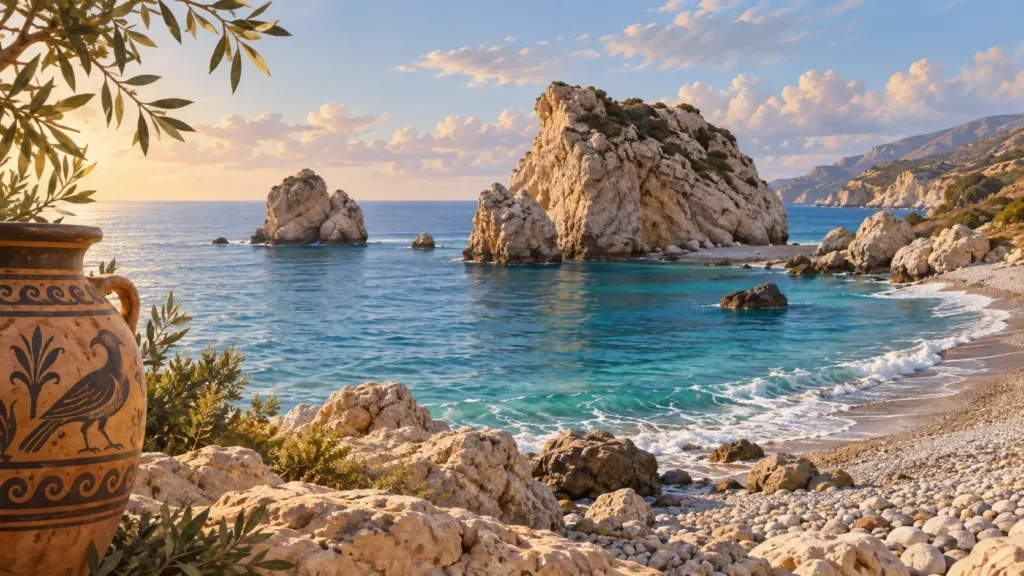
Petra tou Romiou, known as Aphrodite’s Rock, is associated with the story of her birth. Visit Cyprus describes this connection as a legend. The rock and the shoreline exist in physical reality, whilst the myth explains the cultural significance of the landscape. Visitors can see the place described in the story, but not the ‘exact spot’ where the event took place in a historical sense.
There are other legendary explanations for the name ‘Petro-tu-Romiu’, including the legend of Digenis Akrites. Different accounts may coexist in local memory. One should not single out any one of them as the established historical origin of the name without linguistic and documentary research. Make it clear that this is a matter of tradition, and allow the reader to distinguish between the different versions.
The coast is an open, natural environment, not a museum exhibition. Before stopping, check the car park, access to the shore, sea conditions and the weather. Just because there is a tourist route does not mean it is safe to swim on any given day. For people with reduced mobility, the terrain and the approach to the water may be more important than the distance from the road.
Palepafos and the sanctuary at Kouklia
Paleopaphos, in the Kouklia area, is one of the key sites associated with the cult of Aphrodite. In the UNESCO description, it forms part of the ‘Paphos’ World Heritage Site alongside the components of Nea Paphos. One can speak of it as a place of worship and a site of archaeological remains, without claiming that direct evidence of the mythical event has survived.
As you explore the site, look for clues to its dating and the different phases of its use. The sanctuary has not remained unchanged over the centuries: the archaeological strata reflect different periods and practices. If a reconstruction is shown on the plan, it must be distinguished from the surviving wall. Explanations provided by the Department of Antiquities and UNESCO help to maintain this distinction.
Koukli requires a separate trip from central Paphos. Do not try to fit it in with a large number of other places in a single short day without taking travel time into account. Check opening times, ticket prices, the accessibility of the paths and the temperature before your visit. If you’re only interested in the mythological story, the museum exhibition and the official route can serve as a useful introduction.
The Mosaics of Nea Paphos
The mosaics of Nea Pafos depict scenes featuring the gods and heroes of the ancient world. UNESCO recognises the artistic and historical value of these works as part of the protected site. The mosaics reflect the artistic practices and cultural horizons of their time; their characters and scenes must be interpreted on the basis of specific evidence, rather than by conjecture.
Whilst there, take note of the position of the floor, the condition of the image and the archaeologists’ explanation. A photograph of a single figure does not show where it was located or what part of the composition it formed. The museum or an information panel helps to link the subject matter to the building’s layout, the date and the history of the artwork’s preservation.
Not all of Paphos’s monuments are included in the UNESCO World Heritage List in the same way, and mythological motifs can also be found outside the protected boundaries. You can check whether a particular site forms part of the World Heritage Site by consulting the official UNESCO map.
How to plan a themed itinerary
To get started, compare these three types of sites: the natural landmark of Petra tou Romiou, the religious monument at Kouklia, and the mosaics of Paphos. They are linked by the stories of Aphrodite, but differ in terms of their date, the nature of their origins and how they can be visited. The itinerary does not have to include all these sites; the choice depends on the time available and your interests.
Start with an official map and break your trip down by area. Visiting an archaeological site takes longer than stopping at a viewpoint, and the distance between them can be considerable. Bear in mind the sun, water, footwear and the site’s opening hours. Don’t stray from the authorised paths just to get that ‘picture-perfect’ photo.
If you’re travelling with children, you could ask them to compare the myth depicted in the mosaic with the modern sculpture, explaining the difference between the ancient artwork and the later interpretation. If you’re interested in research, make a note of the section number, the period and a reference to the official catalogue. That way, every subsequent account will be linked to a verifiable source.
Where does legend end and evidence begin?
Fact: Archaeological sites associated with the cult of Aphrodite and ancient depictions of mythological scenes have been preserved in Cyprus. Interpretation: Researchers explain their role in past society. Legend: The goddess emerged from the sea foam at a specific location. These levels can be described side by side, provided the nature of each statement is clearly identified.
Be wary of claims that a stone, water or ritual has miraculous powers. Such claims are not endorsed by UNESCO or the Department of Antiquities. The cultural significance of the site is interesting enough in its own right.
The sources for this page were verified on 27 September 2026: the official Aphrodite Cultural Route from Visit Cyprus, the Kouklia information sheet, and the description of the Paphos site in the UNESCO World Heritage List. Please check the visiting arrangements for these sites again before travelling. Mythology becomes easier to understand when you can see the monument, a museum caption and an honest acknowledgement of the limits of our knowledge right there alongside it.
Continue planning
- Paphos museums: finds, collections and links to archaeological sites
- The Cyprus Railway: the route and the museum in Evrychou
- Cyprus in 1974: a chronology and primary sources