The Cyprus Railway: the route and the museum in Evrychou
The history of the Cyprus Government Railway, the line from 1905 to 1951, and the surviving station at Evrychou: what can be seen today.
Checked: 27 September 2026.
Was there a railway in Cyprus?
There was indeed a Cyprus Government Railway in Cyprus — a railway dating from the British colonial period. According to the Department of Antiquities of the Republic of Cyprus, it operated from 1905 to 1951. Today, there are no trains running on this line; travellers can explore the history of the route and the surviving sites, most notably the museum at the former Evrychou station.
The term ‘government’ refers to the line’s construction during the colonial era, not to the Republic of Cyprus’s current transport network. There is no need to describe it as a modern passenger service or to promise a journey along historic tracks. The museum displays documents, models and artefacts; the reconstructed section of track serves as an exhibit.
Before your visit, please check the museum’s own website for the latest information.
The route of the historic line
The Department of Antiquities describes the main route as running from Famagusta in the east, via Nicosia, to Morphou in the west. The third section ran from Morphou to Evrychou. This is a generalised diagram: it is not possible to mark every stop along the way, the distance and the journey time on it without a separate source. Historical documents are required for a detailed map.
The line connected different parts of the island during a particular period, when methods of transporting people and goods differed from those of today. The history of the railway is linked to the economy, governance and the transformation of towns, but a single route map does not account for all the reasons behind its construction and closure. Attribute specific decisions to documents from that era.
Some of the former sites are located in areas that today’s tourists cannot easily reach via the imagined old route. Do not offer to ‘travel the entire route’ as a standard tour without checking modern borders and roads. It is safer to select accessible museum sites and to separate historical geography from the practical itinerary of the trip.
Evrychou: the station has become a museum
The Cyprus Railway Museum is situated in the old station building near the village of Evrychou in the Troodos Mountains. The Department of Antiquities reports that the main station building has been preserved and restored. It houses original documents, drawings, photographs and artefacts relating to the railway, as well as models of stations and rolling stock.
The platform and part of the track near the building have been restored using old rails. Items related to the line and a carriage are on display in the courtyard; it is best to confirm the exact contents of the open-air exhibition on the day of your visit. The reconstructed platform does not signify the resumption of train services. It helps visitors to appreciate the scale of the station and the layout of the area.
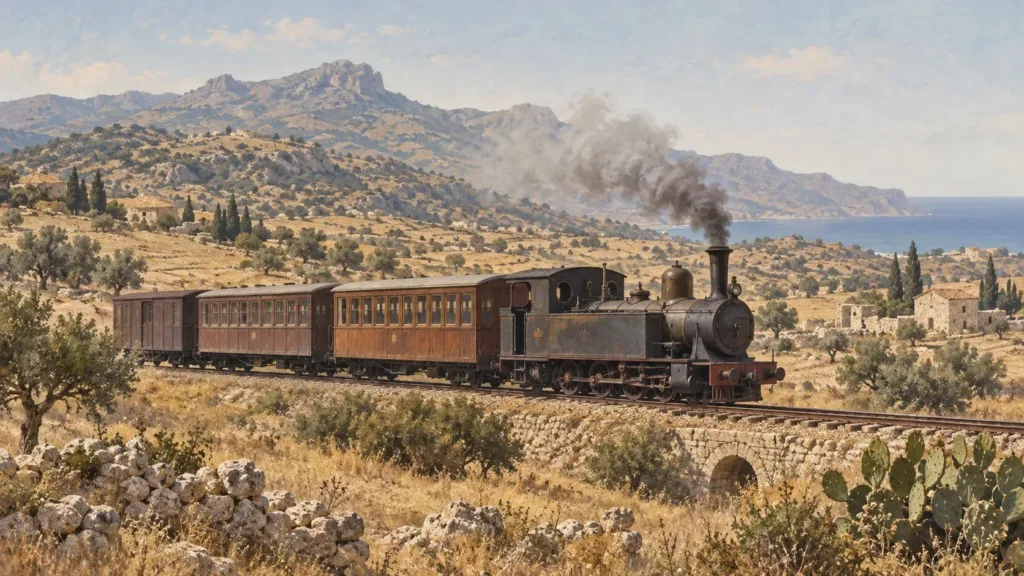
The museum captions make it possible to distinguish between original features and those that have been restored at a later date. This is particularly important for photographs: a shot of a modern platform should not be presented as the station in its original state from 1905. If an illustration of a modern train is used in the overview, it should be labelled as illustrative rather than as an image of the Cyprus Government Railway.
Documents, models and photographs
A photograph of a historic train formation shows the appearance of a carriage or a station at a specific moment, but not the entire period during which the line was in operation. The date, photographer and location of the photograph help to avoid errors. Models in a museum provide a convenient overview, but they should not be mistaken for surviving rolling stock without further explanation. Check the museum’s description for each item.
Drawings and diagrams help to understand the track layout and the organisation of the station. If you are comparing an old map with a modern one, bear in mind that the names of towns and roads may have changed. Do not trace a line onto a modern map with false precision if the historical source indicates only an approximate direction.
For a family visit, you can choose from three types of exhibits — a document, a model and an artefact from the station — and discuss what each one reveals about the past. A strong argument regarding the reasons for the line’s closure requires documents, not just a nostalgic caption beneath a photograph.
How to get there and plan your visit
Evrychou is situated away from the coastal towns, so it is best to include the museum as part of a separate trip to the Troodos Mountains. The official map from the Department of Antiquities shows landmarks to help you find the approach and local signposts. Before setting off, check the current route on your sat-nav and the road conditions, particularly in bad weather. The historic railway tracks are no longer used for modern transport links.
Please check opening times, public holidays, tickets and accessibility with the museum before you set off. The official information sheet describes access to some of the premises and the courtyard, but this does not guarantee the same conditions for every visitor. If you require wheelchair access, assistance with parking or a guided tour in a specific language, please contact the museum directly with your specific enquiry.
Allow time for a stop in the village and the return journey; don’t count on a ‘quick photo by the carriage’ being the whole experience. In mountainous areas, the season and weather can significantly affect the comfort of your journey. For a long journey, take some water with you and decide in advance which other places you’ll visit, so that the museum doesn’t end up being a last-minute stop just before closing time.
What has been preserved, and what has been lost
The mere fact that a museum exists does not mean that the entire historical infrastructure has been preserved. The Department of Antiquities specifically mentions the restored station building at Evrychou and the reconstructed section of the platform and tracks. Individual details are required for other stations and sections of the route; the description of Evrychou cannot be applied to every settlement along the old line.
A historical route can be explored through maps, photographs and memorial sites, but today’s visitor sees only fragments. It is better to state clearly what has not survived or been confirmed than to paint a picture of a continuous ‘museum trail’. If new research is available, please verify the dates and status of the sites before updating the article.
Railway heritage is fascinating even without a working train: it illustrates a stage in the development of transport and ways of preserving history. Compare the photographs to determine whether they show an authentic Cypriot train, a later reconstruction or an artistic illustration. These images help us to visualise the past, but they have varying value as historical evidence.
Sources and checks before travelling
The main source for dates, the route and the museum’s collection is the Cyprus Railway Museum’s entry in the Department of Antiquities’ catalogue. Visit Cyprus confirms the museum’s location in Evrychou and provides further information on its historical context. For specific historical details and photographs, one should refer to an attributed museum catalogue rather than unsourced reposts.
Before setting off, double-check the museum’s opening hours, the route by car, access information and the weather forecast. Holiday exceptions are particularly important. If the information in the tourist guide and that provided by the museum itself differ, please check with the museum. The current timetable is not a permanent historical record of the route.
The sources for this page were verified on 27 September 2026. They provide a reliable basis for discussing the period 1905–1951, the route of the line and the surviving museum in Evrychou; more detailed technical or political conclusions require separate documents. The itinerary is based on today’s roads, whilst the history of the trains remains the focus of the exhibition.
Continue planning
- Museums in Nicosia: what to choose and how to plan your visit
- Cypriot Mythology: Places, Legends and Archaeological Findings
- Cyprus in 1974: a chronology and primary sources
Thank you for posting this informative post about the railway history of Cyprus!
are there any books I can purchase from Cyprus about its Railway History please?
My father grew up in Alona Village near the Railway Line.