Damp and mould in homes in Cyprus: causes and solutions
How can one identify the source of damp and organise its rectification without relying on guesswork?
Checked: 4 October 2026.
First, find the source of the damp
If you have damp or mould in your home, first establish where the moisture is coming from: leaks, condensation, problems with external structures or building services all require different solutions. Simply painting over the stain without addressing the cause often only provides a temporary fix. Make a note of your observations and arrange for an inspection if the problem recurs.
The WHO links damp and mould in buildings to an increased risk of a number of respiratory problems and recommends preventing persistent damp and mould growth. The appearance or colour of a stain does not allow for a medical diagnosis to be made. If you experience any symptoms, consult a doctor, especially if someone in the household has asthma or a weakened immune system.
This guide helps to organise the assessment process and communication between the landlord and the tenant. It does not determine who is at fault based on photographs, nor does it replace a building inspection. The cause of the defect, the obligations of the parties and the safe method of rectification must be determined separately, rather than inferred from the word ‘mould’ in the message.
What to note down before the examination
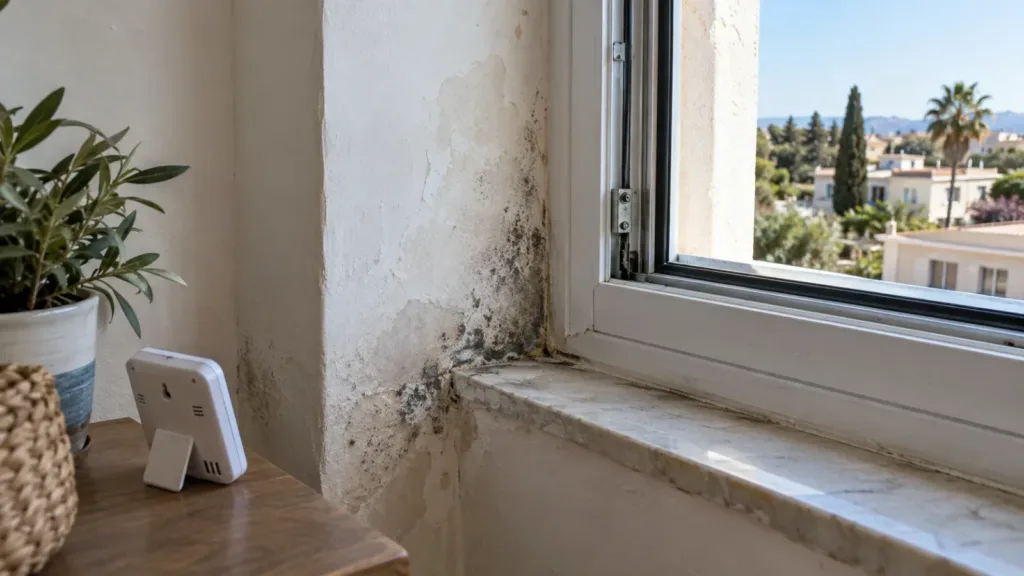
Take photographs of the room as a whole and the damaged area; note the date, any odours, signs of water and the time the damage first appeared. Indicate whether the change is related to rain, the air conditioning, a shower or the room having been closed for a prolonged period. Do not clean up all traces before documenting them, unless this interferes with urgent safety measures.
Note down the location of the stain: near a window, on an external wall, near the ceiling, floor or a pipe. It is the progression that matters, not just a single close-up photograph. If the stain is growing, take photographs from the same angle; do not edit the colour or contrast of the original images, as these are intended for discussing the causes and liability.
Humidity and temperature readings can supplement your observations, but a single household device cannot determine the condition of the entire structure. Take into account the location of the measurement and the conditions in the room. Do not treat a random reading as definitive proof that the occupants are ventilating the room incorrectly or that the wall is definitely leaking.
Condensation and leaks are different
Condensation forms when moist air comes into contact with a sufficiently cold surface. It can appear near windows and in corners that are poorly heated. A leak is caused by water entering through the building structure or a system. As the marks look similar on the surface, it is not possible to decide on a repair without checking the possible sources.
Inspect any accessible sections of pipework, the air-conditioning drain, window joints and marks on the ceiling, without breaking into the walls yourself. For the roof, façade, concealed pipework or the central system, you will need a qualified specialist. The range of possible causes differs between a top-floor flat and a ground-floor property.
Ask the specialist to describe the inspection method, the signs identified and any remaining uncertainties. If the cause is only a hypothesis, arrange for further checks. Do not accept the sale of moisture-proof paint or a new dehumidifier as technical confirmation that the building’s problem has already been diagnosed and rectified.
What changes can be made in everyday life?
Ensure a sensible ventilation regime, the use of an extractor fan and the timely removal of household moisture. Check that the ventilation systems are in good working order and that their vents are not blocked. These measures help to control conditions, but are no substitute for repairing a leaking pipe or a defect in the external structure.
Make sure there is sufficient space around large pieces of furniture placed against external walls, and do not obstruct the necessary air circulation. If you are using a dehumidifier, follow the instructions and ensure it is connected to the mains safely. Compare the results over time rather than declaring the problem solved as soon as the odour has diminished.
Do not apply home cleaning tips to large areas of damage, hidden cavities or rooms occupied by vulnerable residents. Ask a professional to assess the scope of the work and the necessary safety measures. Do not mix household chemicals, and do not attempt to treat inaccessible areas yourself simply to achieve a quick cosmetic result.
Owner and tenant
The tenant should promptly notify the landlord of the problem in writing, stating the address, location, date, photographs and how it affects the use of the room. Suggest a time for an inspection and ask for someone to be appointed to assess the issue. A verbal discussion can be followed up with a brief message to confirm the overall plan of action and deadlines.
The owner should establish the cause and review their obligations under the contract and applicable regulations, rather than automatically blaming the residents. If necessary, involve the management committee if the building’s structure or services are affected. Allocating costs amongst the parties requires documentation of the defect and a legal assessment.
Do not stop paying rent or arrange for major works to be carried out with a view to claiming a deduction as a blanket measure. Before taking such action, check your tenancy agreement and seek legal advice. In the event of an immediate danger, prioritise the safety of people and property, whilst separately documenting the notification, the call to the emergency services and any necessary expenses.
How to accept that the problem has been resolved
The estimate should set out the steps involved in eliminating the source of the water, drying out the area, carrying out the necessary restoration work and checking the results. Note down who is responsible for each stage and what conditions are required for the property to return to normal use. New finishes do not prove that the moisture content of the structure has fallen to a suitable level.
Ask for photographs of the defect identified and the repairs carried out, the contractor’s documentation and any recommendations for use. Agree on a date for a follow-up inspection and the circumstances under which you should contact them again. If the problem was caused by rain or the operation of the equipment, an inspection carried out only under different conditions may be of limited value.
If the problem reoccurs, do not start an endless cycle of cleaning and painting. Compare the new symptoms with the previous findings and check whether there might be another source. In cases of doubt, an independent technical survey is useful, providing a clear description of the structures inspected and any areas that are inaccessible.
When you need extra help
In the event of severe flooding, damaged electrical systems, a risk of collapse or any other hazardous situation, contact the appropriate emergency services and avoid the danger zone. Do not delay seeking help whilst trying to establish who is responsible for the site. Financial and contractual matters can be documented once initial safety measures have been taken.
If a dispute over the suitability of the accommodation cannot be resolved, gather the tenancy agreement, the move-in certificate, photographs, expert reports and correspondence for your solicitor. Share medical information only with your doctor and those directly involved in the proceedings. A technical report on damp does not, in itself, prove that it is the cause of all health complaints.
A successful resolution means that the cause has been identified, the necessary work has been carried out, and a sustainable result has been achieved. Living conditions and building defects should be assessed together. A doctor deals with health issues, an engineer with structures and systems, and a lawyer with contractual obligations; a single answer does not replace all three assessments.
Continue planning
- Buying property in Cyprus
- Long-term home rental in Cyprus
- Setting up utilities in Cyprus after moving