Home renovations in Cyprus: contractor, quotation and handover
How do you determine the scope of the repairs, check the contractor’s credentials and accept the work carried out?
Checked: 4 October 2026.
Determine the outcome of the repair
When renovating a property in Cyprus, start by setting out the desired outcome, carrying out a survey and clearly defining the scope of work. Then check the contractor’s credentials and compare quotes. An agreement to ‘make everything look nice’ does not specify the materials, the quality of concealed work, the deadlines or the acceptance criteria against which you can verify that the work has been carried out correctly.
Separate finishing works, plumbing, electrical works, structural works and layout alterations. Each has different requirements in terms of expertise and approvals. Before carrying out any work on walls, shared services, the façade or the roof, check whether a project plan, permits and the owners’ consent are required; ownership of a flat does not automatically grant permission for any renovation work.
Ask the specialist to describe the condition of the substrates and any potential hidden problems before agreeing on a price. If the survey is limited in scope, make this clear in writing. A preliminary estimate without opening up concealed areas may require clarification, but any changes must be agreed in advance and must not result in an unlimited increase in cost.
Check the contractor
Please confirm the legal name of the contracting party, their contact details, registration information and who is responsible for the specific works. For construction and engineering contracting projects, the official portal provides details on the contractor’s registration and annual licence. Check the applicability, category and class of authorisation in relation to the scope of your project, rather than just the company name.
The areas of expertise of architects, engineers, contractors and specialist contractors vary. The involvement of one specialist does not replace the necessary authorisation of another. Ask to see the relevant documentation and establish who is in charge of the project, supervision and the required inspections; neighbours’ recommendations are useful, but do not confirm authorisation.
Take a look at examples of comparable completed projects and enquire about the possibility of speaking to the client, with their consent. Assess not only the photographs, but also adherence to deadlines, the rectification of defects and the clarity of the invoices. If the contract proposes that another person sign it, check the link between the promises, the contractor and liability.
A cost estimate that can be compared
In the quotation, specify the quantities, units, materials, equipment models, site preparation and method of execution. List the following separately: dismantling, waste removal, site protection and repair of damage. Two quotations with the same total amount may involve completely different outcomes and varying levels of preparation.
Please specify any taxes, allowances, exclusions and the cost of any additional work that may be required. For materials, clarify who is responsible for purchasing, accepting delivery and dealing with any defects. If the chosen model is unavailable, any replacement must be agreed upon in terms of specifications and price, rather than being decided automatically at the fitter’s discretion.
Compare quotes based on a single list of works and note any discrepancies in a separate table. A low price that does not include preparation, inspection of engineering systems and rubbish removal may turn out to be incomplete. If there is a significant discrepancy, ask for an explanation of the scope of work, rather than assuming it is due to the contractor’s lack of integrity.
Contract and payments by stage
Set out the parties involved, the address, the project or scope of works, the deadlines, access arrangements, the cost and the acceptance criteria. Attach the agreed quotation and the procedure for making written amendments. Clarify how delays in delivery, defects in the substrate and the inability to carry out part of the works without new authorisation are to be resolved.
Link payments to clear milestones and verifiable outcomes. The amount of the advance payment and the possibility of withholding part of the payment are agreed in the contract; there is no standard percentage applicable to all repairs. Obtain documentation for each payment and verify the payment details via a trusted channel before making the transfer.
Set out the warranty terms, the timeframes for rectifying defects and the procedure for making a claim separately. Do not confuse the manufacturer’s warranty on the appliance with liability for its installation. For large-scale or complex projects, it is advisable to have the contract reviewed by a lawyer and to arrange for independent technical supervision, particularly if the client does not live near the site.
Monitoring during the course of the work
Agree on access to the property, working hours, protection of furniture and communal areas, and relations with neighbours. Ask the contractor to ensure that work is carried out safely and that waste is disposed of properly. Building regulations and the requirements of the relevant authorities must be complied with, regardless of whether they are specified in detail in the brief estimate.
Check concealed works before the finishing work is completed: ensure they comply with the project specifications, that the required tests have been carried out, and that photographs are available. These should be assessed by a qualified professional, rather than by the client simply judging by the appearance of the cable or pipe. Keep a record of the documents and the sequence of stages so that it is clear later on exactly what work was carried out.
Record any significant change, stating the reason, the new cost, the timeframe and the impact on other works. Do not regard a message such as ‘we need a bit more’ as sufficient approval. If a risk to structures or systems is identified, halt the affected work and obtain a specialist’s decision before continuing.
Acceptance based on the list
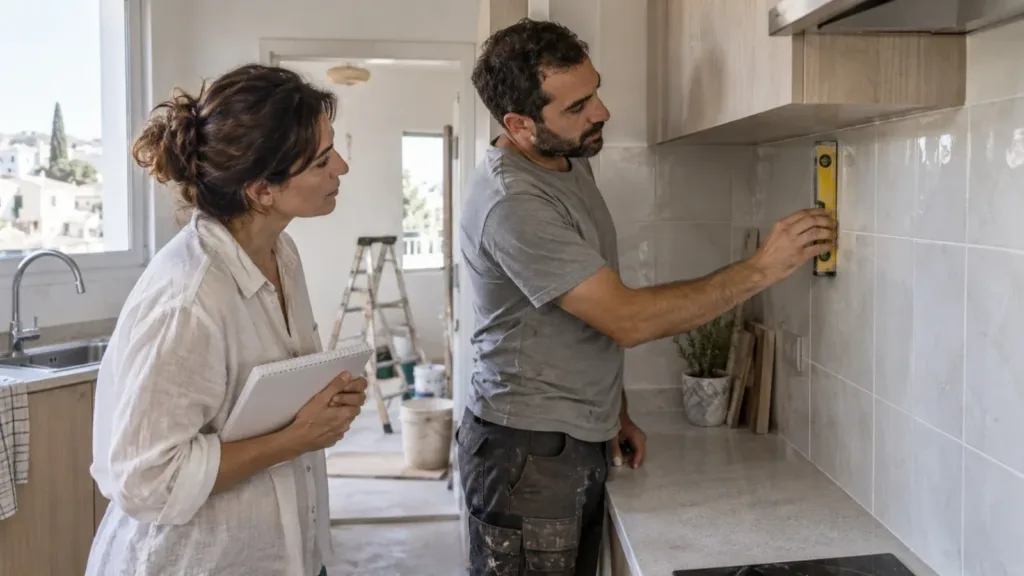
Walk through the premises with the contract and the quotation, checking each agreed item. Note the finish, the completeness of the equipment, the accessibility of maintenance points and the documentation for the systems. Functional testing must be carried out safely; do not tamper with electrical circuits or equipment safety features for the sake of a demonstration.
Draw up a report listing the items that have been completed and those that remain outstanding, along with any defects, photographs, deadlines for rectification and the person responsible. If some of the systems have not yet been tested, state this clearly. The signing of the report by the parties does not replace official approval or any other document from the competent authority where this is required for the project.
Obtain the instructions, warranties, model information, results of the prescribed tests and installation materials. Find out who to contact in the event of a fault and what actions are permitted prior to an inspection. Keep this pack together with your contract; the fitter’s verbal explanation may no longer be available once the repair work is complete.
Defects and final settlement
If you discover a problem, send the contractor a written description, referring to the specific clause in the contract and suggesting an inspection. Keep copies of any photographs and replies. Cosmetic defects, hidden faults and unauthorised replacement of materials each require different forms of evidence, and a general statement such as ‘everything is wrong’ does not help to resolve the issue.
Do not destroy the results of work that is in dispute, and do not order a complete overhaul without proper documentation, unless there is an immediate danger. If people are at risk, ensure their safety first and call the relevant authorities. Check the contractual notification procedure and the legal consequences of replacing the contractor before making any further financial decisions.
Finalise the settlement for the agreed works, alterations and the final account, once you have received confirmation of payments and corrections. In the event of a significant dispute, forward the contract, the quotation, the certificates, the reports and the correspondence to a solicitor. A well-organised renovation yields clear results, with documents organised by system and verifiable obligations, rather than just a new finish.
Continue planning
- Buying property in Cyprus
- Long-term home rental in Cyprus
- Setting up utilities in Cyprus after moving