School transport in Cyprus: routes and safety
How to check eligibility for the school bus, the route area, the application, the bus stop and the handover of the child to an adult.
Checked: 27 September 2026.
Start with the school and the level of education
School bus services in Cyprus are not a single, standardised service for all children. State primary schools, state secondary schools and private schools may have different routes, operators, payment terms and application procedures.
General articles about public transport help you understand the city bus network, but they do not answer the question of who meets a child at the school bus stop. Do not simply apply the standard timetable for a regular passenger route to a school bus service. Ask for the current route map, stops, timings, the operator’s contact details and the rules for handing over children in writing.
The 2026–2027 ministerial forms for the transport of state secondary school pupils link entitlement to a specific scheme to the educational district and refer parents to the local operator or school for route details. These forms do not guarantee the same conditions for primary or private schools. It is precisely this distinction that must be borne in mind when comparing options.
Route rights and application
Please check with the school to see if there is a school bus service for your address and year group, whether your child falls within the designated catchment area, and what documents are required. The presence of a bus at the school gates does not guarantee a free seat at the relevant bus stop. Ask who makes the decision on the application and when the family will receive confirmation of the route.
School catchment areas may be reviewed, and routes may change before the start of the school year. If you are moving house, check your new address before signing the tenancy agreement or changing schools. Do not use a friend’s address just to get a bus: the school and the transport operator need accurate details to be able to drop your child off and contact the family in the event of an emergency.
Application and payment are separate stages. Some schemes may require a form from the school, whilst others may require a card or a contract with the operator; you should check the exact conditions with the relevant organisation. Keep a copy of the application, the decision and the instructions for the first day, especially if your child is starting to attend partway through the school year.
Bus stop, time and safe route
Walk the route to the bus stop with your child at the time the bus usually runs: the pavement, pedestrian crossings, lighting, shade and traffic are more important than the distance shown on a map. Find out the exact boarding point on both sides of the road and who is responsible for the child until the bus arrives. If the bus stop is inconvenient or dangerous, discuss an alternative with the school and the transport operator before the journeys begin.
Check how long the journey takes in the morning and after school, including waiting times. Timetables may change due to traffic, the weather and school events. Agree on who your child should ring if they are delayed and how the family will find out if a journey is cancelled; don’t rely on messages in the group chat always arriving on time.
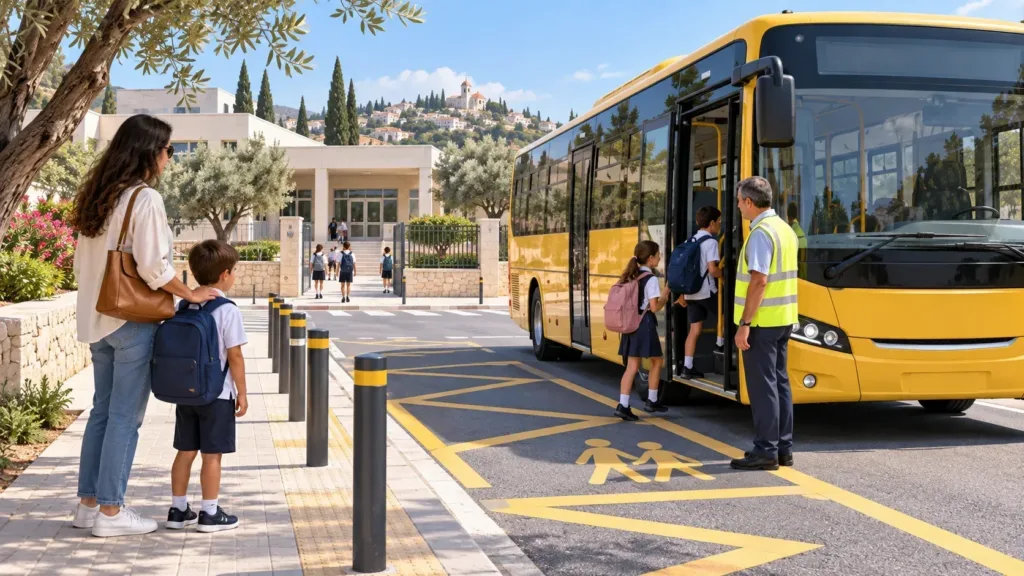
The youngest child needs a clear procedure for being handed over to an adult at school and at home. Ask whether there is a supervisor, how attendance is recorded, who is authorised to collect the child, and what the driver does if there is no one at the bus stop. Do not assume there is a one-size-fits-all rule: obtain the specific instructions from your school or transport operator.
On board the bus and when the route changes
Discuss some simple rules with your child: wait in a safe place, board without pushing or shoving, follow the instructions of a responsible adult, do not distract the driver, and let them know if you’ve missed your stop. The rules regarding seatbelts and boarding depend on the type of transport used; check the equipment and requirements with the operator, rather than relying on a photograph of the bus on the website.
Ask where to turn in the event of a dispute between passengers, lost property, a breakdown or dangerous behaviour. Record the facts without publicly sharing photos of children. The designated channel should be available during journey times, not just via the school’s general reception, which is open after arrival.
A sightseeing or one-off coach service may be operated by a different contractor and run to a different timetable. Do not assume that a signed booking form for a daily service covers all journeys and additional charges. Please request separate information regarding the meeting point, tour guides and return times for each event.
Costs, private schools and alternatives
For private schools, transport is often included as a separate item in the contract. Ask for the annual price, the zones covered, the procedure for changing the drop-off point, the refund policy in the event of cancellation, and the terms and conditions for school holidays. Advertisements stating ‘transport provided’ do not guarantee that your address will be served. Compare prices alongside journey times and the times at which an adult must drop off and collect the child.
If the school bus service is not suitable, the family may wish to consider using regular public transport or arranging their own journey, taking into account the child’s age and the school’s rules. However, a standard passenger ticket does not automatically include an accompanying adult, and a nearby bus stop does not solve the issue of a safe handover.
For a child with special educational needs, transport may be arranged following an individual decision by a competent committee. The Ministry sets out the circumstances in which free transport is provided when the required school is located outside the child’s local area, based on established criteria.
Day One and change control
Before the first journey, please provide the school and the transport operator with up-to-date contact details for the adults authorised to collect your child, as well as any important information required to ensure their safe transport. Show your child the bus stop and explain what to do if they miss the bus or get off at the wrong stop. Do not share sensitive medical information in the public parents’ chat group.
During the first few days, check that the actual time and place of alighting match the written route. If the service is consistently late or overcrowded, make a note of the specific dates and contact the relevant authority via the specified channel. Do not change your stop based on a verbal agreement with the driver without confirmation from the organisation responsible for the route.
During the holidays, at exam time and when lessons finish early, the timetable may be different. The school should provide the current schedule, but families should also check any notifications in advance. Agree on an alternative way to collect your child if a school bus service is cancelled, so that you do not have to find a solution after the school has closed.
What to check again each academic year
As at the date of source verification, 27 September 2026, the ministerial forms set out the specific arrangements for the 2026–2027 academic year for state secondary schools. For the coming academic year, routes, operators, fares and zones must be checked again with the school and the transport provider. A map saved from last year does not confirm the current bus stop.
To sort out the arrangements for the family, draw up a single sheet listing the following: school, class, address, zone, route, booking, price, time, accompanying adult, handover arrangements and emergency contact details. If there is no answer to any important point, ask for clarification before the first journey. Such a check is more useful than a general statement such as ‘in Cyprus, children are transported by school buses’.
This information does not confirm a specific child’s entitlement to free or paid transport, nor does it supersede the rules of the school or the transport provider. It helps to distinguish between the schemes for different school stages and to check the safety of the route. In the event of a dispute regarding access to the service or special needs, please contact the relevant school and the local authority with your family’s documents.
Continue planning
- Cyprus’s beaches with children: choosing a spot and safety
- Enrolling a child at a state school in Cyprus
- School holidays and childcare in Cyprus