The Cyprus Problem, or ‘Evolution, Turkish-style’
‘Evolution, Turkish-style’ is an inevitable consequence of the interaction between the Turkish (Ottoman) mindset and the Christian environment. The desecrated Hagia Sophia – one of the holiest sites in the Orthodox world, now standing with a crescent on its dome and surrounded by four minarets – is not an isolated case or an exception. It […]
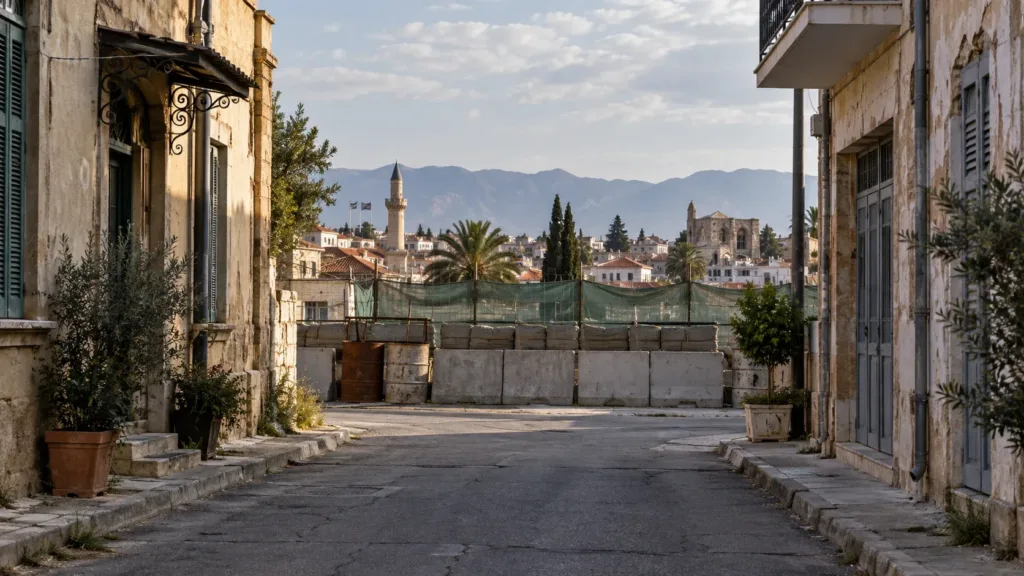
‘Evolution, Turkish-style’ is an inevitable consequence of the interaction between the Turkish (Ottoman) mindset and the Christian environment. The desecrated Hagia Sophia – one of the holiest sites in the Orthodox world, now standing with a crescent on its dome and surrounded by four minarets – is not an isolated case or an exception. It is a pattern that is repeated everywhere. It has also been applied in Cyprus. Just a few days ago, the newly elected President of Cyprus, Nicos Anastasiades, declared his desire – or, more precisely, his top priority – to resolve the issue of the island’s division. The first meetings between the leaders of the two Cypriot communities are due to take place this month. We have written in detail about how the island became divided in 1974.

Illegally occupying 38 per cent of the island, the Turks attempted to establish control over the whole of Cyprus. Kofi Annan decided to assist them in this, drawing up a plan to reunify the island. The Annan Plan restricted the rights of Greek Cypriots to return to their homes, whilst allowing Turkish settlers who had arrived on the island after 1974 to remain on the illegally occupied land. The document was put to a referendum, which took place on 26 April 2004. Unlike the Greek Cypriots, who voted against the plan, the Turkish side supported the proposal by a majority of votes. It is important to note that the Turkish side’s vote included not only Turkish Cypriots but also Turks who had settled on the island after 1974. At the time of the vote, their numbers were twice that of the Turkish Cypriots. It is not difficult to guess where the much-discussed 65 per cent who voted in favour of the Annan Plan came from – they were, first and foremost, Turkish migrants.
A ‘Turkish-style’ evolution turned Cyprus into a bi-communal society 350 years ago: Turks migrated from impoverished regions of Anatolia to Cyprus, resulting in the creation of a new people – the Turkish Cypriots. These processes continued after 1974 and are still ongoing today.

Today, in the occupied part of Cyprus, 20 per cent of the territory is occupied by Turkish military bases, whilst the indigenous Turkish Cypriots (the 17th-century settlers) have become a minority.
In so-called Northern Cyprus (an unrecognised state), the majority of Orthodox churches and monasteries have been destroyed. Fifty-five churches have been converted into mosques, whilst 50 churches and monasteries have been turned into warehouses, hotels, cinemas and public toilets.
Turkish military units are stationed in several monasteries. For example, this fate befell the monastery where the great Cypriot saint, Spiridon of Trimythous, revered throughout the Orthodox world, once served.
Very recently, four icons dating from the 16th century were returned to Cyprus.
The icons, depicting the apostles Peter, Paul, John and Mark, had been illegally removed from Kyrenia (in the northern part of the island) and sold. The relics were later acquired by a collector from the Netherlands, who in 1995 decided to put the icons up for public auction.
 Experts at the auction house considered the documents presented by the seller to be dubious. The Cypriot authorities confirmed that the relics belonged to the Cypriot Orthodox Church.
It should be noted that it was not until 2007 that the Cypriot Church was able to make an official claim to these icons. To do so, changes had to be made to Dutch legislation, which had previously not provided for the return of works of art from private collections to their former owners.
These are just a few of the many examples illustrating ‘Turkish-style evolution’ in action.
Today, speaking at a UN General Assembly conference, the President of Cyprus, Nicos Anastasiades, emphasised the need for a swift resolution to the Cyprus problem and the reunification of the island. One can only hope that the former practising lawyer will have enough common sense and a good memory to take full account of the lessons of history. And the official certainly has plenty to think about.