10 Cypriot dishes: a practical guide to local cuisine
What to order in Cyprus, how meze, souvla, sheftalia, kleftiko and koupepia differ, how to gauge portion sizes and check for allergens – without a ‘best of’ list.
Checked: 13 September 2026.
Not a ranking, but a map for your first taste
Cypriot cuisine varies between home cooking, village fare, city tavernas and coastal restaurants. This list of 10 dishes does not claim to identify the ‘best’ options nor does it promise identical recipes. It helps you interpret the menu, ask questions and organise your orders so that you can sample different cooking techniques, ingredients and styles without wasting food.
Many dish names are familiar from Greek or Middle Eastern cuisine, but the local version has its own combinations and presentation. Don’t argue with the establishment about the ‘one true’ recipe you found online. It’s better to clarify the meat, side dish, cooking method and portion size specifically for today.
Season and location affect availability. A mountain stew and a fish meze serve different purposes, whilst a dessert might be sold in a patisserie rather than a tavern. Choose a few dishes, leave room for shared dishes, and treat the list as a guide rather than a commitment to tick off every item in a single dinner.
1. Meze and 2. halloumi
Meze is a sequence of small shared dishes, rather than a single starter. It can be meat-based, fish-based or a mixed selection, but the exact composition is determined by the establishment. Before ordering, ask about the minimum number of guests, the approximate number of courses, the price per person, and whether drinks are included. For a small group, a full meze can serve as a complete dinner.
Halloumi is a registered Cypriot cheese with a distinctive firm texture. It is served fresh, fried or grilled, sometimes with watermelon, bread or salad. The name of the cheese does not guarantee a light dish: the frying method, oil, salt and portion size all affect the final result.
There’s often a hidden repetition in meze: separately ordered halloumi, sauces and salad may already be included in the set. Show the waiter your entire order before confirming it and ask them to remove any duplicates. This is more practical than choosing from photographs, where the size of the plates isn’t visible.
3. Souvla and 4. Sheftalia
Souvla consists of large pieces of meat, slowly cooked on a spit over charcoal. Souvlaki is usually smaller and cooks more quickly, so don’t assume the names are interchangeable. Specify the type of meat, portion size and side dish; the dish of the day may run out before the evening.
Sheftalia is a seasoned meat mixture, shaped into small portions and traditionally wrapped in a fat net before frying. It is not a standard sausage. If you do not eat certain meats or offal, ask directly: you cannot tell the ingredients just by looking at it once it’s cooked.
Both dishes are often served with pita, potatoes, salad and sauce. Compare not only the price of the dish itself, but also the set. Ordering one portion of meat and several shared vegetable dishes makes for a more varied meal than a separate main course for each guest.
5. Kleftiko and 6. Koupepia
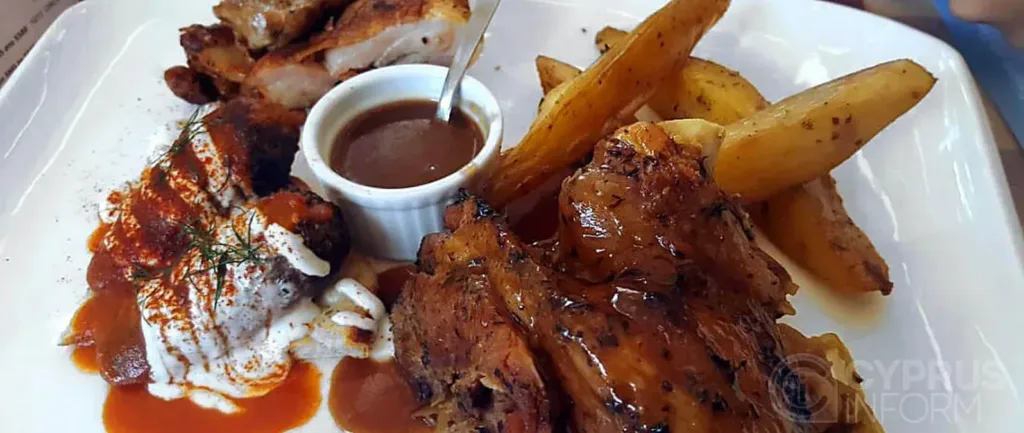
Kleftiko is meat that has been slow-cooked in a closed oven or in a bag until tender. In Cyprus, lamb or goat is most commonly used, but the specific restaurant determines the cut and the accompaniments. Ask about bones and serving times: the dish may be prepared in limited quantities and may not be available every day.
Koupepia are stuffed vine leaves, usually filled with rice, herbs and meat, although a vegetarian version is also available. The appearance does not reveal the ingredients. Check whether there is meat, what stock is used, and whether yoghurt is served. The word ‘vegetarian’ on the menu should refer to the entire recipe, not just the visible filling.
These dishes are ideal for sharing: kleftiko makes for a hearty main course, whilst koupepia come in small portions. But don’t count on standard portion sizes. Ask the waiter to estimate the portion size for your group and order more after the first courses are served, rather than ordering too much in advance.
7. Afelia and 8. stifado
Afelia is pork cooked with wine and coriander. Alcohol is used in the recipe, and we cannot guarantee that it will be completely absent from the finished dish. Anyone who needs to strictly avoid alcohol or pork should choose another dish after speaking to the kitchen.
Stifado is meat slowly braised with plenty of small onions and a spicy sauce. The type of meat varies, so the name alone does not indicate the exact ingredients. The sauce may contain wine and spices, whilst the side dish may be potatoes, rice or bread, depending on the region.
Stews are particularly suitable for a cool evening or a trip to the countryside, but may seem a bit heavy in summer. Ask for a smaller portion and add a fresh salad. If you’re watching your salt, fat or portion sizes for medical reasons, ask for a simple description and don’t rely on the term ‘homemade’.
9. Fish meze and 10. Cypriot sweets
Fish meze is a selection of seafood and fish, not a guarantee of locally caught produce. Ask what is fresh and what is frozen, which varieties are available today, and how the price is calculated. Do not use the restaurant’s proximity to the sea as the sole indicator of a product’s origin or quality.
For dessert, look out for loukoumades, soujoukos, palouze, mahallebi or spoon sweets. These vary by season and location: one dessert is fried to order, another is made with grape juice, and a third is sold in a jar. For your first time, order a few small portions to share.
Sweet treats may contain honey, nuts, sesame seeds, milk, gluten or rose water. The name does not indicate any allergens or the method of production. If you have diabetes or are on another medical diet, check the ingredients and portion sizes with a specialist; this traveller’s guide is no substitute for personalised advice.
Allergens, ordering and the bill
EU regulations require allergen information to be provided for unpackaged food as well. Inform the staff of any allergies before ordering, specify the exact product and ask about the ingredients, sauces, oils and cross-contamination. The phrase ‘no nuts on top’ does not guarantee that the kitchen is safe for those with severe reactions.
Check what’s included in the price: bread, water, side dishes, meze per person and service charges may be calculated differently. Read the menu before ordering and check the bill at the table. If an item is unclear, ask a question calmly; it is better to clarify things transparently than to have a dispute once the food has been cooked.
Order in stages, take only what can be safely kept cool with you, and do not leave cooked meat or fish in the car for long periods. Check seasonal offers and prices on the spot. And look out for current food festivals in the news: this guide explains sustainable dishes, but does not keep a short-term programme of events.