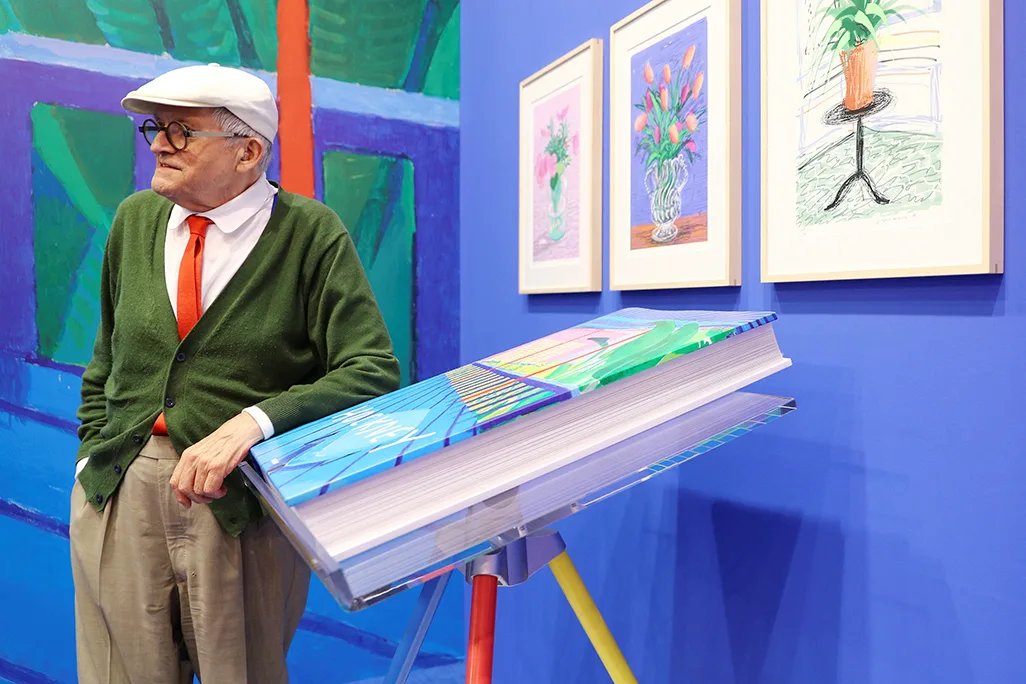
London, United Kingdom. David Hockney, the British painter known for his brightly coloured depictions of California and his role in 20th- and 21st-century art, has died at the age of 88. His publicist Erica Bolton said in a statement that he died on Thursday.
Early life and influences
As a child growing up in northern England, Hockney noticed the sharply defined shadows in Hollywood films featuring Laurel and Hardy.
“Strong shadows meant a lot of sun,” the painter recalled to BBC television in 2009. “So I thought, well, wherever that is, it’s always sunny.”
Move to California
Two decades later, Hockney moved to Los Angeles to immerse himself in that light. His brightly coloured renditions of California later helped make him one of the most celebrated artists of the 20th and 21st centuries.
“I thought people who produced such work must live in colour, so I went in search of it,” he was quoted as saying in a biography by art critic and friend Peter Adam.
“I had spent the first 20 years of my life in the gothic gloom of the North. Here I felt free.”
Public image and early career
At first, Hockney was known almost as much for his public image as for his paintings. His thick-rimmed spectacles, peroxide hair and shiny gold jacket became a symbol of Britain’s Swinging Sixties.
As an art student in Bradford, where he was born to an accountancy clerk father and a devout Methodist mother, he rebelled against convention. He gave abstract paintings titles such as “Going to be a Queen for Tonight” and “Doll Boy” at a time when homosexuality was punishable by prison.
Rise in Britain and the United States
In 1959, Hockney moved to London to continue his studies. He rapidly rose within the British pop art movement and associated with figures including Rudolf Nureyev and Mick Jagger.
Using money from the sale of his art, he visited New York for the first time in 1961, where he became a friend of Andy Warhol. He moved to California three years later, drawn by the excitement he saw in the work of American artists.