Astronomers identify first green star after white dwarf absorbs planetary debris
Researchers say rocky planetary debris changed a white dwarf’s chemistry, producing a chartreuse glow about 280 light-years from Earth.
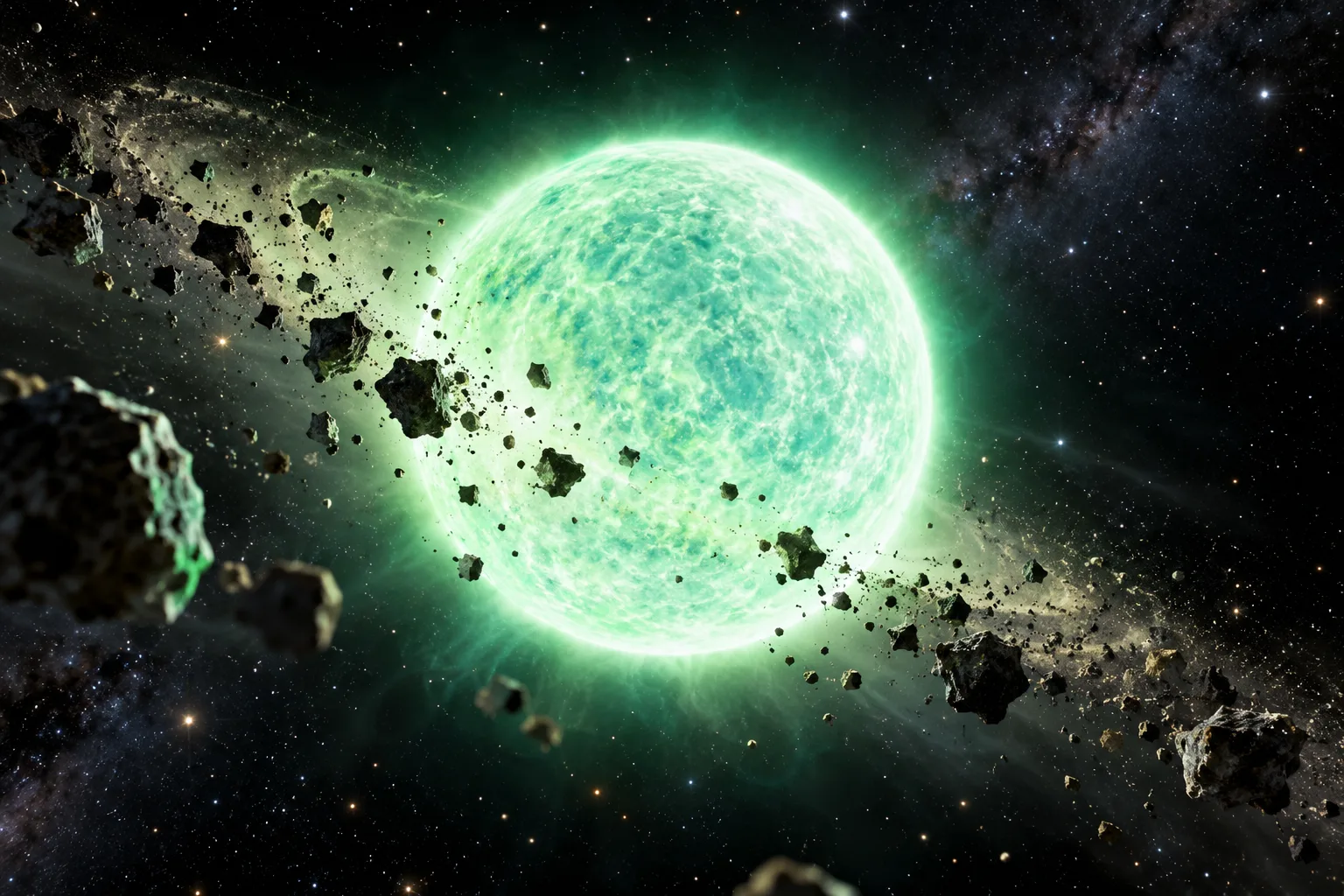
London, England. Astronomers have reported the first identification of a green star: a dense stellar remnant whose chartreuse appearance resulted from absorbing rocky debris left by planets that previously orbited it. The white dwarf, WD J1330+6435, lies roughly 280 light-years from Earth, within the Milky Way’s constellation Draco.
Planetary material changes the star’s chemistry
The findings appear in RAS Techniques and Instruments, in a study led by Mark Hollands, an astrophysicist at England’s University of Warwick. The research formed part of a project examining how white dwarf colours would appear to human eyes.
Hollands said the team initially took an interest in WD J1330+6435 because planetary fragments had landed on its surface. That material added calcium, lithium and, most importantly, sodium to the star’s outer layers.
According to Hollands, sodium in ordinary stars absorbs orange light at a narrowly defined wavelength, matching the distinctive orange colour of sodium street lamps. Conditions inside this white dwarf, however, change how the element interacts with light.
Hollands explained that the extremely high density exposes sodium atoms to continual collisions with surrounding helium atoms, changing their atomic energy levels. Rather than absorbing only a narrow orange wavelength, the sodium absorbs yellow and orange light, along with some red wavelengths.
The remaining light gives the star its chartreuse-green glow, Hollands said, adding that such a colour would not be possible in stars resembling the sun.
Why white dwarfs can have unusual colours
The researchers explained that temperature normally determines a star’s colour. Cooler stars look orange, the sun and comparable stars look white, and the hottest stars appear pale blue.
White dwarfs behave differently. These remnants are the cores left behind when stars of low or medium mass exhaust their nuclear fuel and shed their outer layers. Although most have colours resembling those of other stars, with white their average colour, changes in chemical composition over time can produce less common hues, according to the study.
A typical white dwarf compresses around half the sun’s mass into an object approximately Earth’s size, the researchers said.
Study co-author Boris Gänsicke, also an astrophysicist at the University of Warwick, said white dwarfs contain roughly 165,000 Earth masses despite being about as large as Earth. That extreme density means even a small quantity of sodium can prevent a substantial amount of orange light from escaping, he explained.
The distance to WD J1330+6435 is expressed in light-years. One light-year measures how far light travels over one year: 5.9 trillion miles (9.5 trillion km).
This news item was generated automatically by Cyprus Inform from publicly available materials. Report an error →