Putin at the Valdai Forum: The World Has Reached a Turning Point
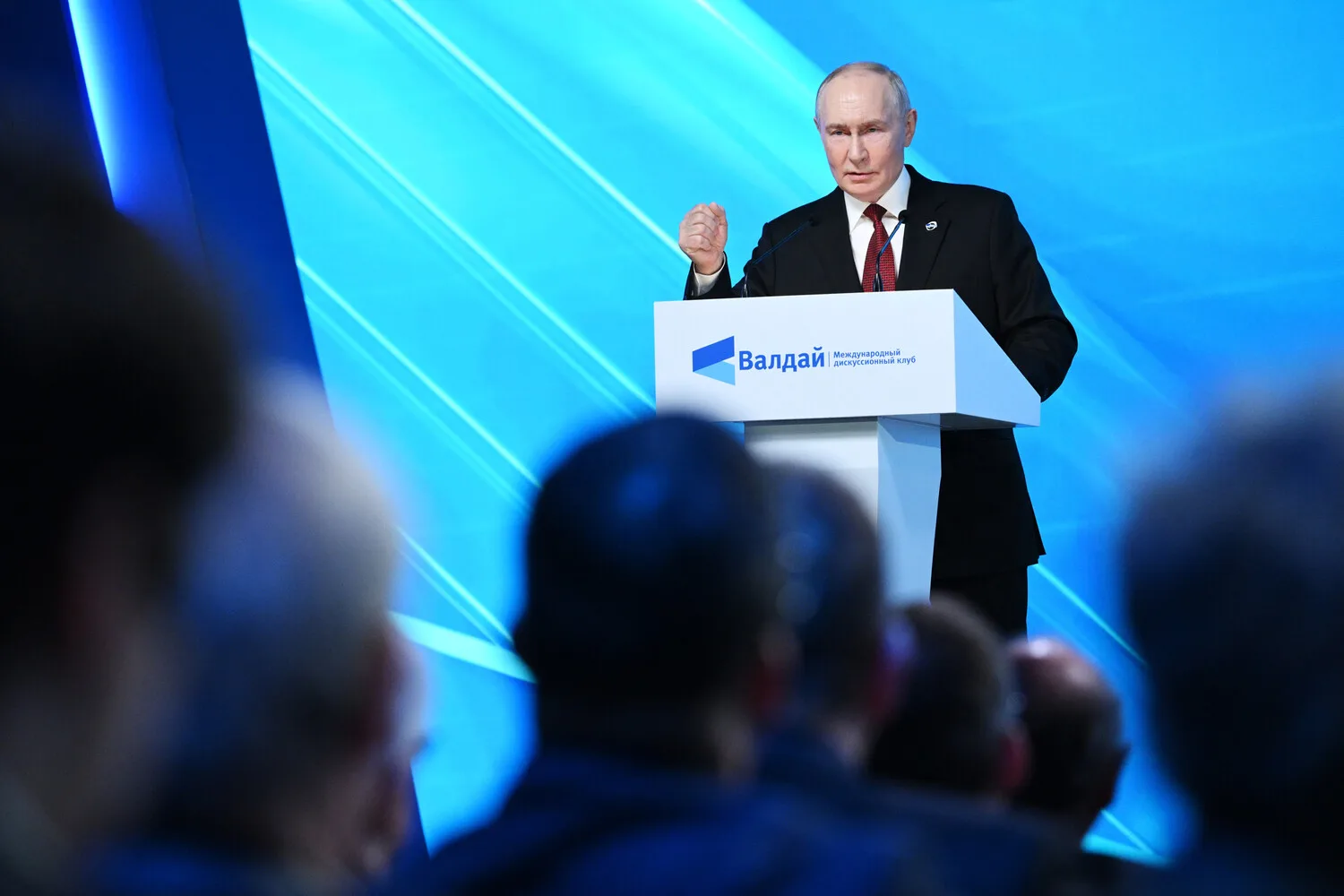
Moscow, Russia. The world has reached a “decisive, pivotal moment in its development,” and the primary task facing responsible politicians now is to prevent humanity from sliding to the brink of survival. Vladimir Putin delivered this message on October 1 during the plenary session of the 23rd annual meeting of the Valdai International Discussion Club.
The forum took place from September 28 to October 1 and brought together about 120 experts from 40 countries, including China, India, Iran, Brazil, South Africa, the United States, and Europe. Its theme was “Responsibility for the Future: The Limits of What Is Possible, or Limitless Possibilities?” The session’s moderator, Fyodor Lukyanov, research director of the Valdai Foundation, summarized the three days of discussions into three concepts: change, responsibility, and calm. This year’s annual report from the club was titled “Don’t Panic.”
Along with the usual arguments about the crisis of Western hegemony and the conflict in Ukraine, the president spoke at length about artificial intelligence and the threat of “digital totalitarianism,” genetic engineering, the rules of warfare, and the lessons of the Soviet Union’s collapse. He concluded with a warning: if humanity cannot find the strength to unite, “there will be no one left to learn from these textbooks.”
“A Completely New Reality”
Putin noted that the Valdai Forum has traditionally served as a forum for assessing the state of the world and discussing the contours of the future world order. Sooner or later, its principles will have to be negotiated, and that is when the club’s “intellectual capital and experience in direct and trusting communication” will come in handy. But “unfortunately, we must acknowledge that today we face different challenges”—ones that are more acute and urgent. Responsibility now, he said, means taking practical steps to “prevent humanity from sliding to the brink of survival and to avoid the irreparable.”
The president noted that radical changes are occurring simultaneously in technology, social structure, climate, medicine, military affairs, energy, demographics, and the field of artificial intelligence, and their impact on society is contradictory. “Taken together, this creates the conditions for a qualitative transformation,” the consequences of which are still difficult to assess. “The scale of the changes that have already occurred and those yet to come is simply enormous,” and humanity has not yet fully grasped the magnitude of the challenge: “This is the beginning of a completely new, utterly new reality,” in which threats and opportunities are inseparable.
Most importantly, these changes affect “the biological and moral nature of human beings.” Technologies open up fantastic prospects, including the extension of life, but “they also take the potential for universal destruction to a new level”—as a result of conflicts, environmental degradation, or the loss of control over the technologies themselves.
Hence the “increased anxiety among people and societies, rising internal tensions,” and domestic political turmoil in many countries: traditional party systems no longer reflect the changing social structure, and some governments are inclined to “export, unfortunately, instability” abroad. The president’s conclusion: “The continuation of international conflicts is, unfortunately, highly likely,” since major shifts “stimulate and fuel ambitions and a willingness to take risks.”
From a strategic perspective, “as we move away from Western hegemony,” Putin is confident that the situation will change for the better—toward “a more stable, democratic, and free multipolar international order.” But the path to it is fraught with risks, and minimizing them “at every level, from the global to the personal, is the main task today.” There is no universal recipe: it is necessary to combine “caution and prudence, so as not to be swept away by an avalanche of uncontrolled changes,” with an active, assertive approach, although in the context of a “multi-crisis,” it is difficult for leaders to break free from the daily fray. “The current responsibility is enormous, and a mistake can be very costly,” he emphasized.
The UN, AI, and “Digital Totalitarianism”
According to Putin, many international organizations do not reflect modern realities, and some even create risks themselves by serving the interests of a narrow group of countries. In his view, the UN “is run in a far less collegial and democratic manner than was intended”: “A limited group of Western countries exerts disproportionate influence,” even as their actual global clout declines against the backdrop of a growing global majority. Russia advocates for “fair reform of the United Nations”—not only the expansion of the Security Council, but also a new direction for its work, with a greater role for Asia, Africa, Latin America, and the Middle East.
Among the new dilemmas, the president cited “the issue of artificial intelligence, which we all still have to learn to live with,” and recalled the idea of “prudent digitalization” being discussed by experts—refraining from the uncontrolled introduction of technologies into spheres critical to moral development. “Experts are increasingly voicing concerns that the spread of artificial intelligence could become yet another attempt to reduce everyone to a common denominator—to depersonalize us, this time through the use of algorithms configured by certain parties,” Putin stated. He added: “Such digital totalitarianism will be just as dead-end, bleak, and inhumane” as the totalitarian societies of the past. A separate challenge is how states in the digital age can “guarantee their security and identity” without shutting themselves off from progress or falling behind technologically.
An even more sensitive topic is biotechnology. Science gives humans “the ability to intervene deeply in what was once considered the prerogative of the Creator”: in genetics, the formation of personality, and the programming of behavior and thought. To find mutually acceptable solutions to such existential questions, “it is necessary to unite the efforts of countries and communities.” But the international institutions created after World War II are subject to the influence of countries “interested not in universal progress, but only in preserving their own power,” while new alliances like BRICS have yet to define their roles. The emergence of a multipolar world is “a long, thorny path with many unknowns.”
Does this mean the world is doomed to chaos? “No,” the president answered himself. An orderly world order is “a recent invention, from the last century,” and responsible powers have, even in the past, not only competed but also worked together for the sake of stability.
“We Didn’t Start the War”
According to Putin, “a huge responsibility, commensurate with their immense capabilities, falls on the major powers”: they are capable of instantly shifting global security trends or, conversely, deepening a crisis, and new technologies multiply this potential many times over. The absence of universally recognized rules “encourages selfish behavior” and, at times, aggressive attempts to secure unilateral advantages.
The president is convinced that international relations require “compliance not only with established laws but also with customary international law.” “Moral and ethical constraints, as well as propriety—they are, after all, important,” because they leave room for dialogue. And “systematic failure to fulfill obligations, deception, turning communication into a farce,” and the blatant mockery of facts undermine the very foundation of international coexistence. The principle of “might makes right,” according to Putin, sometimes seems to guide actors who are convinced of their own exceptionalism, but “it never leads to anything good.”
The president also addressed a question that, he said, experts often ask: how can Russia talk about peace when it was the one that initiated hostilities? “It wasn’t us who wanted this, and it wasn’t us who started the war—they started the war against us,” he declared. Putin listed his grievances against the West: “They should not have spent years encouraging aggressive nationalism and Russophobia in Ukraine,” militarizing Russia’s historical territories with NATO forces, supporting a coup d’état, and flooding Kyiv with weapons. According to him, they also should not have “turned Russophobia, the oppression, and the killing of Russian people into a state ideology,” with the goal of “Russia’s strategic defeat.” The president is convinced that Russia was deliberately placed in a position where it was forced to defend itself with arms.
And yet Putin called for “living in harmony and working together to find ways to do so,” acknowledging that building trust is “a complex and fragile process.” “Even the interests of the closest partners cannot coincide completely,” let alone those of rivals. But sooner or later, the world will reach a stable balance—through mutual compromises and a sober assessment of the situation, including on the part of the West. “The former hegemon will inevitably have to acknowledge the realities of a multipolar world” and learn to cooperate with the countries of the global majority “on the basis of respect for their fundamental interests.” This will not happen quickly: the path to a new system, the president warned, will be fraught with unexpected, often unpleasant, and even dangerous twists and turns.
Lessons from the Collapse of the USSR and Egon Bar’s “Foresight”
“Russia has undergone a difficult process of fundamental transformation, and this process continues,” Putin said. “Thirty-five years ago, we experienced the collapse of the state system”—a tragedy for tens of millions of people who suddenly found themselves abroad. The president pointed to “a certain naivety, idealism, and perhaps even carelessness” on the part of the late-Soviet leadership: “Blind trust in Western partners and confidence in the possibility of certain gentlemen’s agreements” played a cruel trick not only on the USSR but also on global stability. “Soviet leaders wanted to please the West,” while the West sought to reshape the world in its own image and secure its share of the Soviet legacy.
However, Putin sees the main cause within the country itself: “The collapse of the USSR was the result of a combination of accumulated internal imbalances” and mistakes made by more than one generation of leadership. “Narrow and inadequate ideological templates instead of pragmatism,” unprofessionalism, and the habit of sweeping obvious problems under the rug gradually undermined the country’s position. The current conflicts, he said, are the result of “the unwillingness, unpreparedness, or inability of late 20th-century politicians” to take the era of sweeping change seriously.
There were, however, those who understood what was happening. Putin recalled the West German Social Democrat Egon Bar (1922–2015), the architect of Willy Brandt’s “New Eastern Policy”: after reading the transcripts of his conversations with the Soviet leadership, the president, in his own words, “was simply amazed” by Bar’s intellect. In February and June 1990, Bar warned that without decisive steps to overcome the division of Europe into hostile blocs, developments could take “a highly unfavorable turn, condemning the USSR to international isolation,” and proposed the creation of a European Security Council involving the United States and the USSR. But after the collapse of the Soviet Union, forces in the West that “were not eager to embark on the path of pan-European cooperation” gained the upper hand, and the new Russia’s long-standing attempts to become part of “so-called Western civilization” ran up against a desire to isolate it.
The president’s conclusion: “Without the past, of course, there is no future,” but also “without a future, the past loses its meaning.” “We must not turn into a museum of past greatness”: true greatness is impossible without the ability to keep pace with the times—or, better yet, to stay ahead of them. Russia needs a “road map” for moving forward—not a utopia, but a “realistic assessment of risks, opportunities, and necessary goals,” and Moscow is ready to develop it together with other countries.
“A Gun on the Wall”: Escalation, AI, and the Rules of War
The moment when nothing can be changed anymore may come very quickly, Putin warned: “The logic of escalating, reciprocal, and harsh responses leads to fatal irreversibility.” The reluctance to resort to “genuine diplomacy” pushes parties toward bluffing and crossing red lines, and escalation—rooted in arrogance and overconfidence—is a “path to the edge of the abyss” in a world where there are “weapons capable of destroying all life.” “Can we be sure that these weapons will never be used? Well, of course not,” the president said, recalling Chekhov’s rule about the gun that is bound to go off at the end of the play. The clearer the goal of strategically defeating the enemy, the higher the risk of entering the most intense phase: if a society is faced with the prospect of losing “its independence, dignity, and even its right to exist,” the logic behind retaliatory actions changes.
The president named AI in the military sphere as the first of two issues that, in his words, require serious discussion. “It is impossible to stop technological progress,” but there are already cases where AI “makes decisions on its own, based on its own understanding of what is appropriate.” Humans may be slower than machines, but they possess “instinct and intuition.” Putin recalled September 1983, when the early-warning system detected the launch of five American ICBMs: according to the algorithm, this was grounds for a retaliatory strike, but Lieutenant Colonel Stanislav Petrov suspected a malfunction—and he was right. Had AI been in his place, things might have turned out differently. “The limits on the use of artificial intelligence technologies in the security sphere are a matter of humanity’s survival,” he emphasized.
The automation of war, according to the president, leads to the “dehumanization of perception,” turning the loss of human life into a computer game. He recalled that in 1899, it was Russia that initiated the Hague Convention, which for the first time established the rules of warfare, and called for “revisiting the issue of the rules of armed conflict.” Wars, Putin acknowledged, “have always existed,” but military professionalism also entails adherence to humanitarian norms; the Russian military, he said, “has never been the first to attack targets not directly related to the enemy’s military infrastructure.”
Eurasia as “Our Own Home”
The second aspect concerns global issues that have taken a back seat amid the atmosphere of confrontation. Climate, the environment, poverty, inequality: “These issues were constantly being discussed just a short while ago, but today they’ve been somewhat forgotten,” even though they are becoming increasingly acute. There is no reason to hope that the international community will soon address them collectively, so they must be resolved at the regional level.
“We are all responsible for the planet as a whole, but first and foremost—for our own home,” Putin said, explaining that for Russia, that home is Eurasia. In a context where confrontations are disrupting production and logistics chains, the idea of a Great Eurasian Partnership takes on special significance, he said. Centuries of experience in the coexistence of civilizations can make Eurasia a model for international cooperation, where “differences become an advantage rather than an obstacle.” The President recalled that, on the sidelines of the UN General Assembly, work began on the Eurasian Charter on Multipolarity and Diversity in the 21st Century—an initiative by Russia and Belarus. The only thing Eurasia needs is “indivisible security, the absence of military threats, and lasting peace.”
Concluding his speech, Putin expressed hope that future generations would read in their textbooks that the second quarter of the 21st century marked a turning point when humanity “found the strength to set aside squabbles, ambitions, and selfishness” and transformed the technological revolution “from a set of threats into a wide range of opportunities.” “If none of this happens, there is a risk that there will be no one left to study from these textbooks,” he said, calling on everyone to “believe in the best and, most importantly, do everything possible to make it happen.” The president then answered questions from the moderator and forum participants.
This news item was generated automatically by Cyprus Inform from publicly available materials. Report an error →