Kakopetria: the old quarter, how to get there and a stroll
About the place
Checked: 1 October 2026.
Kakopetria for a short trip
Kakopetria is ideal for a stroll through the old quarter, exploring the traditional houses and paying a separate visit to the Church of St Nicholas of the Roof. For a first visit, it’s a good idea to start with the village, stop for lunch and only then head to the monument, provided its opening hours have been confirmed.
The village is situated in the Solea Valley in the Troodos Mountains. The old quarter and the modern part each serve a different purpose: one is of interest for its historic buildings, whilst the other helps to organise your trip. Don’t expect the whole of Kakopetria to look like a compact, pedestrianised set, devoid of transport and everyday life.
If you’re short on time, choose one main area of interest. Architecture enthusiasts would be best advised to set aside more time for the side streets, whilst those interested in Byzantine painting should allow more time for the church on the outskirts of the village. These itineraries can be combined, but the journey and access to the interior require a separate slot in your schedule.
Where to start and how to proceed
Park your car where permitted and continue on foot. Trying to drive right up to every house in the old quarter creates unnecessary difficulties on the narrow streets. Mark your parking spot on the map, along with a convenient exit to the modern part of town, so you don’t have to rely on a random return route.
In the old quarter, take note of the stone ground floors, wooden features, balconies and the winding alleyways. This is a residential area, so windows, entrances and courtyards are not public spaces where you can take photographs. If a door is open, this does not necessarily mean you are invited to enter; you must ask the owner for permission.
It is best to plan your route in short loops, returning to a familiar landmark. On a slope, the distance shown on the map does not reflect the effort required to climb it. For visitors using a pushchair or with reduced mobility, please specify the exact route, surface and any steps, rather than simply promising that the whole village is accessible.
The Old Quarter and Local History
The traditional architecture is the main reason to linger in old Kakopetria. Observe how the houses are adapted to the terrain and the narrow streets: this allows you to experience the village without having to follow a set itinerary of museum stops. The fact that the neighbourhood’s appearance has been preserved does not mean that every house is open to tourists or serves as an exhibition space.
The official tourist guide mentions local attractions linked to wine and olive oil. If you’d like to visit them, check opening times in advance: a small museum may operate differently to a nearby café or shop. Only include a visit in your plans once you’ve confirmed the details, allowing plenty of time to explore the exhibits.
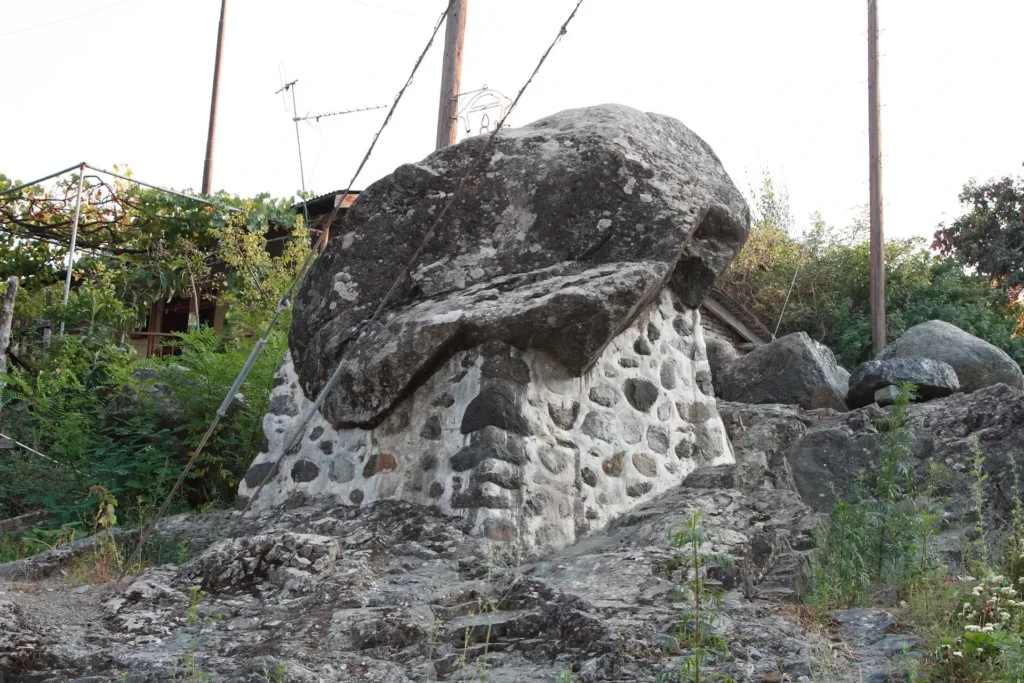
The legends about the village’s name and the ‘bad stone’ form part of local folklore. They are interesting to hear as part of cultural memory, but should not be treated as proven evidence of the name’s origin. When dating churches and determining their status as listed buildings, it is better to use a description of the building in question rather than a retelling of a legend.
The river and a walk by the water’s edge
The river valley helps you to understand the layout of Kakopetria and adds variety to your walk. Choose the signposted public paths and viewing points, if they are open. A walk along the water’s edge does not require you to go down to the riverbed: the view from a safe path often provides plenty of enjoyment without having to step onto the wet rocks.
Don’t expect the river to look the same in every season. Water levels and the condition of the river sections change after rainfall; you should go round any closed sections, even if the map suggests the usual route. Do not climb over barriers just to take a photograph, and do not take children to the edge of an unprotected bank.
A walk along a nature trail outside the village is a different matter altogether. Before setting off, you should check the route, the distance, the conditions and whether you can find your way back. Footwear suitable for a short stroll through the streets is not always suitable for a forest path, and the fact that a path is shown on a map does not confirm its current condition.
St Nicholas of the Roof
The Church of St Nicholas of the Roof is situated just outside the village and is well worth a visit in its own right. It forms part of the UNESCO World Heritage Site ‘The Painted Churches of the Troodos Region’. This status applies to the listed monuments, not to Kakopetria as a whole or to all the churches in its vicinity.
The church is of interest for its architecture and wall paintings from various periods. Before your visit, read the official description of the site so that you know exactly what you want to see inside. Viewing the exterior and entering the interior offer different experiences; do not promise your travelling companions that there are frescoes until access has been confirmed.
Please check opening times, any breaks and photography rules with the site custodian or tourist office for the latest information. In active places of worship, please respect the service and follow staff instructions. Do not touch the wall paintings and do not use a flash if photography is restricted by the site’s rules.
Food, relaxation and a mountain road
After your walk, it’s a good idea to take a break in the modern part of the village. Choose a café or tavern based on its location and menu, checking the details of your order and the price before confirming it. Comments about the ‘tastiest’ dish or the enduring popularity of a particular place are no substitute for up-to-date information from the establishment itself.
If you’re visiting at the weekend or for a local event, allow plenty of time for parking and queuing for food. If you’re staying overnight, check how to get to your accommodation with your luggage and where to leave your car. A lovely house in an old neighbourhood may have steps and limited access; it’s worth checking these details before you pay.
Before setting off, check the forecast and the condition of the mountain routes. Don’t automatically assume that the weather in the Troodos Mountains will be the same as on the coast: make sure your clothing and return time are suited to the conditions of the journey. If you’re travelling by public transport, confirm your return journey and the route to the bus stop before deciding on a time for lunch.
A plan with no unnecessary stops
For the first half of your trip, plan to visit the old quarter and take a stroll along the accessible public walkways. After a break, decide whether you have time left to visit a church or a local exhibition. It’s better to see your chosen destination properly than to end the day with a few closed doors and a rushed journey home.
If you’re travelling with children or elderly relatives, make sure you have the option to shorten the walking section. Narrow streets, uphill sections and uneven surfaces call for a more leisurely pace than a typical city promenade. Pick a place to rest and a convenient meeting point in advance, in case the group decides to split up.
The day before, save the contact details for your chosen destinations and check for any updates regarding their accessibility. For a cultural day out, Kakopetria can be combined with another destination in Solea, though this is not essential. A self-guided stroll through the village solves one particular problem: how to explore its old quarter without an overcrowded itinerary.
Continue planning
Official sources
- Visit Cyprus — official destination description
- Primary source: heritage or practical information
- CYSTAT — population census, 1 October 2021
Photo: Dmitry Panov · CC BY 3.0 · converted to WebP and resized.
.jpg)