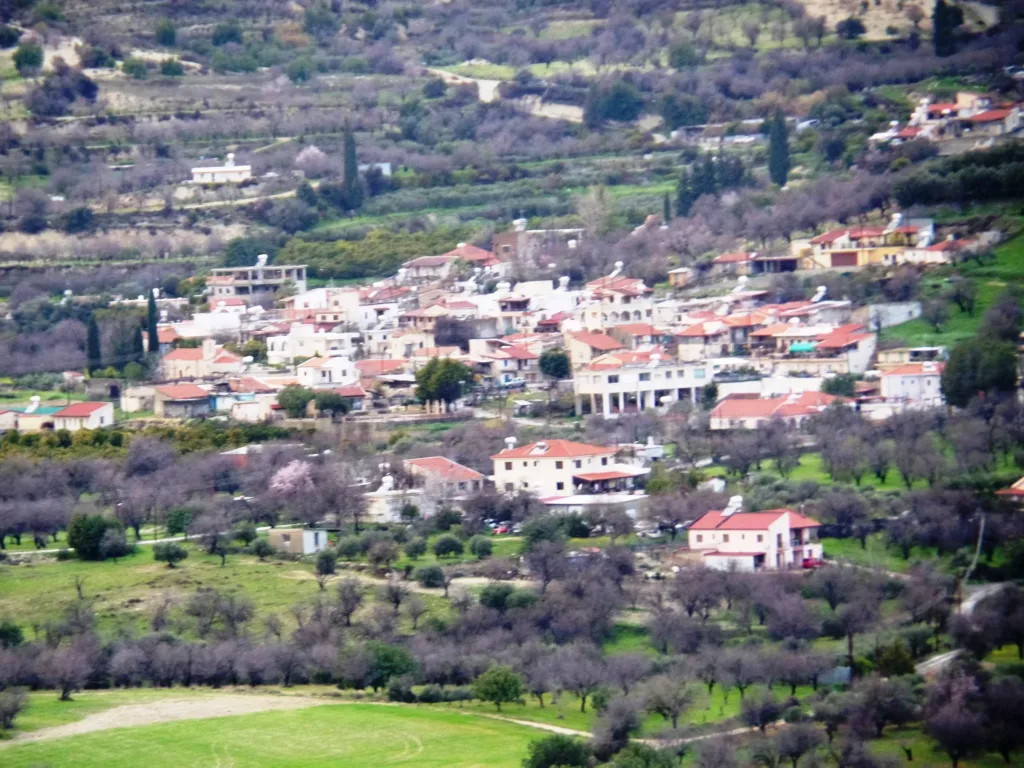
Limnatis, Cyprus: the almond village near Limassol
About the place
Checked: 25 October 2026.
Limnatis at a glance: where it is and what it is known for
Limnatis (Greek: Λιμνάτης) is a semi-mountainous village in the Limassol district, north of the city, where the land rises towards the Troodos Mountains. According to Visit Cyprus, it lies about 480 m above sea level; the 2021 census recorded 303 residents. Limnatis is known as the ‘almond village’: according to All About Limassol, more almonds are produced here than anywhere else in Cyprus.
The village is surrounded by greenery, both wild vegetation and orchards. Besides almond trees, olives and citrus trees grow around it: the courtyard of the community centre looks out over citrus orchards.
For travellers Limnatis is a short trip from Limassol, especially in the almond blossom season. There are no major museums: the point of a visit is the orchards, a few churches and chapels, the village square with its old tree and the Blooming Almond Tree Festival.
History of Limnatis and its name
The name apparently comes from the Greek word ‘limni’ (λίμνη), ‘lake’. All About Limassol adds that this form of the name may indicate that the village already existed during the Byzantine era. Sources do not describe the lake itself, so the connection between the name and a specific body of water remains conjecture.
People lived here as early as the Classical period, 500–323 BC: according to All About Limassol, tombs of that time found here show this. In the Frankish and Venetian periods the village existed under the same name; the historian and traveller Louis de Mas Latrie mentions it as Limniate, a Frankish estate.
A memorial to EOKA fighters in the churchyard of St John the Baptist recalls more recent history. It is dedicated to Demetris Charalambous and Vasilis Alexandrou, who were killed in the liberation struggle of 1955–1959.
What to see in Limnatis
The largest and newest church in the village is the Transfiguration of the Saviour (Metamorfosis tou Sotiros). It stands on the northern edge, on top of the hill on which Limnatis is built, and is visible from afar. Closer to the centre is the small single-aisled stone church of St John the Baptist (Timios Prodromos).
In the village centre part of a wall of the chapel of Agios Mamas (St Mamas) survives, and nearby is a small square with a fountain and an old terebinth (tremitos in Greek). According to All About Limassol, this tree is around 600 years old; only the trunk remains today, but it once shaded the chapel.
North-east of the village, among olive groves and almond orchards, stands the chapel of Agios Epifanios; above it is a small rest area with wooden benches and drinking fountains. Around the village there are other chapels too: Agia Paraskevi, Agios Nikolaos, Agios Georgios, Profitis Ilias (the Prophet Elijah), Agia Thekla, Agia Marina and Agioi Konstantinos and Eleni (Saints Constantine and Helen).
Almonds, local produce and festivals
Almonds are the main crop in Limnatis. Every February, the extensive almond orchards are covered in blossom, and at the entrance to the village there is an area with benches for visitors, a good spot to watch the hillsides in bloom.
Residents make sweets from almonds, as well as soutzoukos, a traditional Cypriot sweet of nuts coated in thickened grape must. Almond products are sold at local traditional fairs, and the annual almond festival is a good chance to try them on the spot. The community centre next to the Church of St John the Baptist serves as a venue for village events.
Every year in late February or early March Limnatis holds the Blooming Almond Tree Festival; Visit Cyprus includes it in its calendar of village festivals. The date and venue are announced afresh each year, so check them before you go.
Walks, nature and the surrounding area
The best way to explore the village is on foot: from the centre to the church of the Transfiguration on the hill and on to the chapel of Agios Epifanios. Along the way, in the northern part of the village, there is a cultural centre with a children’s playground and an open-air amphitheatre for events.
The almond blossom season is usually in February, but the exact timing depends on the weather in any given year: after a mild winter, the trees blossom earlier; after a cold one, they blossom later. If you are going for the blossom, check with the community a few days before your trip.
Limnatis is on the Visit Cyprus circular route ‘Celebrating the Vine’ through the wine villages of the Limassol district. From the village the road runs north, parallel to the Ambelikos river, to the wine village of Kapileio, and on to Agios Mamas and the Pitsilia villages. In Kapileio Visit Cyprus suggests leaving the car and walking among the pines and vineyards, as the streets there are narrow.
Getting to Limnatis and planning your visit
On the Visit Cyprus route, from Limassol you head north from the Polemidia roundabout on the B8 towards Troodos, turn right for Apesia and continue through Korfi to Limnatis. According to Visit Cyprus, Korfi was built in the 1970s for residents whose old village had become unsafe after landslides. The easiest way to get there is by car.
The village is small: a walk around the centre, the churches and the viewpoints takes about two hours. In the blossom season and on the festival day there are many visitors, so arrive in the morning and plan in advance where to park.
In summer the middle of the day is hot, so walk in the morning or evening. Public transport to small villages is limited, and Limnatis itself is easy to combine with a drive to the neighbouring villages on the route.
What to check before visiting Limnatis
Check the dates and programme of the Blooming Almond Tree Festival in the Visit Cyprus calendar and in the Limnatis community announcements, as the day and venue have changed over the years. If you want to buy almonds or sweets from local producers, ask the community where and when the fairs take place.
The almond orchards are private property. Enjoy the blossom from the roads and viewpoints, do not enter the orchards without permission, do not break branches and do not touch the crop. Do not leave litter by the chapels or in the rest area above the Agios Epifanios chapel.
In the churches and chapels, behave as you would in any working church: wear clothing that covers your shoulders and knees, speak quietly, do not use a flash when taking photographs of icons, and do not take photographs during the service. The EOKA memorial in the churchyard of St John the Baptist is a place of remembrance; treat it with respect.
Continue planning
Official sources
- CYSTAT — Census of Population and Housing 2021: population by place of residence
- All About Limassol — Limnatis village guide: history, churches, almonds
- Visit Cyprus — Cyprus Authentic Route 4 brochure, Celebrating the Vine
View of Limnatis · Photo: Xaris333 · CC BY-SA 4.0 · converted to WebP and resized.
