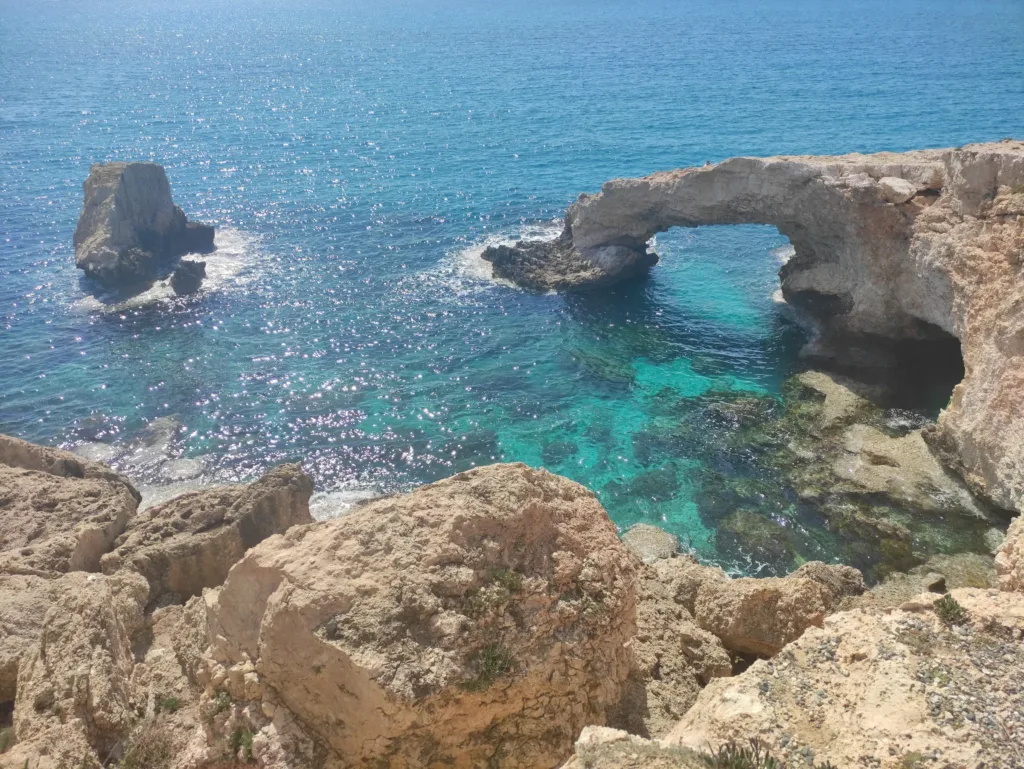
Love Bridge Ayia Napa: the Story, Location and Cliff Safety
About the place
Checked: 25 October 2026.
Love Bridge in Ayia Napa: what it is and where to find it
Love Bridge (in Greek Γέφυρα των Ερωτευμένων, Gefyra ton Erotevmenon) is a spot on the rocky shore at the eastern edge of Ayia Napa, by Kryou Nerou Avenue, the coastal road, where a natural limestone arch juts out over the sea. People come for the view of the open sea, for sunset photographs and for the romantic tradition that gave the place its name. Entry is free.
Two neighbouring features in Ayia Napa go by this name. Most guidebooks and online maps label the stone arch itself as Love Bridge, while the list of sights on Visit Cyprus, the official portal of the Deputy Ministry of Tourism, separately names Lovers Bridge with its ‘love locks’ — a footbridge not far from the arch.
The municipal guided walk described on Visit Cyprus stops on the way back at ‘a sea cave (rocky bridge) and the nearby love bridge’. The area belongs to the Municipality of Ayia Napa in the Famagusta district, in the part of the island controlled by the Government of the Republic of Cyprus.
Where the name comes from and what is known of its history
The arch is a natural formation. The coast here is made of limestone, and the waves wear away its softer layers faster than the harder ones, which is why caves, niches and through-passages form along this shore. The showcaves.com directory of caves and karst features classifies the site as a natural bridge and describes it as a fairly large arch projecting into the sea that you can walk across.
The name comes from a local romantic tradition rather than a historical event. According to a legend quoted by the same directory, if a couple kiss in the middle of the arch and make a wish, it will come true. That is why couples and newlyweds often come here, including for wedding photographs against the backdrop of the sea.
The footbridge with the padlocks continues another custom found in many countries: couples fasten a padlock to the railing as a sign of fidelity. Official sources do not say when or by whom the footbridge was built or renovated, so opening dates and accounts of formal ceremonies found online should be treated as unconfirmed.
What to see at the site
The main sight is the arch itself and the view from it over the open sea and the indented coastline. According to the showcaves.com description, you can walk out onto the arch, and people swim at its base. This is not an organised beach but open rock with an uneven surface, so go out onto it only in sturdy footwear and only in calm weather.
Nearby is a footbridge where couples hang padlocks on the railings; this is the one Visit Cyprus calls Lovers Bridge. The legend about making a wish belongs to the stone arch, while the padlocks go on the footbridge, so it is worth seeing both while you are there.
Around it is the limestone coast typical of eastern Ayia Napa, with niches and sea caves. According to the municipality, in the Cape Greco area the caves are cut into coastal cliffs up to 10 metres high. The best light for photographs, as showcaves.com notes, comes at sunset, and for walks in hot weather the municipality advises setting out early in the morning.
Getting there and planning your visit
Your landmark is Kryou Nerou Avenue along the coast: follow it east along the sea from the centre of Ayia Napa. In a sat-nav, the place is easiest to find by searching for ‘Love Bridge’ or for its Greek name.
From the eastern part of town you can walk here along the coastal streets, or drive in on the town roads. Leave the car only where signs allow parking, and do not drive onto the unpaved ground near the cliff edge. This is a natural shore with no facilities, so bring water and a hat.
The visit combines easily with a walk along the coast or a trip to Cape Greco. Describing walks along the Cape Greco coast, the municipality advises wearing a sun hat and comfortable sports shoes, carrying water and setting out early in the morning. If you want to catch the sunset, come in good time while it is still light.
Safety on the cliffs and in the water
The shore here is rock that the sea is constantly undercutting. The edge can be uneven, slippery and hollowed out from below, and in windy weather waves wash over the lower ledges. Go no closer to the edge than you need for a photo, do not walk out onto the arch in strong wind or a storm, and keep children by the hand.
Cliff jumping on this coast regularly ends in injuries. According to the Joint Rescue Coordination Centre, as reported by the Cyprus Mail, six or seven accidents are recorded every year at the sea caves of Ayia Napa and Cape Greco. The Geological Survey Department had warned of the danger of collapses in the sea caves near Cape Greco, access to them was banned in 2019, and municipal signs there prohibit jumping into the water.
Swim off the rocks only when the sea is calm and only where you are sure you can climb back out onto the shore. This is not a lifeguarded beach, so check in advance whether there are lifeguards nearby, and do not swim alone. General rules for staying safe in the water are collected in our article on water safety in Cyprus.
What else to see nearby
On the same eastern edge of town are the International Sculpture Park and the neighbouring Park of Mediterranean Plants, Cacti and Succulents, both listed by Visit Cyprus among the sights of Ayia Napa. They are easy to combine with the arch in a single walk.
Further east begins the Cape Greco National Forest Park, with the Palatia sea caves and the Kamara tou Koraka natural bridge. The Aphrodite Trail, featured by Visit Cyprus, runs through the park. These places are covered in more detail in our guide to the sights of Ayia Napa.
In the town centre stands Ayia Napa Monastery, with several old chapels around it; they are covered in a separate guide to the churches of Ayia Napa. The resort’s beaches are covered in a separate article, and our general guide to Ayia Napa will help you plan the rest of the trip.
What to check before you go
Weather and sea. On a windy day the surf at the arch is heavy, and going out onto the rock is dangerous. Before the trip, look at the wind and wave forecast from the Cyprus Department of Meteorology and judge the sea yourself on arrival: if waves are washing over the ledges, keep to the view from the shore.
Restrictions in force. The rules for the sea caves and cliffs on this coast change: after accidents, some stretches are fenced off or closed. Watch for signs on site and check the current restrictions with the Municipality of Ayia Napa.
Guided walks. The free municipal coastal walk, which Visit Cyprus describes with a stop at the love bridge, had been postponed until further notice at the time of checking. To find out whether it has resumed, ask at the Deputy Ministry of Tourism’s tourist information office in Ayia Napa or at the municipality.
Continue planning
- Ayia Napa: beaches, the town centre and routes around the resort
- Ayia Napa Sights
- Water safety in Cyprus: currents, jellyfish and flags
Official sources
- Visit Cyprus: Agia Napa sights (Lovers Bridge, sea caves)
- Visit Cyprus: municipal guided walk 'Agia Napa and the Sea'
- Agia Napa Municipality: Cape Greco, sea caves and walking advice
- Cyprus Mail: rescue service data on cliff-jumping accidents in Ayia Napa
Love Bridge, a natural rock arch on the Ayia Napa coast · Photo: Fry72, Karel Frydrýšek · CC BY-SA 4.0 · converted to WebP and resized.
