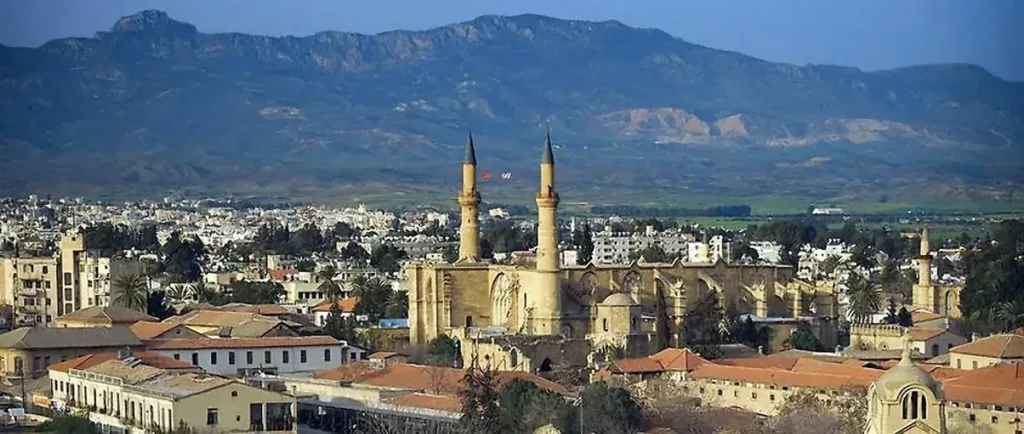
Nicosia: Cyprus capital in the centre of the island
About the place
In brief: Nicosia, officially Lefkosia, is the capital of the Republic of Cyprus and the island’s main inland city. Visit for the walled old town, museums, contemporary city life and an atmosphere very different from the coastal resorts.
Why visit Nicosia
Sixteenth-century Venetian walls enclose pedestrian streets, workshops, cafés, museums and historic buildings. Beyond them are government offices, universities, galleries and the everyday life of the capital.
Nicosia is not a beach stop: the coast is some distance away. It works well as a separate day trip from Larnaka or Limassol when you want history and urban culture alongside a seaside holiday.
What to see
Start at Eleftheria Square and walk into the walled city. Useful landmarks include Famagusta Gate, the Cyprus Museum, Ledra and Onasagorou streets, Laiki Geitonia and monuments from several periods.
Do not try to cover every sight in a few hours. For a first visit, combine one museum, an old-town walk and lunch, checking the attraction’s own opening hours before setting out.
Understanding the buffer zone
A UN-controlled buffer zone runs through the city. It is an active security area, not a visitor attraction. Follow signs, stay out of restricted areas and do not photograph military facilities.
This page does not determine a right to cross. If your route includes a crossing, verify documents, the opening hours of the specific checkpoint and the conditions applying to your nationality with the competent authorities.
When and how to arrive
Summer is generally hotter inland than on the coast, so start a walking route early or later in the day. Spring and autumn are more comfortable for a long walk.
Buses serve the city, but a day visitor should check the last return service and departure point. If driving, choose parking outside the narrow lanes of the old city before arrival.
Practical checklist
- choose one priority museum and check its hours;
- carry water, sun protection and comfortable shoes;
- do not plan Nicosia as a beach destination;
- use only an official crossing point and current rules for the buffer zone.
How to plan an itinerary in Nicosia
First, work out how much time you’ll actually have left in the city after your journey. For a short visit, it makes more sense to stay within the Venetian walls: Eleftheria Square, one pedestrianised street, one museum and a pre-selected place for lunch. Travelling between distant locations can quickly eat into your limited time.
For a full day, split your itinerary into two parts and allow for a break indoors between them. The old town is best explored on foot, but modern neighbourhoods, archaeological sites and certain galleries may require a bus or car. Check the address, entrance and opening hours of each site, rather than just the marker on the map.
If your group includes a child, an elderly person or someone with reduced mobility, check in advance for road surfaces, steps, accessible entrances and toilets. Historic environments are uneven, and shade is patchy; a short, accessible loop is often more useful than a long list of attractions.
A buffer zone in your travel plan
You should not wait until you reach a checkpoint to decide whether to proceed. Before your trip, check whether your chosen crossing point is open to pedestrians or vehicles, what documents are required specifically for your nationality and route, and whether there are any restrictions on items you’re carrying or on a hire car. Obtain answers from the relevant authorities.
Do not plan your whole day as if the crossing is guaranteed and will take a fixed amount of time. Document checks, queues or changes to border procedures may disrupt your schedule. Plan an alternative route on the side of the city where you started your walk, so that having to cancel the crossing doesn’t turn your trip into a wasted day.
A navigation app does not determine whether a street is accessible. A passage shown on the map may end at a fence or a controlled area. Once there, follow official signs, do not go round barriers, and do not take photographs of military or secure sites, even if they appear to be part of the ordinary urban landscape.
Transport, heat and practical logistics
For intercity buses, check the exact stops in both directions: the drop-off point and the return departure point may not be the same. Note the last suitable service and one earlier alternative. That way, a museum visit, lunch or a queue won’t force you to rush to find an expensive alternative at the end of the day.
If travelling by car, choose a car park before entering the old quarters. Narrow streets, one-way traffic and limited parking spaces shouldn’t become part of your sightseeing tour. Make a note of your parking spot, payment rules and closing times, then plan a circular walking route that takes you back to your car.
In summer, save outdoor activities for the morning and evening, and spend the middle of the day at a museum or over a long lunch. Water, a hat and regular breaks are essential even on a short walk. If it’s hot, or if you’re feeling unwell or the air quality has deteriorated, shorten the route rather than trying to stick to your original plan at all costs.
Check your route the day before
The day before, visit the official websites of your chosen museum, bus operator and, if you intend to use a crossing, the relevant authority. Check the date of the announcement, not just the page title: an old timetable may still appear in search results. A screenshot is useful as a reminder, but in the event of any discrepancies, the most recent official announcement takes precedence.
Draw up a basic itinerary comprising three essential stops and a supplementary list of nearby attractions. Allow time between them to find the entrance, go through security checks and take a break. Save the address of a chemist’s, your pick-up point for the return journey and the number of a service through which you can book a licensed taxi separately.
After your trip, do not automatically carry over your observations to the next season: opening hours, routes and access to specific areas are subject to change. For a return visit, double-check the latest information, retaining only the general geography and a respectful approach to the current security zone.
Official sources
- Visit Cyprus: Regions & Cities
- Republic of Cyprus: District Administrations
- UNFICYP: About the buffer zone
Information checked on 9 September 2026. Recheck timetables, fares, opening hours and temporary notices before travelling.