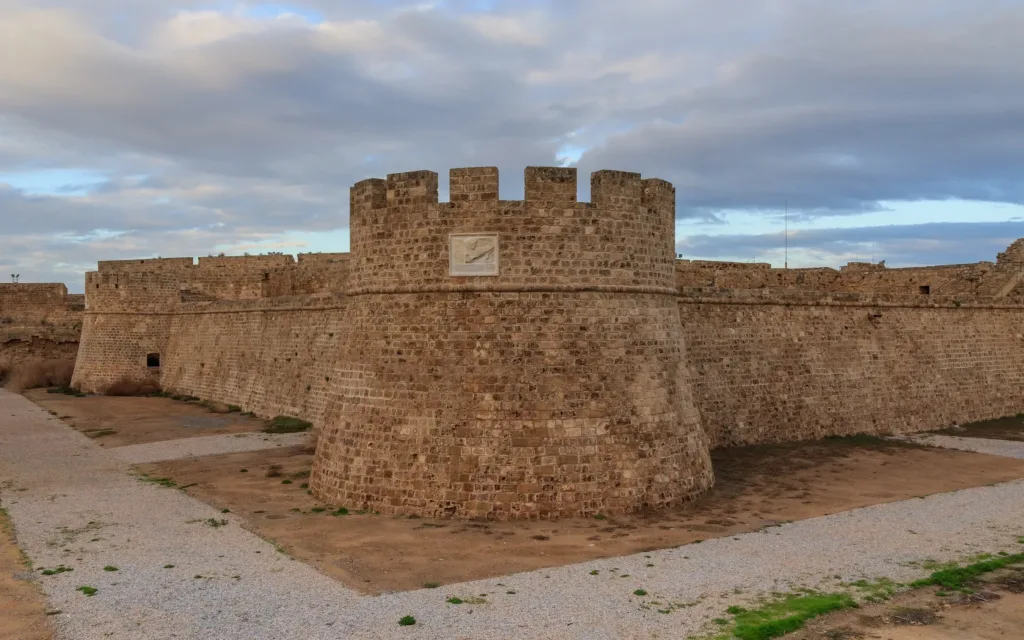
Othello Castle, Famagusta: History, Shakespeare and Visiting
About the place
Checked: 25 October 2026.
Othello Castle in Famagusta: in brief
Othello Castle, or Othello Tower, is the citadel in the north-eastern corner of the walls of Famagusta (Ammochostos), by the old harbour. Within the Venetian fortifications dating from 1492, an earlier 14th-century Lusignan fortress has been preserved. Since 1974, Famagusta has been located in the occupied northern part of Cyprus.
The castle takes its name from Shakespeare’s tragedy Othello, the setting of which is shifted from Venice to Cyprus. According to the Technical Committee on Cultural Heritage, the citadel was restored in 2014–2015 with funding from the European Union, and it reopened to visitors in July 2015.
It is one of the main sights of old Famagusta. Below, you’ll find the history of the citadel, the origin of its Shakespearean name, and what you need to know before visiting.
The 14th-century Lusignan citadel
According to the Department of Antiquities of the Republic of Cyprus, the citadel was originally built in the 14th century: it is a square castle with a round tower at each corner. It originally had a second storey and was surrounded on all sides by a moat, which separated the citadel from the rest of the city’s fortifications.
The citadel was Famagusta’s key defensive position: it stands at the apex of the city walls, between the harbour and the sea. The breakwater protecting the harbour began here, so the citadel guarded both the entrance to the harbour and the approaches to the city.
According to the Department of Antiquities, the coats of arms of the Kingdom of Jerusalem are still preserved in the main hall. The Lusignans bore the title of Kings of Jerusalem, and were crowned with this title at St Nicholas’s Cathedral in Famagusta.
The Venetian rebuilding of 1492
In 1489, Cyprus came under Venetian rule, which lasted until 1571. The Venetians adapted the citadel for warfare involving cannons: according to the Department of Antiquities, in 1492 the second storey was dismantled and the fortress was rebuilt.
Set into the gate is a marble slab bearing a relief of a winged lion – the symbol of Venice – and an inscription bearing the name of Captain Niccolò Foscarini, who oversaw the reconstruction in 1492. The Technical Committee describes the monument as two structures, one within the other: the Venetian fortifications of 1492 surrounding the earlier Lusignan fortress.
Following the fall of Rhodes in 1522, the threat posed by the Ottoman Empire grew, and the Venetians reinforced all the walls of Famagusta. The Deputy Ministry of Tourism’s brochure on the history of Cyprus says as much: on the sea-facing side of these walls stood Othello’s Tower, famous from Shakespeare’s tragedy.
Why it is called Othello Castle
The tragedy Othello was written in the early 17th century. Its plot goes back to a novella by the Italian writer Giraldi Cinthio, published in 1565, and from the second act onwards, the action takes place in Cyprus, which is under threat from the Turkish fleet. The protagonist is a Venetian military commander of Moorish descent.
There is no evidence that Shakespeare ever visited Cyprus, and the tower’s name is literary rather than historical. Both the Technical Committee and the Deputy Ministry of Tourism explicitly link the monument’s name to the play, which is why it is referred to as such in all languages: Othello Tower, Πύργος του Οθέλλου.
There are many legends surrounding the castle: about the real-life inspiration for Othello, about Leonardo da Vinci’s involvement in its reconstruction, and about hidden treasures. There is no evidence to support these in official or academic sources, so they should be regarded as tourist tales.
The siege and the Ottoman period
In 1570–1571, Famagusta withstood a long siege by the Ottoman army, and its fall in 1571, according to the Deputy Ministry of Tourism, marked the beginning of Ottoman rule in Cyprus. The citadel formed part of the city’s defences, together with the walls and bastions.
Under Ottoman rule, the fortifications continued to serve military purposes, whilst St Nicholas’s Cathedral and some other churches in the old town were converted into mosques. Our Famagusta guide provides more details about the walls, St Nicholas’s Cathedral and other landmarks in the old town.
The citadel’s moat is still clearly visible today, whilst inside, a large hall with Gothic vaults and a courtyard have been preserved. The Technical Committee notes that the condition of the castle’s various parts varies: from ruins to intact walls with ribbed vaults.
The 2014–2015 restoration
According to the Technical Committee on Cultural Heritage, a survey was carried out and a project drawn up in 2012, whilst the work took place from May 2014 to July 2015 and cost approximately 1,305,000 euros. The restoration was funded by the European Union and carried out by the United Nations Development Programme in collaboration with the bi-communal Technical Committee.
The masonry of the walls and arches was reinforced; a drainage system and new layers of roofing to protect against rainwater were installed; and information for visitors, ground-level access and toilets for people with disabilities were added. The project was called ‘Support to cultural heritage monuments of great importance for Cyprus’.
The opening in July 2015 was marked by a performance of Othello inside the castle: according to the Technical Committee, Greek Cypriots and Turkish Cypriots performed together in the production. The Committee brings together experts from both communities and is responsible for the conservation of heritage sites across the island.
How to visit
The castle is situated in the old town of Famagusta, in the occupied part of the island. From the south, the nearest crossing points are Deryneia, Pergamos and Strovilia, the last two inside the British Dhekelia base; the crossing rules and vehicle insurance requirements are described in our articles on Northern Cyprus and the Green Line.
Check opening hours and admission prices on site: the Republic’s official sources do not publish this information. St Nicholas’s Cathedral stands not far from the castle, and you can walk along the ramparts to the Sea Gate, so it’s easy to include the castle in a stroll through the old town.
According to the Department of Antiquities, parts of Famagusta’s walls and bastions are located within a military zone. Do not enter fenced-off areas or take photographs of military installations: the UK Foreign Office warns that you could be arrested for taking photographs near military sites, and this applies to the whole island, including the north.
Continue planning
- Famagusta (Ammochostos): Old Town, Walls and Monuments
- Varosha, Cyprus: History of the Fenced-Off Quarter and Its Status
- Northern Cyprus: Status, Crossing the Line and What to Check
Official sources
- Technical Committee on Cultural Heritage: Othello Tower / Citadel project
- Department of Antiquities of the Republic of Cyprus: walled Ammochostos (Famagusta)
- Deputy Ministry of Tourism: Cyprus, 10,000 years of history and civilisation
- UK Foreign Office (FCDO): Cyprus travel advice, safety and security
Othello Tower in the walls of Famagusta · Photo: A.Savin · FAL · converted to WebP and resized.
