Protaras beaches: how to choose the best beach in Protaras
About the place
Checked: 29 October 2026.
Protaras beaches at a glance: what they are like and where
Protaras (Πρωταράς) is the resort part of the Paralimni–Deryneia Municipality (Δήμος Παραλιμνίου–Δερύνειας) in eastern Cyprus; Visit Cyprus, the official portal of the Deputy Ministry of Tourism, describes it as a resort within Paralimni. The centre of the resort has sandy beaches with full facilities, including the best known, Fig Tree Bay, while the south has small coves among the rocks.
Most of these beaches hold a 2026 Blue Flag according to the list of CYMEPA, the programme’s national operator; the status of each is given below. Maps often name stretches of the shore after the nearest hotels, but this guide uses the names given by the municipality and CYMEPA, which make it easier to check a beach’s status.
The northern beaches — Pernera (Περνέρα), Louma (Λούμα), Agia Triada (Αγία Τριάδα) and Kapparis (Καππάρης) — are covered in our guide to Paralimni beaches. This guide covers central and southern Protaras: from Potami (Ποτάμι) to the coves on the edge of Cape Greco National Forest Park.
Fig Tree Bay: the best-known beach
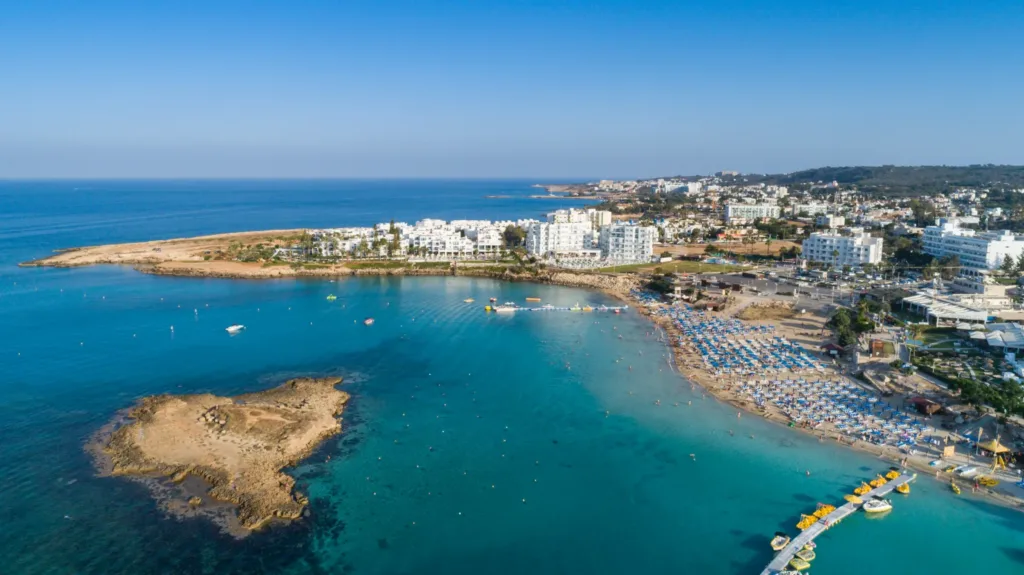
Fig Tree Bay is the main beach of Protaras; on the Greek Blue Flag list it appears as Protaras beach. According to Visit Cyprus, it is named after a lone fig tree that has grown here since the 17th century. The sand is fine, and the islet opposite, as the municipality notes, acts as a natural breakwater, so the water near the shore is usually calm and shallow.
According to the municipality, the beach has sunbeds and umbrellas, toilets, showers and water sports, with cafés and restaurants along the promenade. Visit Cyprus reports that the lifeguard tower has a special chair that lifeguards use to help people with disabilities into the sea. The beach holds a 2026 Blue Flag.
The flip side of its fame is the crowds: the municipal guide says the beach is always full, so come in the morning. The guide suggests swimming out to the islet, but do so only in calm weather, outside boat zones and never alone.
Vrysi and Potami: a long stretch of sand by the promenade
Vrysi (Βρύσι) is the longest sandy beach in Protaras: according to the municipality, it stretches for about a kilometre and is divided into four sections — A, B, C and D. The seabed is flat and sandy, and the water stays shallow for several metres from the shore. A promenade runs along the beach, and the municipality suggests walking it early in the morning and at sunset.
Because it is so long, Vrysi makes it easier to find a spot than Fig Tree Bay: you can choose the busy part or the quiet ends. The 2026 Blue Flag list includes sections A, B and C, but not section D. According to the municipality, section C has a floating chair and a Seatrac system for entering the water independently.
Potami is a 2026 Blue Flag beach north of Vrysi, towards Pernera. The municipal guide describes it as a mix of sand and pebbles with clear water, recommends it for families and for a quiet swim towards evening, and suggests bringing a mask and snorkel.
Southern coves: from Lombardi to Glyfades
South of Fig Tree Bay the coast is rocky. Lombardi (Λομπάρντι), opposite the Cavo Maris hotel, is a small sandy cove with shallow water that the municipality recommends for families. Next comes the small cove of Vali tou Hadjixeni (Βάλι του Χατζηξένη), with a rocky seabed, where the promenade ends. Neither is on the 2026 Blue Flag list.
According to the municipality, a narrow path leads to Vyzakia (Βυζάκια), and the cove itself is good for snorkelling. Just beyond the cove, according to the municipality, is the Neolithic settlement of Nisia (Νησιά). The beach of the same name, Nissia, also known as Green Bay, is known for its rocky shores; visitors take out canoes and stand-up paddleboards here. Both coves hold a 2026 Blue Flag.
Glyfades (Γλυφάδες), which locals call Mimosa or Nissia Gardens, is a small cove with fine sand and a rocky seabed, without a Blue Flag this season. According to the municipality, sea turtles are seen at Green Bay, Fig Tree Bay and Konnos; do not swim close to them. Konnos Bay (Κόννος), by Cape Greco park, is listed on the Blue Flag list under Ayia Napa.
How to choose a beach in Protaras
With small children, beaches with a sandy seabed and a gentle entry are easier: according to the municipality’s descriptions, these are Fig Tree Bay, Vrysi and Lombardi; the first two have both toilets and showers. There is more in our article on Cyprus beaches for families with children.
For snorkelling, choose coves with a rocky seabed — Vyzakia, Nissia, Vali tou Hadjixeni and Glyfades — as well as Potami. They are less crowded but have fewer facilities, and you will need water shoes on the rocks. Quiet is easiest to find early in the morning, in the small southern coves or at the ends of Vrysi.
The icons on the CYMEPA list help people with reduced mobility. The list marks access and a floating chair at Potami, Vrysi A and B and Fig Tree Bay, and Vrysi C and Vyzakia also have Seatrac. Because of the narrow path to Vyzakia, check access conditions in advance.
Facilities: sunbeds, lifeguards, getting there
Municipal sunbeds and umbrellas are paid — €2.50 each, according to the municipal guide, which also says that most beaches have free Wi-Fi. Fig Tree Bay, according to Visit Cyprus, has toilets, changing rooms and water sports.
According to Visit Cyprus, lifeguards are on duty at Fig Tree Bay from April to October; Vrysi, according to the municipality, also has lifeguards. CYMEPA adds that their hours are set by the municipality together with the Ministry of Interior and the Joint Rescue Coordination Centre, and the schedule is posted on the board by the Blue Flag pole.
According to Visit Cyprus, Fig Tree Bay is easy to reach on foot, by bike or by car, and there is parking nearby. The beaches are linked by the seafront promenade, and buses, according to the municipality, run along the main avenues. Local routes are run by the district operator OSEA (ΟΣΕΑ): check routes and timetables on its website shortly before your trip.
What to check before you go
Blue Flag status. This guide uses the CYMEPA list published in July 2026. The list changes every season, and the flag is temporarily lowered if the water is polluted; the municipality’s materials give a longer list, probably based on previous years.
Prices and season. Sunbed prices come from the 2025 municipal guide and may change. Out of season, beaches are usually unguarded, so check lifeguard hours on the board at the beach or with the Paralimni–Deryneia Municipality.
Sea and weather. On windy days, waves reach even sheltered coves, so check the forecast from the Cyprus Department of Meteorology. Swim in the guarded area and do not swim beyond the buoys; general rules are collected in our article on sea safety in Cyprus.
Continue planning
- Protaras: beaches, neighbourhoods and routes in eastern Cyprus
- Paralimni beaches: a coastal walk from Kapparis to Protaras
- Cyprus’s beaches with children: choosing a spot and safety
Official sources
- Paralimni–Deryneia Municipality: Fig Tree Bay
- Paralimni–Deryneia Municipality: Vrysi beach
- Paralimni–Deryneia Municipality: tourist guide (2025)
- CYMEPA: Blue Flags 2026
- CYMEPA: the Blue Flag programme in Cyprus, process and criteria
- Visit Cyprus: Protaras Beach (Fig Tree Bay)
- OSEA — Famagusta District bus operator
Fig Tree Bay and its islet, Protaras · Photo: dronepicr · CC BY 2.0 · converted to WebP and resized.
