Protaras: beaches, neighbourhoods and routes in eastern Cyprus
About the place
Checked: 13 September 2026.
What is Protaras and who is it suitable for?
Protaras is a stretch of resort along the east coast in the municipality of Paralimni–Derinya. It does not have a single compact centre in the usual urban sense: coves, hotels, restaurants and residential areas stretch along the coast. Therefore, the resort’s name in your booking doesn’t necessarily indicate whether you can walk to your chosen beach or the evening promenade.
The resort is particularly well-suited to a peaceful beach holiday and families, provided your accommodation is close to the bay of your choice. The nightlife is more subdued than in Ayia Napa, but in summer the main streets remain lively. Museum-goers and those keen to explore the old town will need to venture out. Protaras’s strengths lie in the sea, short walks and its proximity to Cape Greco.
Seasonal variations are more pronounced than in the larger towns. During the warmer months, a wide range of services is available, whilst in winter, some establishments and tourist routes are scaled back. This does not mean that a visit is impossible, but you should check the catering, transport and activities available at a specific venue before booking your accommodation.
Fig Tree Bay and other bays
Fig-Tri-Bay is Protaras’s most famous bay, but its popularity means it gets very busy. If it’s your first visit, arrive early, decide in advance where to park, and don’t count on finding a space right by the entrance. The small island opposite the shore is not an invitation to walk or swim out to it under any circumstances: water depth, wave conditions and boat traffic vary.
There are other beaches and small coves along the resort. They differ in terms of the shape of the shoreline, access, shade, facilities and proximity to accommodation. Instead of relying on rankings, define your own criteria: shallow water, tranquillity, water activities, accessibility or a promenade. Then check the latest information from the local council for the specific location.
On the shore, follow the flags and instructions of the lifeguards. Keep a close eye on your child at all times, even in clear and calm water. Do not swim beyond the buoys or into areas where boats are operating. The rocky edge of the bay can be slippery, and water shoes do not eliminate the risk entirely. Get out of the water if conditions deteriorate.
How to choose an area and accommodation
Accommodation near Fig Tree Bay is ideal for those who value having the beach and restaurants within walking distance, but it tends to be busier and noisier in the evenings. The northern and southern areas may be quieter, though the distances involved are greater. Check not just the direct line to the sea, but also the public access route, the gradient, any steps and whether there is a safe crossing across the road.
A villa with a swimming pool set back from the shore offers space, but means your group will be reliant on a car or taxi. Check the parking facilities, pool fencing and night-time lighting. For families with a pushchair, pavements and an uninterrupted route are essential. A ‘accessible accommodation’ label does not guarantee an accessible route to the nearest beach.
If you’re planning daily trips to Ayia Napa or Paralimni, accommodation near a convenient bus stop may prove more practical than beachfront accommodation. Make a note of the exact name of the bus stop in both directions and the last service. During the off-season, double-check the timetable: summer frequencies are not guaranteed all year round.
The Promenade, walks and Paralimni
The coastal path allows you to walk between some of the bays, but it should not be thought of as an endless, flat route. There are inclines, steps and sections with no shade. Choose a section with a clear turning point, especially if you’re with children. In summer, early mornings and evenings are safer for long walks than midday.
Paralimni is the administrative and residential centre of the district, not a continuation of the beachfront. A visit there is worthwhile for the town square, churches, shops and everyday atmosphere. Opening hours for places of worship and shops vary; please observe dress codes and do not disrupt religious services. Plan your return to the resort according to the timetable.
Viewpoints and small churches are not always accessible via barrier-free routes. The map shows the location but not the terrain or gradient. If a participant has limited mobility, please enquire about the condition of the approach and car park before setting off. In hot weather, even a short climb requires water and a rest break.
Cape Greco from Protaras
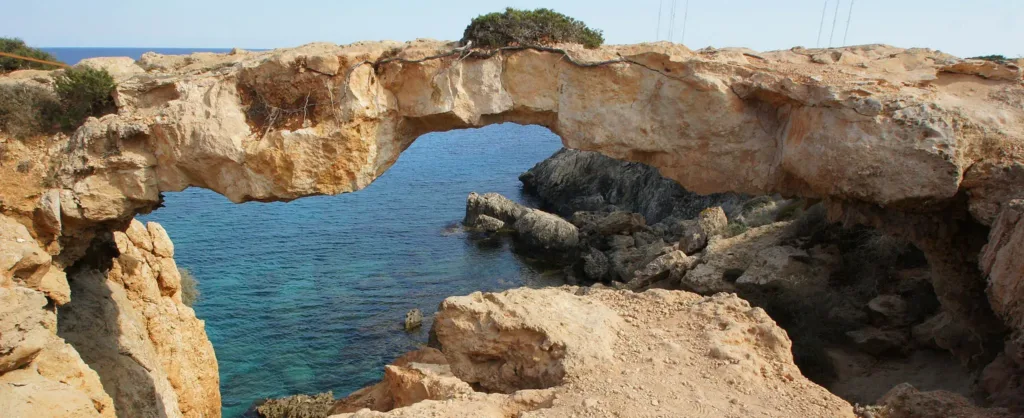
Cape Greco is situated between Protaras and Ayia Napa. Individual access points can be reached by public transport, bicycle or car, but you will then need to follow your chosen walking route. Do not start your walk on the nearest random path: use the official route description, and check the length, surface and exit point.
The route is exposed to direct sunlight, and strong winds are possible on the cliffs. Take water, sturdy footwear, a fully charged mobile phone and an offline map. Do not approach the crumbling edge or jump into the sea. Caves, boat trips and swimming should be assessed based on the current weather, not on photos from a different season.
For a short day out, choose one trail or a few permitted viewing points and return before the heat sets in. Attempting to combine a long walk, a day at the beach, a boat trip and an evening in Ayia Napa creates unnecessary risks. Detailed rules and the natural context are set out in a separate guide to Cape Greco.
Transport, car hire and the evening
Larnaca Airport is the most common point of arrival. Check with your transfer, taxi or bus service provider for your address and flight time. The resort is spread out, so your drop-off point in Protaras may be some distance from your accommodation. Save the location, the host’s phone number and a clear route from the drop-off point.
A car is handy for visiting several bays and nature spots, but remember that they drive on the left here. Park only in authorised areas and do not block access for emergency services. Check the hire terms and insurance cover before driving on unpaved roads. If you plan to drink alcohol, designate a driver in advance or arrange for the group to use a taxi.
In the evening, the main streets come alive, though outlying areas of the resort may be poorly lit. Do not take a shortcut across the rocks along the shore. Check the last bus from Ayia Napa and have a taxi on standby. Teenagers and children should return with adults, and the phone number and address of your accommodation should be accessible offline.
Holiday plan and seasonal check
Spend the first day at the nearest cove and exploring the area to get a feel for the actual distances. You can devote the second day to Fig Tree Bay or another chosen destination without rushing between beaches. On the third day, head to Cape Greco, Paralimni or Ayia Napa. One long trip a day saves time and reduces reliance on transport.
In summer, head to the beach earlier in the day and save long walks for the evening. In spring and autumn, keep an eye on the wind and water temperature. In winter, check in advance which restaurants are open, where the nearest shop to your accommodation is, and how frequently buses run. For any date, have a backup plan in case the sea is rough or a path is closed.
The day before, check the local authority’s information on the beach, the forecast, transport links and any official warnings. Do not simply carry over the itinerary and equipment from last year’s plan. Protaras is convenient when a specific bay, area and two departure points have been chosen in advance; then the spread-out geography becomes an advantage rather than a source of unnecessary journeys.
Continue planning
- Ayia Napa: centre, beaches and evenings
- Cape Greco: trails and practical route
- Larnaca: city base and transport