Flea markets in Cyprus: Nicosia, Limassol, car boot sales and antiques
Where to find flea markets and car boot sales in Cyprus, what is known about flea markets in Nicosia and Limassol, and which rules apply when you buy old objects and antiques.
Checked: 29 October 2026.
Flea markets in Cyprus: where to look and what to expect
A flea market in Cyprus is not one permanent place but several formats: open-air Sunday markets, indoor second-hand markets, car boot sales, antique shops and charity bazaars. There is no single official calendar. The best documented is the Sunday market run by the Nicosia Municipality (Λευκωσία), while for Limassol (Λεμεσός) there is currently no official list.
In Greek such a market is called παζάρι (pazari), and a small one παζαράκι (pazaraki) — the name used both for the Nicosia Sunday market and for school or charity fairs. These are not farmers’ markets (λαϊκή αγορά, laiki agora) or covered municipal markets, which are covered in our guide to markets in Cyprus by city.
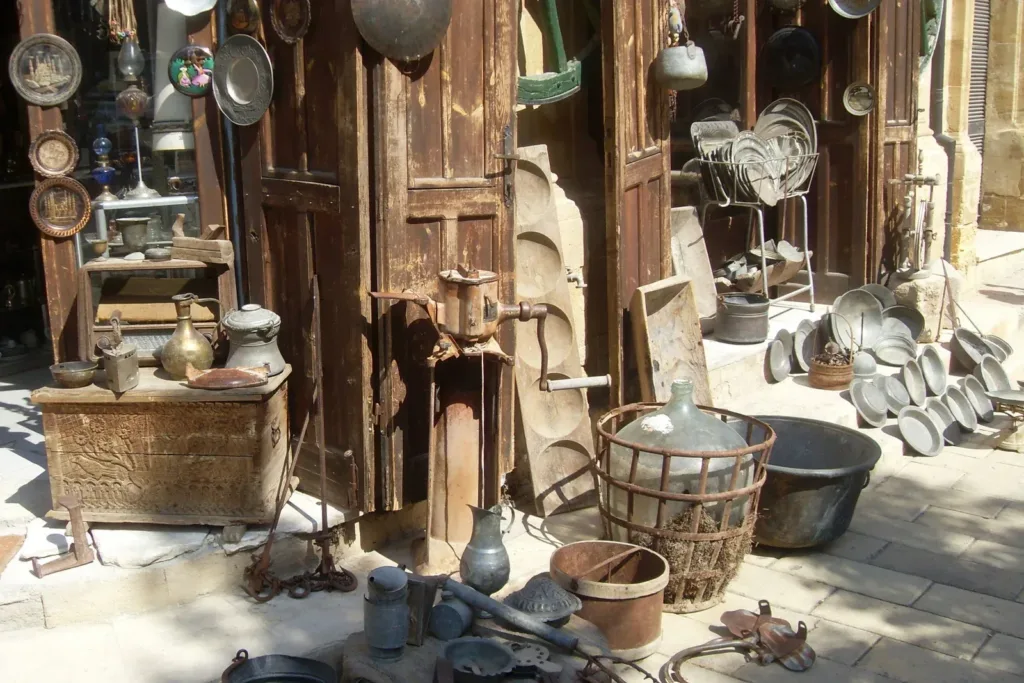
Most sellers are private individuals offering crockery and copperware, books, records, clothes, furniture and small appliances, and the selection changes every week. Items that look like archaeological finds are subject to strict rules under the Antiquities Law — more on this below.
Nicosia: the Sunday Pazaraki and the indoor market in Kaimakli
According to a Nicosia Municipality announcement of 9 July 2024, the Sunday market Pazaraki sto OXI (Παζαράκι στο ΟΧΙ) is held at the municipal Constanza car park (Κωστάντζα) every Sunday morning. Traders sell under a municipal licence issued for six months or a year for a specific pitch.
The OXI area by the Constanza bastion is best known for its farmers’ market, which, according to Visit Cyprus, the official portal of the Deputy Ministry of Tourism, is held on Wednesdays and Saturdays. The Sunday market is a separate event. The municipality does not publish a list of goods: each seller states them in the licence application.
The Kaimakli (Καϊμακλί) neighbourhood was home to the indoor Flea Market of Lefkosia. The Visit Cyprus events calendar for September 2017 called it the city’s first indoor flea market, open at weekends, with books, furniture, appliances, clothes and antiques. There is no more recent official information, so check whether it is still open.
Limassol: which flea markets are mentioned
Neither the Limassol Municipality nor the Limassol Tourism Board currently publishes a list of flea markets. The board’s previous website listed, in its section on markets, a flea market in the village of Asomatos (Ασώματος) and a car boot sale in Linopetra (Λινόπετρα), but since the site was updated that page no longer opens.
Guidebooks call the market near Asomatos the Fasouri flea market, after the neighbouring area of Fasouri (Φασούρι). In 2005 the Cyprus Mail described it as a large indoor market in a former warehouse on the road from the old port past the water park. Official sources do not confirm whether it is still operating.
An earlier version of this article described a Saturday flea market on a vacant lot at the junction of Agios Athanasios and Kolonakiou streets, and blogs mention a Sunday market near the old port. Neither has an official schedule, so check recent announcements or ask at a tourist information office.
Car boot sales, Larnaca, Paphos and charity bazaars
At a car boot sale, private sellers lay out their goods straight from the car boot or on folding tables. In Cyprus such sales are often one-off events: in March 2026, for example, the Cyprus Mail reported that a car boot sale in the Engomi (Έγκωμη) industrial area in Nicosia was returning almost a year after the previous one.
For Larnaca (Λάρνακα) and Paphos (Πάφος), blogs and forums describe a Sunday flea market at the site of the old GSZ stadium and markets in Chloraka (Χλώρακα) and Peyia (Πέγεια). The days and addresses in these sources differ, and the municipalities do not publish schedules, so treat this information as unconfirmed.
Second-hand goods are also sold by charity shops, and schools and community organisations hold one-off bazaars, especially before Christmas. Look for announcements about them in the local news.
Old objects and the Antiquities Law
The key rule is set by the Antiquities Law (Ο περί Αρχαιοτήτων Νόμος, Cap. 31), whose consolidated text is published on cylaw.org. The law defines an antiquity as an object of art or craft made by humans before the last 100 years and found or excavated in Cyprus, including its sea areas. For ecclesiastical and folk art of great value, the cut-off is 1940.
Article 26 prohibits anyone from dealing in antiquities; offenders face up to five years in prison or a fine. Antiquities not yet discovered belong to the state, and a chance find must be handed to the community leader, the police or a museum. So a ‘genuine’ ancient coin or amphora of Cypriot origin on a stall is either a copy or an illegal sale.
Under Article 27, no antiquity may be exported without a licence from a committee chaired by the Director of the Department of Antiquities; licences are granted for exhibitions, museums and scientific study, but not for private collections. In addition, under Regulation (EC) No 116/2009, an export licence is needed to take certain cultural goods out of the European Union; the age and value thresholds, as the European Commission explains, are set out in its annex.
How to buy: cash, checking items and returns
Bring cash in small notes: a private seller may have no card terminal or change. If there is no price, ask straight away. You can bargain, especially when buying several items, but the seller may refuse, and it is best not to insist.
Test electrical items on the spot. According to Visit Cyprus, the mains voltage in Cyprus is 230 volts, and sockets take British plugs with square pins. Inspect the cable and plug and ask to switch the appliance on if there is a socket nearby.
Flea market goods are mostly sold by private individuals, so there is usually no one to return an item to or ask to repair it later: the seller may not be there next week. Check for chips, cracks and missing parts before paying, and in an antique shop ask for a receipt and about return terms in advance.
What to check before you go
Schedules. This information was checked at the end of October 2026. The Sunday market at the Constanza bastion is organised by the Nicosia Municipality: ask there about date changes and opening on public holidays. Outdoor markets may not run in bad weather.
Private markets. The Kaimakli market and the Limassol flea markets have no official schedules: call the organiser or check recent reviews. Gift ideas are collected in our guide to what to bring back from Cyprus.
Buying in the north. At the crossing points, goods are checked by Republic of Cyprus customs: according to the Customs and Excise Department, non-commercial goods worth up to €260 per person can be brought across duty-free, and counterfeit goods are banned even as a single item. The Cyprus Mail reported that a late 18th-century church book seized at the Agios Dometios (Άγιος Δομέτιος) crossing point was handed over by a court to the Department of Antiquities.
Continue planning
- Cyprus’s markets by town — days, addresses, shopping
- What to bring back from Cyprus: food, handicrafts and limits
- Nicosia: Cyprus capital in the centre of the island
Official sources
- Nicosia Municipality: licences for the Sunday open-air market (Pazaraki at OXI)
- Visit Cyprus: events calendar, September 2017
- CyLaw: Antiquities Law (Cap. 31), consolidated text
- European Commission: cultural goods (customs)
- Cyprus Customs and Excise Department: crossing points, Green Line rules
- Visit Cyprus: Travel Planner, useful information
Old household ware outside a second-hand shop in northern Nicosia · Photo: Mindaugas Danys · CC BY 2.0 · converted to WebP and resized.
