Cyprus’s markets by town — days, addresses, shopping
Cyprus’s farmers’ markets by town: where they are, which days they’re open, how they differ from indoor municipal markets, and why you should check the opening times in advance.
Checked: 17 September 2026.
Two different markets under one name
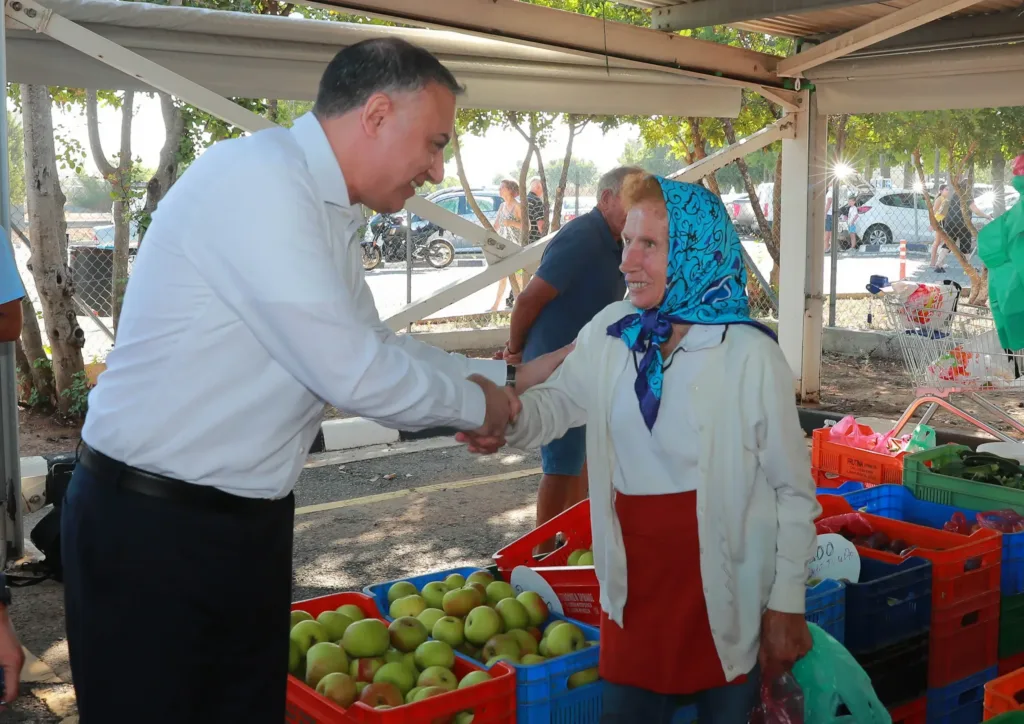
In Cyprus, the word ‘market’ refers to two different types of venue. Λαϊκή αγορά — an open-air farmers’ market organised by the municipality or local council once or twice a week, where produce is sold by the farmers themselves. The ‘Δημοτική Αγορά’ is a covered municipal market with permanent stalls and its own opening hours, which do not coincide with those of the street market.
The difference is not merely a matter of semantics: the two markets have different addresses, operate on different days and have completely different opening hours, yet Russian-language texts usually translate both names as ‘municipal market’ and lump their opening hours together in a single line. Because of this confusion, readers may turn up at an empty square or find themselves looking for farmers under the roof of the covered market.
From here on, we’ll focus solely on the food stalls: this guide will be useful for those who buy fruit and vegetables directly from the producer, are looking for local honey, halloumi or wine, and are planning a weekend itinerary around the various market sites. There is a separate, detailed feature on the Limassol flea market on the portal, and this overview does not replace it.
Limassol and Nicosia — where to find the stalls
Since 7 January 2023, the Limassol Saturday market has been held on Georgiou Tirotu Street, behind the municipal waterworks building. According to the council’s announcement, it runs on Saturdays from 06:00 to 14:00; the council may change the opening hours via separate announcements, so please check the latest information on its website before you go.
The municipality itself refers to the site colloquially as ‘pazaraki’, but it is producers, not flea-market traders, who sell here: there are no vintage items, no second-hand goods and no antiques. The site has been refurbished — there are 104 stalls under canopies, lighting, a café and toilets, whilst six free car parks have been designated in the surrounding area, some of which are private.
In Nicosia, the stalls are set up in OXI Square near Konstantinos Palaiologos Avenue, on the Costanza bastion within the Venetian walls, next to the Bayraktar Mosque. Producers from the municipality mainly sell fruit and vegetables here; the market is said to operate all year round, except on public holidays.
Larnaca, Paphos and the east of the island
The Larnaca market is held on Saturdays in the square behind the new covered market building. Aristotle Street is closed to traffic from 19:00 on Friday until 14:00 on Saturday; parking in the square is not permitted. However, these are the road closure times, not the trading hours: according to one-off announcements, the market ran from 06:00 to 13:30; there is no fixed schedule.
In Paphos, the stalls are set up in the western part of the Perbola car park on Fellachoglu Street, covering an area of around two hundred square metres. The operating hours – Saturdays and/or Sundays from 06:00 to 13:00 – are taken from the 2024 call for vendors: these are the recruitment conditions, not the timetable; please check with the municipality for the exact day and times.
In the east of the island, there is a market in Deryunia, which has come under the jurisdiction of the unified municipality of Paralimni–Deryunia. In February 2025, a replacement for the previous site was under construction there: a 50-metre-long covered market, 121 parking spaces, a café with a terrace and toilets; so the site’s address may have changed since then.
Official schedule, goods and crafts
There is a single official list – a brochure published by the Department of Agriculture (April 2025): Nicosia – Wednesdays and Saturdays; Strovolos – Fridays; Anfoupoli-Lakatamia – Sundays; Pano Polemidia – Sunday and Wednesday; and Derunia, Larnaca, Limassol and Paphos – Saturday. In Paphos, the local council adds Sunday; this discrepancy has not been resolved.
The product range is defined by a fixed list of 10 categories: fruit and vegetables; processed products made from them — ‘glyka tou koutaliou’ jams, marmalades, bread and koulouria; cut flowers and potted plants; snails; honey; eggs; wine and spirits; fresh fish; halloumi and home-made sausages; organic produce.
There are no weekly craft markets on this list at all. The state-run craft network is organised differently: the Cyprus Crafts Service has its headquarters in Nicosia and regional centres with shops and experimental workshops in Limassol and Paphos — no such centres have been announced in any of the eastern towns.
Price tags, cash payments and VAT on food
The Consumer Protection Law of 2021 requires sellers to display both the final price including all taxes and the price per unit of measurement – per kilogram, litre, metre or per item, if the goods are sold individually. The labelling must be clear and easily legible; no specific exemption for street stalls is stated anywhere.
Hence the answer regarding haggling: whilst it is a common practice, it is not described as such in any official source; the seller is under no obligation to lower the price, and the price displayed is the one that applies. According to the government documents found, stalls in the farmers’ market are not required to accept cards: please pay in cash and check with the specific seller regarding payment.
The tax framework follows the calendar: zero VAT on fresh fruit and vegetables applies throughout 2026, whilst for meat and fish it applies only from 6 April to 30 September 2026; processed products such as sheftali and lunza remain at 5 per cent. If you’re reading this after that date, assume that the VAT rate on meat has returned to normal.
Opening hours, public holidays and old addresses
Opening hours are the most uncertain aspect of this topic. Regarding Nicosia’s OXI Square, two official sources give differing information: the municipality states Wednesday until 16:00 and Saturday until 15:00, whilst the Visit Cyprus tourism portal states an hour later on both days. Any timetable here should be treated as a guide only and checked against the original source before setting off.
Municipalities announce public holidays and schedule changes in separate news items: in August 2025, Larnaca announced the cancellation of both its markets in succession. There is no standard closing time: in the west and south, the markets pack up earlier; in the capital, later; and there are only a handful of Sunday markets listed officially across the whole island.
The second pitfall is outdated addresses. Until 2023, the Limassol markets were held on Lella Karayanni Street, and this address still circulates online; the local government reform has changed the municipalities and their domains. The market in Germasogeia isn’t listed in the government register, and the local council’s website isn’t responding.
What to check before heading to the market
Start with the day of the week: using the Department of Agriculture’s list, select the town and market site, then visit the relevant municipality’s website and cross-check the address against the date the notice was published. Cancellations and rescheduling are posted there too, as separate news items. The publication date is more important than the content: an old notice will still list the previous address.
The second step is the route and parking. Check the local authority’s website to see if access is clear and where you’re allowed to park: on market days, the traffic flow around the stalls changes, and some streets are closed off in advance. Allow plenty of time for the journey and finding a parking space: the traffic plan for market days is published by the local council itself.
Thirdly – containers and payment. Bring your own bag for vegetables and cash in small notes. The rules regarding price tags and the current tax rate are explained above – read them again before totalling up your basket: you shouldn’t ask the seller for either figure; instead, check them yourself on the spot before joining the queue.
Continue planning
- The Limassol flea market: a detailed first-hand account
- What to bring back from Cyprus: food, crafts and limits
- Lefkara: lace, silver and a stroll through the village
Official sources
- Department of Agriculture, Cyprus Ministry of Agriculture — “Let’s Go to the Farmers’ Market!” brochure (April 2025)
- Nicosia Municipality — OCHI open-air market
- Visit Cyprus (Deputy Ministry of Tourism) — OCHI Open Market
- Limassol Municipality — operation and parking at the new open-air farmers’ market
- Larnaka Municipality — municipal farmers’ market
- Pafos Municipality — invitation to participate in the new farmers’ market (28 March 2024)