Birdwatching in Cyprus: seasons and rules
How to choose a location and the best time of year for birdwatching, what to take with you, and how to avoid disturbing the birds and their nesting sites.
Checked: 27 September 2026.
Observation begins with choosing a location
Cyprus lies on the migratory route of birds, but a successful birdwatching trip does not depend on a list of rare species. For your first outing, choose an accessible, officially designated spot where you can observe from a distance and return safely. BirdLife Cyprus publishes a guide to observation points and a code of conduct; both are more useful than random coordinates found on social media.
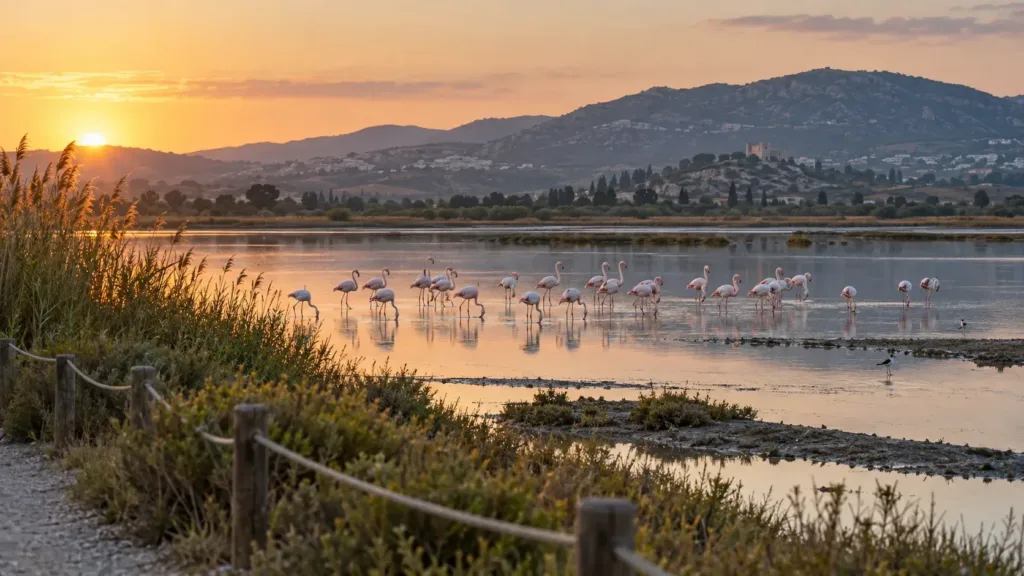
Check the location against the season and conditions. A wetland may only be of interest if there is water present, whilst a coastal spot depends on the wind and access. The map shows where to go, but does not guarantee the presence of birds today. Plan your walk so that the absence of a particular species does not become a reason to disturb a neighbouring restricted area.
For a beginner, it’s better to spend a few hours at a single spot than to rush between lakes. Check in advance for parking, authorised access routes, shade and water. If the spot is in a protected area, read the rules posted at the entrance and don’t look for an unofficial route just to get a better vantage point.
Spring, autumn and local species
Migration changes the composition of the bird population from season to season, but the calendar does not function as a timetable. Weather, water levels and habitat conditions all affect stop-over sites and sightings. The BirdLife guide helps you choose a destination for the season; it’s worth checking current sightings and local restrictions closer to your travel date.
Observation is also possible in summer and winter, although conditions for visitors vary. In hot weather, choose a short walk with water and shade; on a windy day, bear in mind the open coastline. Do not assume that access to the salt marsh is safe simply because it looks dry and level in a photograph.
Do not label a bird as rare based on a single blurry photograph. Compare size, shape, colour and behaviour, and allow for uncertainty. An erroneous report with precise coordinates could attract a flood of visitors to the nest or flock; it is better to send the sighting to a nature conservation organisation for verification.
Distance is more important than the photograph
The BirdLife Code puts the interests of birds first. If a bird takes flight, cries out in alarm or changes its behaviour because of a person, please move away. Do not approach a nest, do not play recorded bird calls to lure birds without understanding the consequences, and do not fly a drone near birds without checking the regulations.
Binoculars or a spotting scope allow you to observe from a designated viewing point. When taking photographs, a long lens is more useful than taking a few steps closer to the bird. Please do not block the path for other visitors, and do not leave your equipment on vegetation, which can easily be damaged. A great photograph is not worth disturbing the animal.
Breeding sites are particularly sensitive. When submitting a report, please indicate the general area only, as specifying the exact location could lead people to the nest. Please respect private land and the activities of local residents. Nature observation should leave the area just as undisturbed as it was before you arrived.
What to take on your first walk
Start with a pair of binoculars, water, a hat, footwear suitable for the terrain, and a fully charged mobile phone. Expensive kit isn’t essential: notes on the silhouette, size and surroundings are sometimes more useful than a poor photograph. Take a map to find your way back and check you have mobile coverage. In warmer weather, plan a break in the shade.
A field guide or app helps you compare characteristics, but an automatic suggestion is merely a hypothesis. A bird’s plumage changes with age and the seasons; a photograph may obscure important details. Only record what you have actually seen, and mark any uncertain identification as provisional.
If you’re out with children, agree on keeping your voice down and setting a route boundary. Give each child a simple task: to spot the shape of a bird’s beak, the direction of flight or its behaviour near the water. When a child gets tired, wrap up the birdwatching session; a long search for a rare sight rarely makes the walk any more rewarding and increases the risk of straying from the path.
Sites and local rules
The official BirdLife guide lists various types of sites, from coastal spots to seasonal water bodies. Compare them on the basis of accessibility, rather than the likelihood of sightings. At some sites, conditions are heavily dependent on rainfall; descriptions from previous years may not reflect current road or water conditions.
A field trip with an experienced group helps you learn to identify birds and keep a safe distance. Please check the group size, route, timing and requirements for participants. Even an organised excursion does not override the signs indicating a protected area or the guide’s decision not to allow visitors to approach too closely.
Do not enter private property or block the service entrance. When observing from the road, park where it is permitted and safe for traffic. If the location is closed or access is uncertain, choose an alternative rather than following an old geotag.
How to keep a record without causing harm
Please note the date, time, weather, habitat type and any observed characteristics. If you were unable to count the flock, please provide an estimate of the number of birds. BirdLife recommends submitting your records to the monitoring schemes; before submitting, please check the guidelines for sensitive species and ensure your identification is accurate.
Photos and notes are useful when they can be used to verify a sighting. Do not add a ‘confirmed’ status after publication: if the species has been revised, correct the record. For rare birds, it is wiser to consult an expert first rather than inviting followers to the spot. Such actions protect both the birds and the accuracy of the data.
Make a note of successful and unsuccessful outings. If you didn’t spot any birds, a record of the weather and water level will provide context and help you choose the next day. This is better than dismissing a route as ‘bad’ and looking for an untrodden path closer to where the flock is resting.
Check before the next outing
Before setting off, check the forecast, access conditions and the latest updates on the site. Take plenty of water with you, bear in mind how long it will be before dark, and do not plan a long trek along an unfamiliar shoreline. During the breeding season, avoid areas where human presence might disturb the nests, even if access was previously permitted.
The information on species and routes in this article is based on sources verified on 27 September 2026. Migration patterns, water levels and access rules are subject to change; the latest information from the managing authority and BirdLife takes precedence over this general overview.
This guide helps you to organise your birdwatching in an environmentally responsible manner and to keep verifiable records. It does not guarantee sightings of specific birds, does not grant access to restricted areas, and is not a substitute for the advice of local conservation experts regarding sensitive habitats.
Continue planning
- Cyprus’s wildlife: where to spot animals and how to avoid causing harm
- Cyprus’s waterfalls: walking trails, seasonal information and safe access
- Stargazing in Cyprus: location and night-time conditions