Stargazing in Cyprus: location and night-time conditions
How to choose a suitable location, take cloud cover, the moon and backlighting into account, and plan a safe return in advance.
Checked: 27 September 2026.
How to choose a night and a place
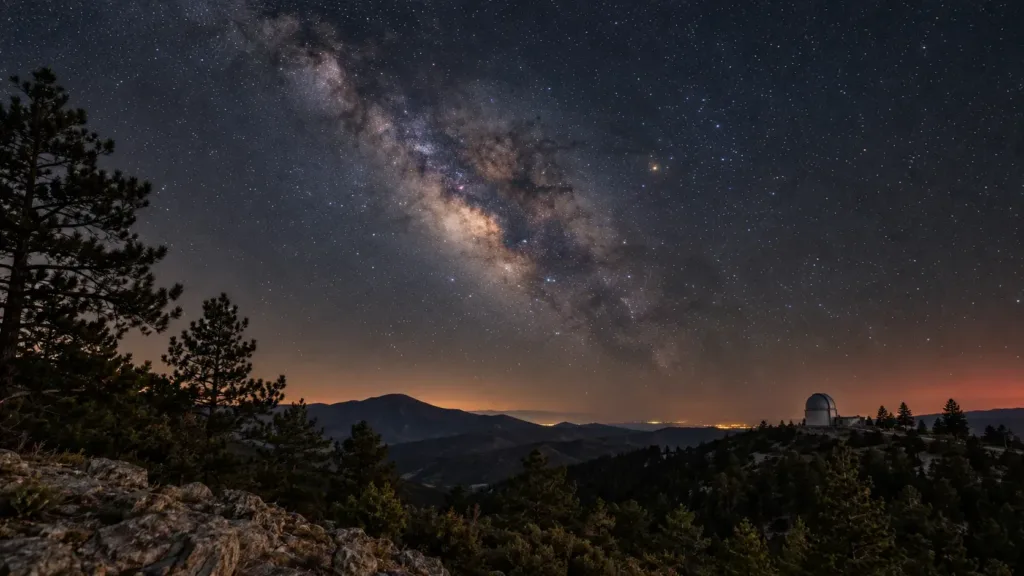
When stargazing in Cyprus, it is important to have an unobstructed view of the horizon, clear skies, minimal ambient light and safe access at night. Even a remote mountainous location does not guarantee a clear sky, and photographs of the Milky Way are often taken using a long exposure. Start with an accessible spot where you can legally park and return, rather than the darkest spot on the map.
Check the Cyprus Meteorological Service’s forecast and the time you plan to observe. Low cloud, haze and strong winds can spoil your evening, even if it was sunny during the day. Check the phase and position of the Moon: a bright Moon reduces the visibility of faint objects, but does not make the evening a waste of time for observing the Moon itself or bright planets.
An astronomical calendar helps you choose a date for a specific event, such as a meteor shower. This guide addresses a different issue — how to assess the location and conditions for your visit. Don’t assume that the event will be visible from just anywhere: the weather and light pollution may prove more important than the date on the calendar.
Light pollution and the eyes’ adaptation
Street lights, shop signs and car headlights make faint stars less visible. DarkSky International explains why directional and moderate lighting is better for the night sky and the environment. For an observer, this means finding a suitable spot away from direct light, rather than driving along a dark, unfamiliar dirt track.
Give your eyes time to adjust to the darkness and do not shine a bright torch in other people’s faces. A small torch is needed for safe movement, but it should be pointed downwards and used only when necessary. Do not switch off your car’s headlights on the road just to see the stars, and do not stand on the carriageway just to get the perfect shot.
Even a good light map does not show current cloud cover or local spotlights. Check out a few available locations in advance and choose one with clear parking and easy access. Once you arrive at the location, assess it again; if it’s closed, cramped or unsafe, simply change your plan.
Organised stargazing
The Troodos Observatory runs daytime and evening programmes, although telescope viewing is subject to weather conditions. Before booking, please check the current opening hours, ticket prices, age restrictions and what is included in the programme. Advertising for a past event does not guarantee that it will be repeated in the same season or in the same format.
A guided tour is useful for beginners: the guide explains the facilities and equipment, and the site usually has a clear itinerary. But even an observatory cannot guarantee a cloudless sky. Check the rules on rescheduling or refunds in case the weather prevents part of the programme from going ahead.
If you’re bringing your own telescope, start by trying a simple location that’s easy to reach. Heavy equipment and fiddly adjustments in the dark take time. Binoculars or observing with the naked eye sometimes provide a better first experience than a rushed trip to a remote area with unprepared equipment.
Mountains, the coast and access restrictions
Altitude and distance from the town may reduce some of the light pollution, but the mountains bring cold, wind and difficult access. Do not assume that every spot in the Troodos Mountains is accessible at night. Forest roads, car parks and protected areas have their own rules; check these before you set off and follow the signs on site.
On the coast, an unobstructed view is ideal for certain subjects, but there may be bright holiday resorts, wind and crowds nearby. Avoid the edge of a cliff or a rocky shore just to avoid streetlights. A safe, level spot with slightly more light is better than a dangerous approach in the dark.
If your journey takes you through a village, please respect the residents: do not block driveways, do not make a lot of noise and do not shine lights into people’s homes. In natural areas, do not play loud music and do not stray from the path to set up your tripod. Your observation should leave the area comfortable for both people and animals.
Plan for returning at night
Save your route for when you’re offline, check your fuel or battery level, and let your loved ones know your estimated time of return. A drive after a late screening requires an alert driver; if you’re feeling tired, it’s better to call it a day early or opt for an organised trip with clear logistics. Don’t rely on a sat-nav that takes you down an unfamiliar dirt track.
Take a warm layer, some water, a fully charged mobile phone and a small torch. Even after a hot day, it can get chilly in the mountains at night. For children, decide in advance how long the walk will take and whether they can return without having to wait for the whole group. Do not leave people on their own in the dark by the car or on the path.
Agree on a meeting point in case the group splits up, and do not set off in search of ‘better skies’ without prior agreement. If the site is closed or the weather has taken a turn for the worse, return via a familiar route. The mere possibility of seeing more stars does not justify the risk of venturing into unknown territory.
Stargazing without expensive equipment
Start by identifying the brightest constellations and planets using a reliable star chart for your chosen date. The app helps you find your way around, but may be inaccurate due to time and direction settings. Check the date, location and that the object is actually above the horizon at the time of your visit.
You don’t need a telescope to observe a meteor shower; what’s more important is a safe spot, patience and a dark patch of sky. Do not treat the number of meteors as a guaranteed figure: cloud cover and light pollution will affect your viewing. If you are taking photographs, check in advance whether you are allowed to set up a tripod and whether it will obstruct other visitors.
Make a note of the time, the weather and any landmarks you can see once you’ve gone out. This will help you compare different locations without resorting to a made-up ‘best spot in Cyprus’ ranking. If a photograph has been heavily edited, don’t pass it off as the view someone would see with the naked eye that very evening.
Check before the next outing
During the day and in the evening, check the forecast, cloud cover, the phase of the moon, access and the timetable for your chosen venue. Check with the organiser to see if the programme will go ahead in the event of bad weather. If you’re planning to attend a specific event, compare the calendar date with the actual night in question, rather than relying on an out-of-date event listing.
The sources for this article were checked on 27 September 2026. Weather conditions, observatory operations and access rules are subject to change, so details regarding opening times and conditions should be confirmed before each visit. The date of this article does not constitute a forecast of clear skies.
This guide helps you plan a safe viewing session and minimise the impact of light on those around you. It does not guarantee that a specific celestial event will be visible, nor does it replace instructions from the site operator, the meteorological service or road signs at night.
Continue planning
- Skiing holidays in Troodos: the season and checking the conditions
- Birdwatching in Cyprus: seasons and rules
- Cyprus’s waterfalls: walking trails, seasonal information and safe access