E-scooters in Cyprus: the 2026 rules and fines
How old you must be to ride an e-scooter in Cyprus, where riding is allowed, what the scooter must have, whether you need a helmet and insurance, and what fines apply.
Checked: 27 October 2026.
E-scooters in Cyprus: at a glance
Since April 2026 the rules for e-scooters in Cyprus have been stricter: you can ride one only from the age of 17, not 14 as before. A passenger must also be over 17 and may ride only on a purpose-built seat, while the speed limit of the scooter itself has, by contrast, been raised from 20 to 25 kilometres per hour.
In law, an e-scooter is a personal mobility device (Συσκευή Προσωπικής Κινητικότητας). It is governed by Law 19(I)/2018 on the movement of bicycles and other personal mobility devices, as amended in 2022 and 2026.
Below: who may ride an e-scooter, where riding is allowed, what the scooter itself must be like, what equipment is compulsory, what fines apply and how hire schemes work.
Age and parental responsibility
You can ride an e-scooter from the age of 17: this limit was set by Law 107(I)/2026, published on 22 April 2026. Articles that mention 14 for riders and 12 for passengers are out of date.
The scooter’s owner and the parents or guardians must take all necessary steps to make sure that children under 17 do not ride it. If they fail to do so, the adults themselves commit an offence.
If a teenager under 17 is riding an e-scooter, the police and municipal inspectors may seize it. The seizure procedure is to be set by a ministerial decree: a draft under which scooters would be seized for 30 to 90 days was under consultation until 26 September 2026.
Where you can and cannot ride
Riding is allowed on cycle paths and cycle lanes, in signed shared areas for cyclists and pedestrians, and on streets with a 30 km/h speed limit. Riding on roads with a higher limit is not allowed, except to cross the road between permitted sections.
E-scooters are banned on motorways and high-speed roads. Squares and pedestrian streets are also off limits, unless the municipality or community has allowed riding there by a decision published in the Official Gazette and put up signs; in such areas the speed limit is 10 km/h.
Riding on pavements is not allowed. Riders must obey signs and traffic lights, keep to the left edge of the lane, give way to pedestrians at crossings and in pedestrian areas, signal turns by hand and not ride side by side with another scooter.
What the scooter must have
The scooter must be limited to 25 km/h, either by design or by an adjustment made by the manufacturer’s authorised representative. A declaration of conformity with CE marking and compliance with European standard EN 17128 have been compulsory since April 2026.
The minimum equipment is brakes that can stop the scooter within a reasonable distance, a white or yellow front light and a red rear light visible from at least 150 metres, a bell or horn, and tyres with good grip. Together with proof of purchase, the buyer should receive written confirmation from the manufacturer, the importer or a registered mechanical engineer that the scooter meets these requirements.
Sellers and importers who sell non-compliant scooters face a fine of up to €5,000 and/or up to six months in prison. An e-bike is a different device: its motor of up to 0.25 kW assists only while you pedal and cuts out at 25 km/h.
Helmet, lights and other rules
A helmet is compulsory for the rider and must be fastened. The type of helmet must be approved by the Road Transport Department.
Between sunset and sunrise, lights must be on and reflective elements worn on clothing. Riding under the influence of alcohol or drugs is prohibited, and the same rules apply as for car drivers.
E-scooters may not be parked on cycle paths, cycle lanes or the carriageway, and on a pavement they must not obstruct pedestrians — at least one and a half metres must be left clear. Riders must also not tow or push objects with the scooter, hold on to other vehicles or carry items that make riding unsafe.
Fines
The law sets fixed fines. A fine of €85 applies to an owner or parent who fails to stop a rider under 17, and to a rider for riding in a prohibited area or on a motorway, using a scooter that can go faster than 25 km/h, speeding in a pedestrian area or ignoring traffic lights.
A fine of €50 applies for riding without a helmet, without lights or reflective elements, for carrying a passenger in breach of the rules and for illegal parking. These amounts apply as of October 2026; if a fixed fine is not paid within 90 days, it increases by half.
If a case goes to court, the main offences carry a fine of up to €1,000 and/or up to three months in prison, and the others a fine of up to €1,000. The rules are enforced by the police and authorised municipal inspectors.
Insurance and hire scooters
The law does not require compulsory third-party insurance for e-scooters, and they do not have to be registered. In September 2026, MPs tabled bills on registering e-scooters and on tougher penalties for riding by under-age teenagers, but so far these are only proposals.
Hire companies need an annual licence from each municipality or community where they operate. Local authorities may cap the number of scooters, require speed limiting and GPS tracking and designate parking spots, and every scooter must carry a sticker with a unique number.
If the rules are broken on a hire scooter, the company passes the customer’s full details to the police and the municipality on request. If anyone is injured in an accident, call 112; the information in this article was checked as of 27 October 2026.
Continue planning
- Driving in Cyprus: rules and safety
- Public transport in Cyprus
- Road accident in Cyprus: what to do after a crash
Official sources
- CyLaw — Law 19(I)/2018 on bicycles and personal mobility devices (consolidated)
- Official Gazette — Law 107(I)/2026 (age 17)
- Official Gazette — Law 106(I)/2026 (25 km/h, EN 17128, seizure)
- Official Gazette — Law 138(I)/2022 (fixed fines table)
- CyLaw — Out-of-Court Settlement of Offences Law 47(I)/1997
- e-consultation.gov.cy — draft decree on seizure of personal mobility devices
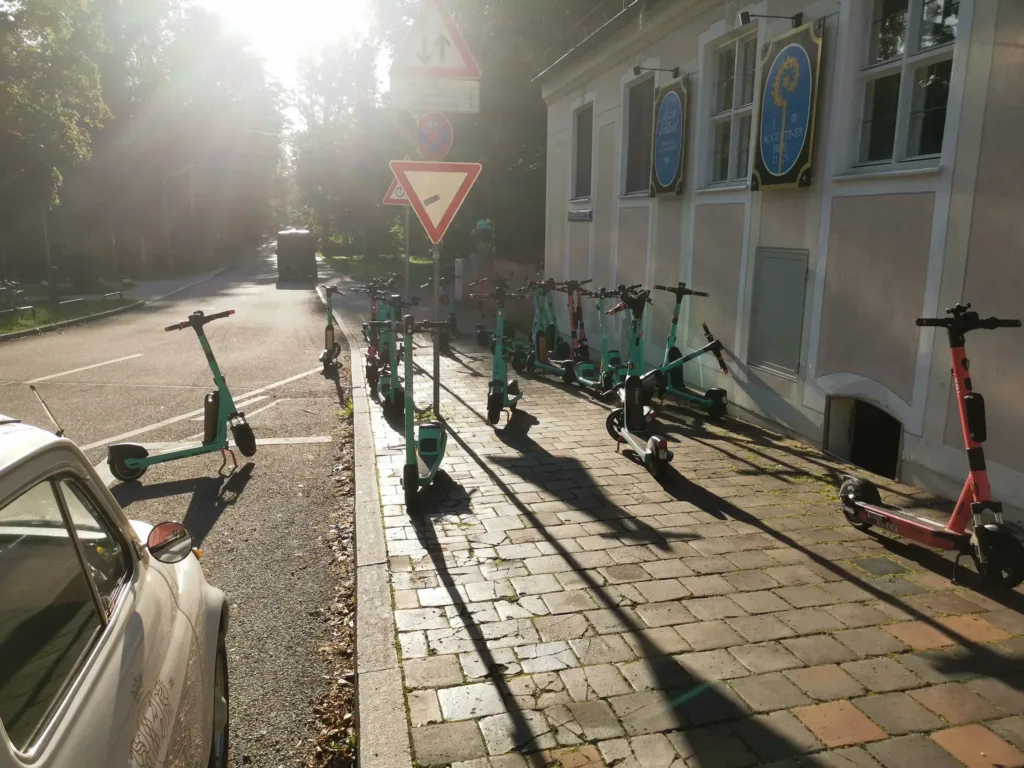
Shared e-scooters parked on a pavement in Munich · Photo: Wikitarisch · CC BY-SA 4.0 · converted to WebP and resized.
