Kayaking and SUP in Cyprus: where to launch and how to assess sea conditions
Choosing a calm stretch of water, checking the sea forecast, local restrictions and a safe return plan.
Checked: 27 September 2026.
A beautiful bay does not guarantee a safe outing
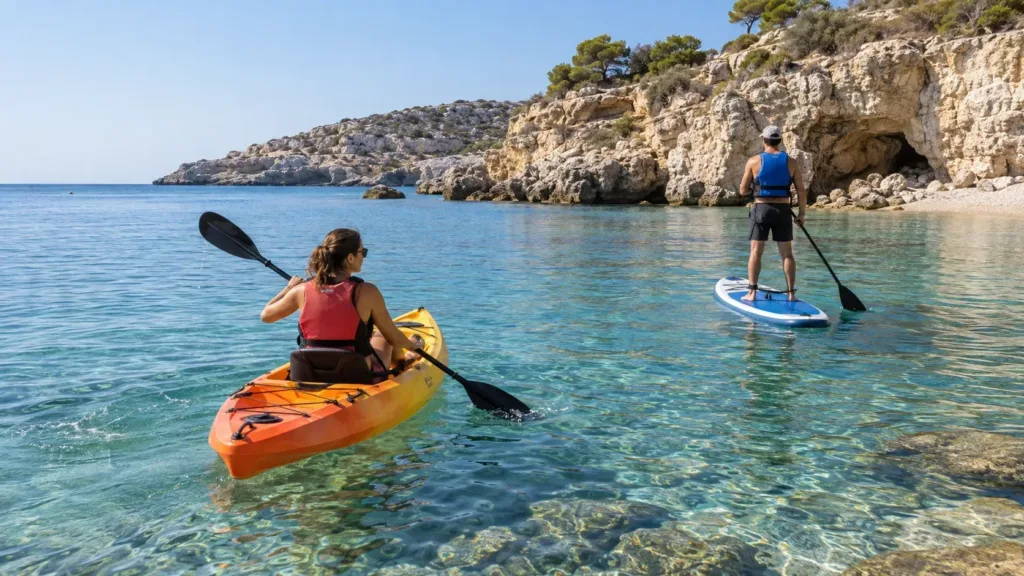
Kayaking and stand-up paddleboarding (SUP) allow you to explore the coastline from the water, but your choice of location depends on your skill level, the wind, the waves, boat traffic and local restrictions. The photograph of the calm cove was taken at a specific time; conditions may be different later on. For your first outing, look for an organiser and a sheltered spot, rather than a distant point on the map.
The Cyprus Meteorological Service publishes a marine forecast, which you should read before every trip. Check the specific area, the time the forecast was issued and any changes in wind conditions during your trip. If the forecast is unclear, ask a qualified local operator. If in doubt, it is safer to postpone your trip than to test the sea conditions for yourself far from the shore.
Decide in advance where you will set off from, where you will finish, and how you will return if conditions deteriorate. Even a short route along the cliffs may not have a convenient way to get ashore. If the group does not know an alternative landing point and when to turn back, the plan is not yet finalised.
Area, boundaries and authorised access
Cyprus’s marine protected areas are subject to various regulations published by the Department of Fisheries and Marine Research. The fact that an area is shown on a tourist map does not mean that all types of recreational activities are permitted there, or that you may disembark at any point. Before travelling, check the specific area, the signs on the shore and the conditions set by the relevant authority.
Please check separately where boats are navigating and where the swimming beaches are located. Do not cut across shipping lanes just because it shortens your journey. Check with the boat hire company to confirm the permitted waterways and what to do when you encounter other vessels; local markings take precedence over route descriptions found online.
The beach access point also needs to be checked. There may be a specific area designated for launching a boat or surfboard, whilst the surrounding stretch of beach may be off-limits or unsuitable. Do not carry your equipment across the dunes or through nesting areas. If access is restricted, choose another area.
The wind, the waves and the time of return
On a SUP, it’s particularly noticeable how a headwind affects your return speed. A kayak has its own stability and handling requirements; no form of water sports becomes safe simply because the shore is in sight. Assess the forecast, actual gusts and wave conditions at the starting point together with your instructor or the operator.
Plan a short initial stretch and a waypoint beyond which you can turn back. Do not set out to round a headland if the wind conditions and landing options on the other side are unknown. Fatigue, the sun and the urge to ‘get that perfect shot’ increase the risk of missing the safe return time.
If conditions deteriorate, cut the trip short in good time. Information on current sea conditions at the shore, warnings from the operator and official announcements take precedence over advance bookings. This material does not specify a universal acceptable wind strength: the decision depends on the group’s ability, the vessel, the area and professional judgement.
Equipment, communications and the group
Before setting off, check that you have a lifejacket of the correct size, and check the condition of the boat or board, the paddle and your means of communication. Ask the operator what is included in the hire, who will be giving the safety briefing and how to report any problems. Participants must understand the route boundaries and the cancellation policy before setting out on the water.
A mobile phone in a waterproof case is useful, but it does not guarantee a connection. Agree on a return time and meeting point with someone on shore, especially if you are travelling without a group. Don’t assume that every cove will have mobile coverage or a place to go ashore.
Children and beginners need a format that is suited to their skill level, the level of supervision provided and the current sea conditions. Do not leave a child on their own on a board near a busy stretch of water. Discuss with the organiser the age requirements, the plan in case of fatigue and who makes the decision about returning to shore.
Nature and other people on the water
Marine protected areas have been established, in particular, to protect habitats and species. Please do not chase dolphins, turtles or other animals just to take photos; do not approach them closely and do not feed them. The Department of Fisheries specifically reminds the public that it is unacceptable to disturb cetaceans with boats; the same principle of considerate behaviour is also important for recreational fishing.
Do not go ashore on a restricted beach and do not damage the delicate vegetation. Collect all rubbish and keep your distance from swimmers. In a narrow cove, there may be swimmers, boats and several rental groups at the same time; you need to share the space safely, rather than assuming the water is free simply because there are no markings on the map.
If you notice any signs of hazardous weather or irregularities, inform the operator on duty and move to a safe location. Do not publish a route as ‘secret’ without checking access permissions: an influx of new visitors could damage the protected area and lead to a conflict with local regulations.
How to choose an organiser
Ask about the instructor’s qualifications, group size, the condition of the equipment, insurance, cancellation policy and rescue plan. A reputable operator will take the forecast into account and may suggest an alternative location or reschedule the trip. A promise of unchanging conditions and ‘complete safety’ regardless of the weather is a good reason to ask for further details.
Check that the price includes tuition, a lifejacket of the correct size, transport and, where applicable, return transport to the starting point. Clarify who is responsible for participants if the group splits up. Do not agree to a long route simply because it has already been paid for; the option to shorten or cancel the session must be made clear in advance.
If you’re bringing your own equipment, be sure to check local restrictions and the forecast anyway. Experience in other waters does not guarantee familiarity with the Cypriot waters. Before setting out, discuss traffic patterns and landing points – which may not be obvious on a satellite map – with a local expert.
A decision just before setting off
In the morning, check the marine forecast; whilst on shore, assess the wind, waves, visibility and the operator’s instructions. Set a return time with a margin of safety and inform the person on shore of your plan. If you have any doubts about the conditions, opt for a walk along the shore or postpone your trip, rather than trying to ‘go out, even if only for a short while’.
Sources were checked on 27 September 2026. Marine warnings, regulations for protected areas and equipment hire arrangements are subject to change; up-to-date information is required for any specific trip. This text does not confirm that any of the areas mentioned are always open to kayaking or stand-up paddleboarding.
A guide helps you ask the right questions and avoid dangerous plans. It is no substitute for training on the water, local guidance or an individual assessment of your skills. In a life-threatening situation, follow your communication plan and contact the emergency services.
Continue planning
- Cyprus’s waterfalls: walking trails, seasonal information and safe access
- Rock climbing in Cyprus: areas, access and safety
- Cycling routes in Cyprus: how to choose a route and prepare