Cypriot sandwiches: halloumi, lountza and how to order
How to choose a Cypriot sandwich with halloumi and lountza: bread, fillings, heating and sauces. What to specify when ordering and important dietary restrictions.
Checked: 3 October 2026.
What is a Cypriot sandwich?
A Cypriot sandwich is an everyday dish made with local ingredients, primarily halloumi and lountza, but there is no single, set recipe. To get the right one for you, specify the filling, choose your bread, vegetables and sauce, and then ask whether the sandwich will be heated or served cold.
The word ‘national’ in the description does not imply a standardised recipe that is the same in every snack bar. In some places, the base consists of cheese and meat, whilst others offer additional types of filling. It is more interesting to compare the different versions in terms of their ingredients and preparation than to look for a single ‘official’ combination.
This is a handy snack that you can find in bakeries, cafés and sandwich shops. Choose a specific place based on the current menu and service options. The appearance of a vehicle, kiosk or sign alone does not allow you to judge either the origin of the recipe or the quality of the food.
Halloumi and Lountza
Halloumi is a cheese that can be enjoyed both cold and grilled. In a sandwich, the texture and flavour of the filling change depending on how it’s heated. If you’d like to experience the combination of ingredients, ask how the cheese is prepared here before adding any extra fillings.
Lountza is a local pork product; it is often served with halloumi. It’s worth remembering this name separately from the general term ‘ham’: this helps you understand the menu and avoid ordering something unexpected. Not all meat fillings are interchangeable, even if they look similar in the finished sandwich.
A sandwich containing only halloumi and vegetables may be a convenient option for those avoiding meat, but this does not necessarily meet all dietary requirements. The ingredients of the sauce and bread, as well as the method of preparation, should be clarified separately. A pork-free option is also not defined simply by the name of the cheese on the menu.
Bread and portion sizes
Various types of bread are used for sandwiches, ranging from soft, long loaves to denser varieties. The size and thickness affect how the filling tastes and how easy it is to eat on the go. Rather than assuming what a standard portion is, have a look at a sample, a photo of the menu or ask the shop assistant.
The word ‘toast’ can refer to both a type of bread and a method of heating. If you want your sandwich to be hot, please state this clearly. A toasted surface does not guarantee that every filling will be the same temperature, and a cold version is not necessarily a mistake in your order.
If you’re heading out for a walk, it’s a good idea to ask for the sandwich to be wrapped and, if necessary, cut into pieces. If you plan to share it, make sure to clarify this before it’s served. Buying a large portion to share doesn’t mean you have to eat the whole thing straight away; it’s best to check with the establishment regarding storage conditions and the use-by date.
Vegetables, sauces and accompaniments
Tomatoes and other vegetables can alter the flavour and juiciness, whilst the sauce may become the most prominent ingredient. Please check what is included in the standard order and which extras incur an additional charge. On a menu with several columns, it is easy to mistake the full list of possible fillings for the ingredients of every sandwich.
If there’s an ingredient you don’t like, tell the staff before they start preparing your order, rather than trying to remove it yourself. Soft cheese, sauce and finely chopped ingredients may end up mixed inside the bread. A simple order made up of straightforward ingredients is easier to check and easier to explain if there’s a language barrier.
Spicy condiments and pickles shouldn’t be considered essential when trying the Cypriot version. Ask for them to be served separately if you’re not yet familiar with the flavour. This way, you can try the combination gradually, without turning an unfamiliar dish into a competition over how spicy it is or the size of the portion.
How to place a clear order
Start with the basics: a sandwich with halloumi, lountza, or both. Then choose your preferred bread and vegetables. The English names ‘halloumi’ and ‘lountza’ are usually enough to explain the combination, but the specific version available will still depend on the menu at that particular place.
Summarise the key restriction in a short phrase: no meat, no specific sauce, or no particular vegetable. Ask the member of staff if they have understood, and give them the chance to clarify. This is more reliable than a long list of requests spoken just once whilst queuing or with loud music playing.
Before paying, please check that the price shown corresponds to the size and filling you have chosen. Drinks, chips or extra cheese may be charged separately. For takeaway orders, please also check the waiting time: a ready-made cold sandwich and a filling prepared to order take different amounts of time.
Dietary restrictions and composition
The question of ingredients is particularly important in the case of allergies or other significant dietary restrictions. Bread, cheese and sauces may contain various ingredients, and equipment may be used for multiple purposes. The name of the dish and a verbal request such as ‘without this ingredient’ do not guarantee the absence of traces of it throughout the entire preparation process.
Ask a member of staff to explain the ingredients and any available information about allergens. If you cannot get a clear answer, choose a different product or go elsewhere. This article helps you to place your order, but does not determine whether a particular sandwich is medically suitable for each individual.
Do not generalise the characteristics of a single product to the whole dish: a cheese filling does not automatically make the whole sandwich light, low-calorie or healthy. Portion sizes, bread and sauce all vary. To introduce the dish as part of a cultural introduction, it is sufficient to describe the flavour and combination, without promising any therapeutic effects or claiming it meets universal nutritional standards.
How to include a snack on a walk
A sandwich is handy when you need a short break between visiting attractions without having to order a full meal at a restaurant. First, work out where you can eat in peace and where you can dispose of the packaging. If you’re getting into a car or visiting a museum, it’s best to finish your snack beforehand and follow the rules of the venue you’re planning to visit.
If you’re comparing several options, make a note of the ingredients, the cooking method and the name of the establishment. That way, your impression will be linked to a specific order, rather than to a vague notion of ‘Cypriot fast food’. The difference is particularly noticeable between a simple filling and a combination where several sauces overpower the taste of the cheese.
Menus, prices and opening hours are subject to change, so an old review is no substitute for checking before you visit. An enduring part of the tradition remains the interest in local produce and its everyday use. Choose the approach that suits you best: there’s no set ritual here that you have to follow to ensure authenticity.
Continue planning
- Cypriot cuisine: dishes, ingredients and seasonality
- Halloumi: Cypriot cheese, origins and cuisine
- A leisurely 3-, 7- and 10-day itinerary around Cyprus
Official sources
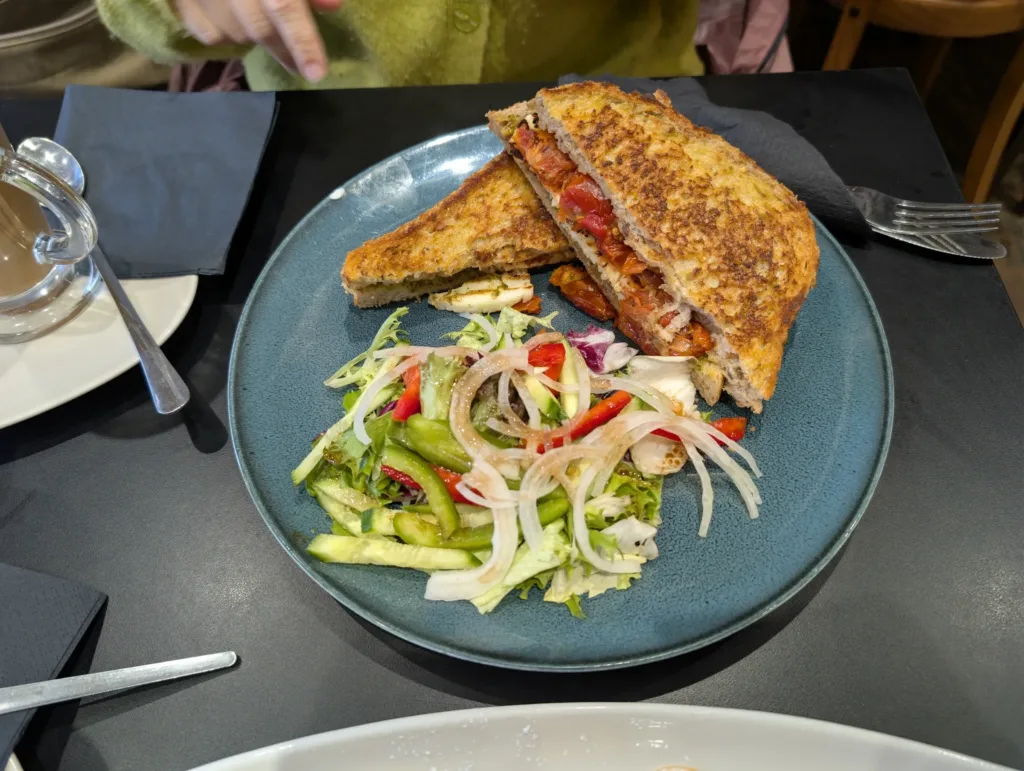
Halloumi sandwich; illustration of a filling, not a local venue · Photo: Andy Li · CC0 · converted to WebP and resized.
