Forest fires in Cyprus: risks, warnings and what to do
Where to check the fire risk in Cyprus, how to prepare for a trip or evacuation, and where to report smoke and fire.
Checked: 23 September 2026.
What the fire risk level indicates
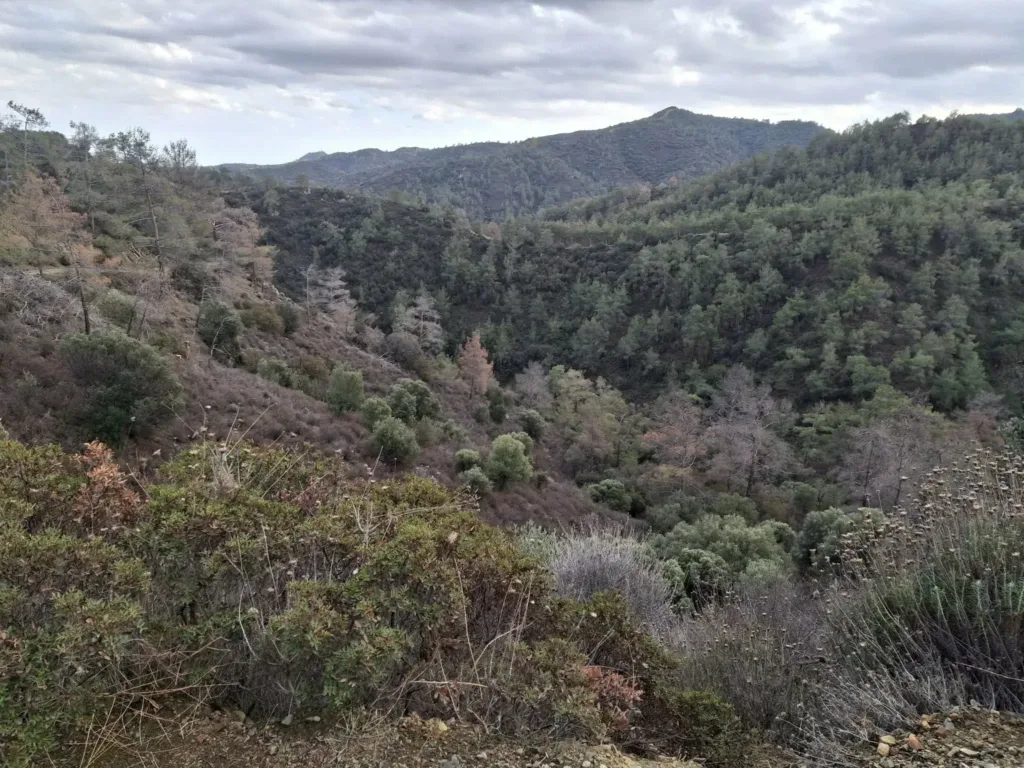
The fire risk describes the conditions under which a fire may start and spread rapidly; it is not a forecast of a specific fire. The Department of Forests assesses the risk daily during the fire season and issues a statement to the media. Dry vegetation, prolonged heat, wind, steep slopes and continuous vegetation cover make the island particularly vulnerable.
A map or colour-coded alert does not replace reports of an incident as it is happening. Before travelling, first check the latest update from the Department of Forests and any warnings from the authorities, then check for road closures and the regulations for the specific national park. A screenshot of yesterday’s map does not prove that the route is open today.
A red alert means you must avoid anything that produces a flame, heat or sparks, and be prepared to change your plans. Even at a lower alert level, prohibited activities do not become permitted. If the official authorities have closed a forest or a trail, you must not enter it, regardless of the weather conditions along the coast.
Where to find official warnings
The main sources are the Department of Forests, the Fire Service, Civil Defence and the gov.cy portal. Since June 2026, CY-Alert has been used to send messages to mobile phones located within a danger zone. In such a message, it is not rumours about the cause of the incident that are important, but the specified area, time and action required of the recipient.
If you receive a CY-Alert, stay calm and follow the instructions in the message exactly: it may instruct you to stay indoors, move to a safe place or leave the area via the specified route. Check for confirmation on gov.cy/cy-alert, on Civil Defence pages and via official government channels, rather than in forwarded screenshots.
Enable your phone’s emergency notifications in advance, charge an external battery and save an offline map. Alerts are location-specific: a warning for a neighbouring area does not necessarily mean there is a threat to your address, but the absence of a warning does not negate visible smoke, a police roadblock or a direct order from emergency services.
How to report smoke or fire
In the event of a fire, a rescue operation or any other emergency requiring the Fire Service, call the single European emergency number 112. For smoke or fire in a woodland area, the Forestry Department also accepts free calls on 1407. Do not delay calling to take photos, and do not assume that someone else has already called.
State your name, a contact number, the nearest road or landmark, the direction of the smoke, the approximate size of the fire and whether there are people nearby. If the coordinates can be provided without risk, give them. Do not approach the fire to check the details, and do not block access for fire engines by parking your car in the way.
After making the call, follow the dispatcher’s instructions. You may only attempt to extinguish a very small fire yourself if you have a safe escape route and are not inhaling smoke; if the flames grow, leave the area immediately. A drone flying over the fire area may interfere with aircraft, so do not fly one just to take photographs.
Preparing your home near woodland
Clear away dry branches and grass, trim back any branches touching the building, and do not store flammable materials against the walls. Fire hoses must reach all sides of the house, and fire extinguishers must be in good working order and easily accessible. Keep the entrance and house number clearly visible so that the fire brigade does not waste time searching for the property.
Gather documents, medicines, water, chargers, a torch, closed-toe shoes and clothing into a single bag. Make a note of who needs assistance: children, elderly people, people with reduced mobility, and pets. Park your car facing the exit and ensure it has sufficient fuel, without blocking the road.
If the fire is approaching and it is still safe to evacuate, leave early, following the route advised by the authorities. If it is already too dangerous to leave, do not improvise: call 112 and follow the instructions. Closed windows and doors reduce the risk of sparks entering, but your home is not a universal refuge — the decision depends on the specific situation.
Trips to the woods and restrictions
Fires for cooking are only permitted in the designated barbecue areas at official picnic sites and only when the site is open. Before leaving, ensure the embers are completely extinguished. Lighting a fire elsewhere, burning rubbish or dry vegetation, or discarding a match or cigarette butt poses a risk and may constitute an offence.
From 1 June to 30 September, a permit is required for any work likely to produce heat, flames or sparks within state-owned woodland and within a two-kilometre radius. For visitors, the practical rule is simpler: do not use a blowtorch or any other tool, do not park on dry grass, and do not throw away glass or rubbish.
Before setting off on a trail, tell a friend your route and estimated time of return, take water and a fully charged mobile phone with you, and check the weather forecast and any closures. If you smell smoke, do not continue towards the source. Head back to a safe road and stay well away from slopes and narrow gorges, where the wind and terrain can fan the flames.
If an evacuation has been ordered
An evacuation is an order, not a recommendation to assess the fire yourself. Switch off whatever the authorities instruct you to, grab your prepared bag, secure your home and leave in the specified direction. Do not go back for belongings and do not take a shortcut through the woods unless it has been designated as safe.
Drive with your windows closed and your headlights on, leaving a lane clear for emergency vehicles. Smoke drastically reduces visibility; if the road is blocked, only turn round on the instructions of the police or rescue services. It is a good idea for families to arrange a meeting point outside the affected area in advance and to designate one person to act as the point of contact.
Upon arrival, register at the location specified by the authorities and send a single brief message to your loved ones so as not to overload the network. You may only return once you have received official permission: smouldering fires, damaged power lines and fallen trees remain dangerous even after the open flames have gone out.
A brief checklist
Before travelling: check the daily risk level, CY-Alert, the weather and any road closures; save the numbers 112 and 1407; let someone know your route. At home: clear away dry vegetation; prepare water, documents, medication and transport. This reduces the time between a warning and taking safe action.
If you see smoke: move to a safe place, call 112 or 1407, describe the area accurately and do not fly a drone. Upon receiving an official announcement: check the location and follow instructions without delay. During evacuation: use only open routes and do not obstruct emergency vehicles.
This information does not replace instructions from the control centre or on-site services. A fire develops faster than this information page can be updated, so every decision must be based on the latest official announcement. The date on which the sources were checked is given below; check the rules again before the season starts and before travelling.
Continue planning
- Heat and UV in Cyprus: warnings and safe behaviour
- Hiking and nature trails in Cyprus
- Sea safety in Cyprus