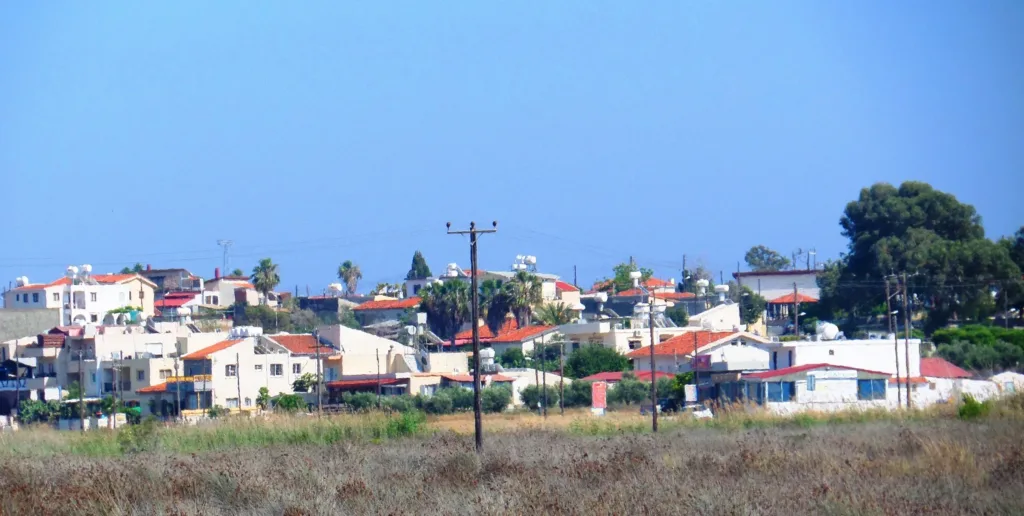
Akrotiri village, Cyprus: salt lake, flamingos and the British base
About the place
Checked: 29 October 2026.
Akrotiri at a glance: a village on the peninsula south-west of Limassol
Akrotiri (Greek: Ακρωτήρι) is a village in the Limassol district on the peninsula of the same name. The Sovereign Base Areas Administration describes its location as south-west of Akrotiri Salt Lake and north-west of the Akrotiri military garrison. Visit Cyprus, the official portal of the Deputy Ministry of Tourism, puts it about 14 km from Limassol. According to the 2021 census, the village has 931 residents.
In Greek, akrotiri means ‘cape’. The same name is used for the peninsula, the salt lake, the British base area and the airbase, so these topics get mixed up in search results. This page is about the village and its surroundings.
Akrotiri is known for its environmental education centre by the salt lake, the flocks of flamingos that winter here and its traditional reed weaving. Nearby are ancient Kourion and Kolossi Castle, which is covered in our guide to Kolossi Castle and how to visit it.
A village inside a British base area: what it means
The village lies within the United Kingdom’s Sovereign Base Areas, in the Western Sovereign Base Area, also known as the Akrotiri area. The civil government of these territories is the Sovereign Base Areas Administration (SBA Administration), headquartered at Episkopi; each area’s Area Office maintains links with the local communities.
The SBA Administration says that many of its functions concerning Cypriot residents are carried out by officials of the Republic of Cyprus under delegated powers. According to the Administration, SBA laws mirror those of the Republic of Cyprus as far as possible. Criminal cases in these territories are a matter for the SBA Police and the SBA Court.
Akrotiri is a civilian community: according to the Administration, its residents work mainly on the bases and in Limassol, or in farming. There are military installations near the village. Observe signs and restrictions on access and photography, and check SBA Administration notices for the rules on flying drones.
Akrotiri Salt Lake and the flamingos
According to Visit Cyprus, Akrotiri Salt Lake is the island’s largest inland body of water, covering about 10.65 km². It fills with water in winter and usually dries out in summer, though not every year. The lake is no more than about 1 m deep. The lowest point of its bed lies 2.7 m below sea level.
From November to March, migrating birds stop at the lake, among them flocks of flamingos thousands strong, as well as cranes, birds of prey and waders. The base of the lake’s food chain is the tiny crustacean Branchinella spinosa. Visit Cyprus notes that in years when the crustaceans are scarce, flamingos and other waterbirds move on to Larnaca Salt Lake or further south.
According to the SBA Administration, the salt lake and Akrotiri Marsh were designated a wetland of international importance under the Ramsar Convention on 20 March 2003. The peninsula is also one of BirdLife International’s Important Bird Areas. Some 300 bird species have been recorded on the peninsula, and green and loggerhead turtles nest on its beaches.
Akrotiri Environmental Education Centre
The village is home to the Akrotiri Environmental Education and Information Centre. According to the SBA Administration, the centre has been running since 2004. Since 2014 it has been housed in an energy-efficient building with solar panels and a water recycling system.
The centre has exhibition rooms, a library and a botanical garden, and its viewing area, equipped with telescopes and binoculars, looks out over the salt lake. The SBA Administration says that all areas are accessible to wheelchair users. The centre’s programmes were developed jointly by the SBA Administration, the Ministry of Education of the Republic of Cyprus and the Akrotiri community.
According to the SBA Administration, the centre opens on weekday mornings and is closed at weekends and on public holidays. Visit Cyprus says admission is free but warns that opening hours may change without notice. Before you go, check the hours by phoning the centre.
Reed weaving and the history of the peninsula
Akrotiri villagers have long woven baskets from plants of Akrotiri Marsh. According to the SBA Administration, ten species of reeds, sedges and grasses are used. Today the craft has almost died out because it no longer pays, and the environmental education centre runs weaving courses. Since 2017 Akrotiri soft basketry has been on Cyprus’s national inventory of intangible cultural heritage, kept under the UNESCO framework.
The peninsula has yielded the earliest evidence of human presence in Cyprus. The SBA Administration describes the site of Aetokremmos (Αετόκρεμμος), a shelter used by hunter-gatherers of the pre-pottery period. People lived here more than 12,000 years ago and hunted pygmy hippopotamuses and dwarf elephants, whose bones were found during excavations.
Other monuments on the peninsula include more than 1,500 rock-cut tombs and sarcophagi of the Hellenistic and Roman periods on the south coast, the early Byzantine monastery of St Nicholas of the Cats (Agios Nikolaos ton Gaton), the 12th-century chapel of Agios Dimitrianos and the church of Panagia Galaktotrofousa from the same century.
How to get to Akrotiri and what to see nearby
The easiest way to get there is by car from Limassol: the road runs through the city’s western outskirts onto the peninsula. Check the route in your navigation app before setting off, and near the village follow the signs to the environmental education centre. Buses run less often here than in the city: check the timetable and the return service with the Limassol district bus operator in advance.
The trip combines well with Lady’s Mile beach on the peninsula’s coast, the Monastery of St Nicholas of the Cats, ancient Kourion and Kolossi Castle. Each of these places has its own visiting rules.
To see the flamingos, come between November and March and start at the environmental education centre: its viewing area gives a good view of the lake. A couple of hours is usually enough for the centre and a walk around the village.
What to check before visiting Akrotiri
Official sources give different opening hours for the environmental education centre, so check them shortly before your trip. Bear in mind that the centre is closed at weekends and that its programmes are designed primarily for organised school groups.
The number of flamingos on the lake varies from year to year, depending on rainfall and the amount of food. Watch the birds from a distance, do not approach them and do not drive off the roads onto the lake shore. Near turtle nests on the peninsula’s beaches, respect the fencing and signs.
Within the base area, do not enter zones with no-entry signs and do not photograph military installations. Summers on the peninsula are hot and there is little shade, so take water and a hat and plan walks for the morning or evening.
Continue planning
- Limassol: neighbourhoods, attractions and itineraries
- Kolossi Castle: history and visitor guide
- Cyprus beaches: how to choose a coast
Official sources
- 2021 Population Census — Cyprus Statistical Service (CYSTAT)
- The Administration — Sovereign Base Areas Administration
- Akrotiri Community — Akrotiri Environmental Education Centre, SBA Administration
- Akrotiri Environmental Education Centre — SBA Administration
- Akrotiri Salt Lake — Visit Cyprus
- Akrotiri Environmental Education and Information Centre — Visit Cyprus
Akrotiri village on the Akrotiri peninsula · Photo: Xaris333 · CC BY-SA 4.0 · converted to WebP and resized.
