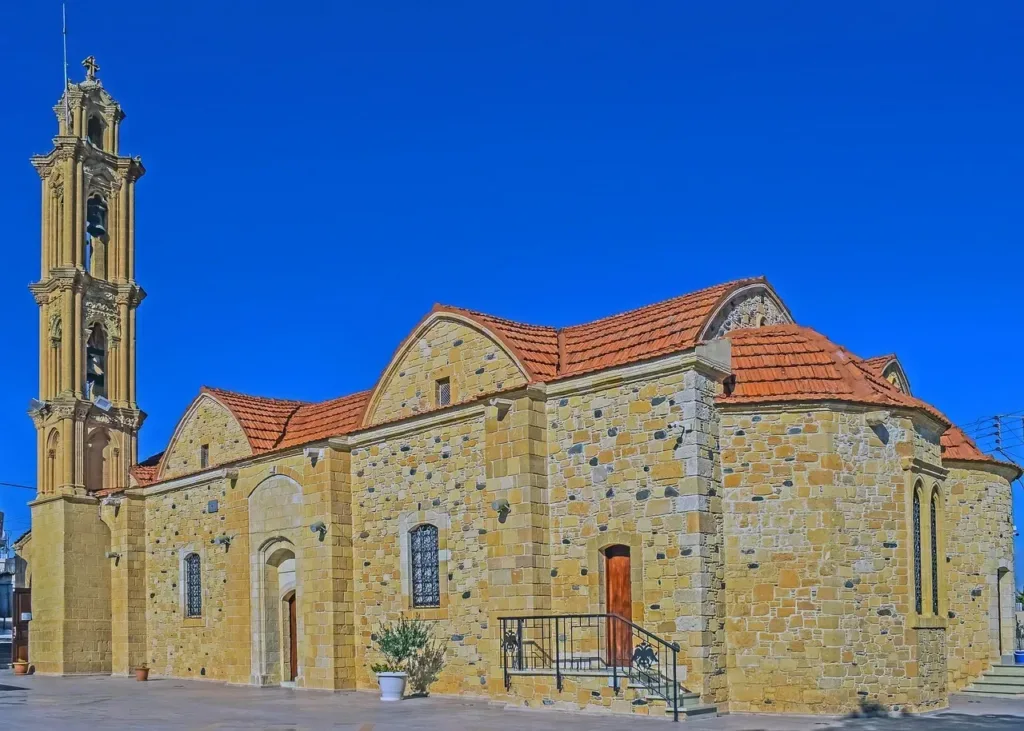
The Church of Saints Cyprian and Justina in Meniko: history and a visit
About the place
Checked: 2 October 2026.
The church in Meniko
The Church of Saints Cyprian and Justina is situated in the centre of the old settlement of Meniko, to the west of Nicosia. It is an active Orthodox church and an important place of pilgrimage. A visit here is also a good way to learn about ecclesiastical art, bearing in mind the building’s liturgical purpose and local customs.
Meniko is also spelled Meniko and Menico, and in Greek as Μένικο and Μένοικο. When searching on a map, look for the church dedicated to the two saints in this settlement. The name ‘Cyprian’ alone is not always sufficient to identify the correct church or historical site.
The church and its prominent bell tower serve as the main landmarks. It is best to begin your visit by exploring the accessible exterior, then check whether entry is permitted. Do not assume that a site’s reputation as a place of pilgrimage guarantees constant tourist access to all its rooms and sacred sites.
Architectural layers and tentative dating
The community’s official website describes several stages in the church’s development, rather than a single, indisputably established construction phase. It mentions medieval remains, earlier architectural elements and subsequent extensions. Therefore, the statement that ‘the church was built in its entirety in a single year’ does not accurately convey the history of the visible complex.
Local records date the northern part to the 14th century, whilst the extension of the southern part is thought to date from around 1846. This information helps to explain the building’s heterogeneous nature. When inspecting the building, do not assume that all the walls and decorative features date from the earliest phase mentioned.
The same source also contains the traditional account of the church’s origins, linked to a Frankish ruler and a miracle of healing. This account does not resolve the discrepancies between the architectural evidence. The account of the legend should be distinguished from the dating of the masonry, the frescoes and individual artefacts.
Traditions and the veneration of saints
Cyprian and Justina are venerated in the Christian tradition as holy martyrs. Pilgrimage accounts associate them with helping the faithful and offering protection from evil. Such claims reflect religious belief; tourist information should not present them as a proven means of resolving life or medical problems.
The temple houses revered relics, which pilgrims come to venerate. If you wish to find out the proper way to pay your respects, please speak to the temple staff and follow their instructions. Please do not attempt to open the reliquaries yourself, enter restricted areas or treat the objects as if they were museum exhibits.
The story of the healing water is also part of the local tradition. Its religious significance does not constitute confirmation of the water’s healing properties or its suitability for drinking. Please check locally regarding whether you may collect water and the rules for handling it, without treating the pilgrimage narrative as a practical guarantee.
Art and architecture inside
The community council website makes special mention of the carved wooden iconostasis dating from 1818. When viewing it, it is worth paying attention not only to the overall splendour of the design, but also to the ornamentation, the rhythm of the carving and the arrangement of the icons. The age of the iconostasis should not be assumed to apply to all the works situated alongside it.
The description mentions icons from various periods, including an image of Saint Cyprian dating from 1613. Please refer to the accompanying explanation or ask a member of staff for details about a specific item. Without a label, you should not attempt to date an item by its appearance alone: in an active church, older objects may be found alongside more recent décor.
The murals and individual architectural details reflect subsequent alterations to the complex. Do not refer to the entire interior as surviving medieval paintings. A respectful and careful examination helps one to discern the differences between historical artefacts, contemporary works and the religious function of the space.
Worship and the festival
The community celebrates the feast day of the saints on 2 October, when many pilgrims visit Meniko and a fair is held. This is a traditional date on the calendar, not a confirmation of the programme for a specific year. Before travelling for the festivities, please check the current schedule of services, traffic arrangements and visiting conditions.
On a normal day, too, please check with the parish directly to see if the church is open to the public. An old notice about a prayer service or worship service is no substitute for the current timetable. If you are visiting on a pilgrimage, check the details of the event in question; if you are visiting for the architecture, choose a time when your visit will not disrupt worship.
Wear modest clothing that covers your shoulders and knees. Inside, speak quietly and ensure that any photography complies with local regulations. Do not take photographs of people at places of worship without their consent, and do not use a flash when photographing works of art, even if your visit lasts only a few minutes.
How to get there and what to check
Plan your route to the church in Meniko using the usual roads, checking the final turns against an up-to-date map. The distance from Nicosia depends on your starting point. Do not base your journey planning on the total number of kilometres given in an old description: travelling and parking also take time.
In the centre of the village, please park your car so as not to obstruct local residents or the path to the church. During the festival, conditions may differ from those on a normal day. For groups, please agree on a meeting and drop-off point in advance, bearing in mind that buses may not be able to drive right up to the door.
If you require barrier-free access, a place to rest or access to a specific place of worship, please enquire about each matter separately. The presence of a spacious courtyard does not guarantee that all internal areas are accessible. If you are travelling without a car, please check the public transport timetable and your return journey before beginning your visit.
A walk around the temple
After your visit, you can take a leisurely stroll through the accessible streets of the old settlement and admire the traditional houses. This is a residential area, not an open-air museum: please do not enter any courtyards without permission. Choose the time of the walk according to the weather and the participants’ interests, allowing for the possibility of a short stop.
Neighbouring temples and rural attractions should only be added once you have checked that they are accessible and that a route is available. Don’t turn Meniko into a compulsory tour of every single spot mentioned in the guidebook. For a first visit, the main temple and a short walk are enough to get a feel for the community.
Please check the latest visiting arrangements via the community and parish sources. There is no promise of fixed opening hours, unrestricted access or a miraculous outcome during your visit. The value of a visit lies in the art, the history of the building and a respectful appreciation of the tradition that Meniko continues to uphold today.
Continue planning
- A leisurely 3-, 7- and 10-day itinerary around Cyprus
- St Neophytos Monastery: frescoes and a visit
- Kykkos Monastery: history, museum and a visit
Official sources
- Menico Community Council — Church of Saints Cyprian and Justina
- Menico Community Council — village history
Photo: Dimitris Vetsikas (dimitrisvetsikas1969) · Pixabay Content License · converted to WebP and resized.