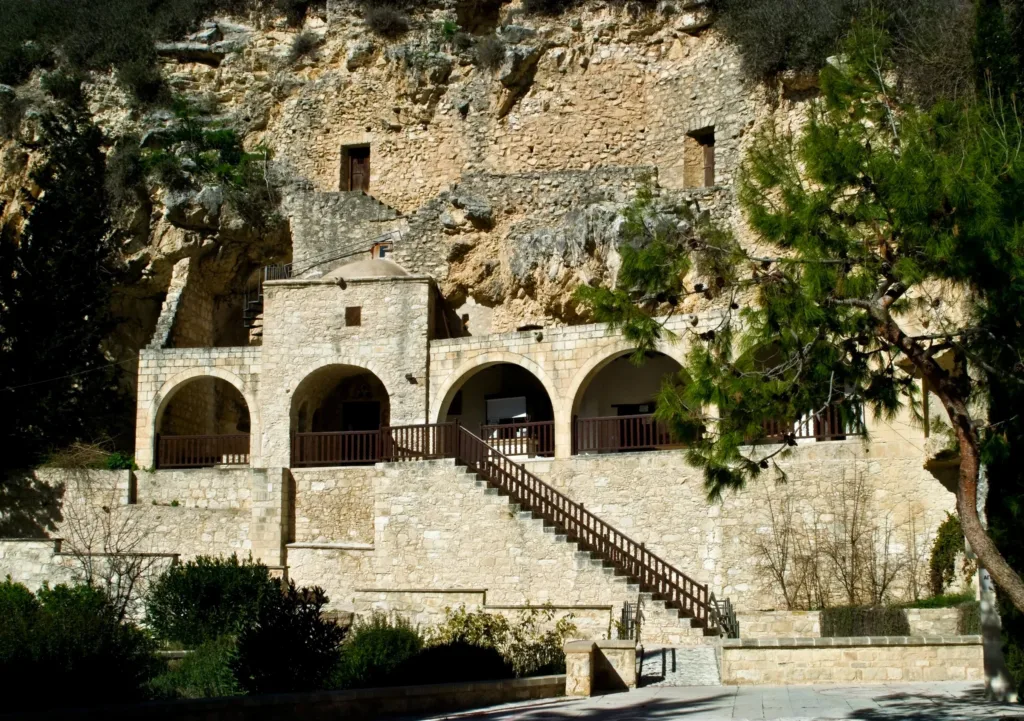
St Neophytos Monastery: frescoes and a visit
About the place
Checked: 2 October 2026.
A monastery near Paphos
The Monastery of Saint Neophytos is situated in the Tala area, north of Paphos. Its main feature is the combination of an active monastery with the Enkleistra, a place of seclusion carved into the rock where the founder lived. This trip is ideal for those who wish to see Byzantine paintings and understand how a hermit’s dwelling came to be the centre of monastic life.
When visiting, please note the distinction between the monastery courtyard, the church, the Enkleistra and the museum. These are interconnected parts of the complex, but they may have different access arrangements. Simply being on the premises does not guarantee access to all areas; please check the arrangements on the day of your visit and allow plenty of time for a leisurely tour.
There are several different spellings of the name: Neofit, Neofytos and Neophytos. When selecting a location on the map, use the monastery near Tala as a guide, rather than relying solely on the word in the name. There are other churches dedicated to the saint in Cyprus which are not part of this complex.
Founder and Enkleistra
Neophytos was a Cypriot ascetic and writer. The history of the complex begins with his seclusion in the rock, and the subsequent development of the monastery continued beyond this early stage. Therefore, the founding of the monastic community and the emergence of a distinct part of the building should not be reduced to a single arbitrary date.
Enkleistra is a space that a hermit has carved out of the rock for prayer and daily life. For visitors, its modest scale and the way the rooms are integrated with the rock itself are key features. This is no ordinary, spacious church: the overall impression is shaped by its intimacy, the architecture of the passageways and the preserved frescoes.
Accounts of the founder’s holiness form part of the Church’s tradition. They may be respectfully presented alongside established facts about the monument, without turning religious interpretation into archaeological evidence. Consider Neophytos’s life, the age of the paintings and the subsequent alterations to the complex separately.
How to view frescoes
The official description dates the Enkleistra murals to several periods between the 12th and 15th centuries. It is therefore incorrect to say that all the visible paintings were executed at the same time. As you view the paintings, please read the accompanying explanations: they help to distinguish the early compositions from later works and additions.
Start by looking at the overall arrangement of the images within the space, then move on to individual figures and scenes. In a small room, it is easy to focus on a single familiar scene and overlook the rest. A brief description read in advance is useful, but it is no substitute for observing the monument in situ.
Please do not touch the painted surfaces or use a flash. Please check with staff whether photography is permitted, even if other visitors are using their mobile phones. The preservation of the artwork is more important than the photograph; if photography is restricted, simply take a closer look at the details and use the official images to explore the artwork further.
Church and museum
The later monastic church offers a glimpse into a different scale of architecture and ecclesiastical art. An official tourist guide specifically highlights the 16th-century post-Byzantine icons. These artefacts should not automatically be considered contemporaries of the original Enkleistra simply because they are located within the same complex.
The museum displays icons, religious artefacts and other relics. Please check which areas are included in your current ticket and whether the museum is open during your visit. The names of the different parts of the complex may not be used consistently in guidebooks, so it is more helpful to ask about a specific entrance rather than making a general enquiry about the monastery.
Please do not disrupt the service whilst in the church, and save your visit to the museum for the exhibition areas’ opening hours. If you are visiting as part of a group, please agree in advance on a meeting point away from the aisles. This helps to separate the interests of pilgrims and tourists, maintaining a peaceful atmosphere within the monastery.
Directions and itinerary
When travelling from Paphos, head towards Tala and follow the signs for the monastery, checking your route against an up-to-date map. The journey time depends on where you’re setting off from. Don’t assume a fixed journey time based on the distance given in the general description: city traffic and the final sections of the approach road are also part of the journey.
Start your visit by checking the opening hours of the Enkleistra and the museum. If they are closed, you can rearrange parts of your itinerary, but you should not enter any areas that are closed to the public. To ensure a relaxed visit, allow plenty of time for queuing at the small entrance and reading the information panels, rather than just moving between the buildings.
If you’re planning to use public transport, check the bus stop, the timetable and the distance you’ll need to walk. The fact that ‘Tala’ appears on the bus route does not in itself guarantee that the bus will take you right to the monastery gates. Arrange your return transport before you start your visit, especially if you’re travelling at the weekend or on a public holiday.
Accessibility and respect for the site
Choose comfortable footwear and clothing that covers your shoulders and knees. At active monasteries, the rules for visitors are explained on arrival. Even a short sightseeing visit requires discreet behaviour: it is best to step outside the church into the courtyard to make phone calls or discuss your itinerary.
The rocky nature of Enkleistra means that the accessibility of this area must be assessed separately from that of the main site. If you have limited mobility, please enquire in advance about steps, the width of passageways and the possibility of a guided tour. Do not substitute such a check with a general photograph of the entrance or a marker on a map.
It is a good idea to explain to the children in advance why they mustn’t touch the walls or talk loudly here. In confined spaces, keep the group together and avoid lingering in doorways. If a child needs a break, finish that part of the tour and resume the programme after they have had a rest.
What to combine your trip with
It’s a good idea to round off the trip with a short stop in Tala or a stroll around Pafos. The main decision depends on your interests: church art calls for a different pace to a packed road trip. Don’t try to fit in several museum complexes in a row if you won’t have time left for reading and looking around.
Paphos Castle and the monastery are located in different parts of the region and are linked to different historical narratives. They can be visited in a single day with suitable transport, but each site deserves a visit of its own. Allow plenty of time for travel rather than promising to visit both sites in the shortest possible time.
Before you set off, please check the official opening hours and any changes due to public holidays. Opening hours and admission fees are not presented here as fixed conditions. If you are specifically interested in the Enkleistra frescoes, please check access directly with the monastery: the fact that the monastery grounds are open to the public does not necessarily mean that this part of the monument is open to visitors.
Continue planning
- Paphos: archaeology, neighbourhoods, beaches and itineraries
- Kykkos Monastery: history, museum and a visit
- The Church of Saint Lazarus in Larnaca: history and a visit
Official sources
Photo: Nikodem Nijaki · CC BY-SA 3.0 · converted to WebP and resized.
